
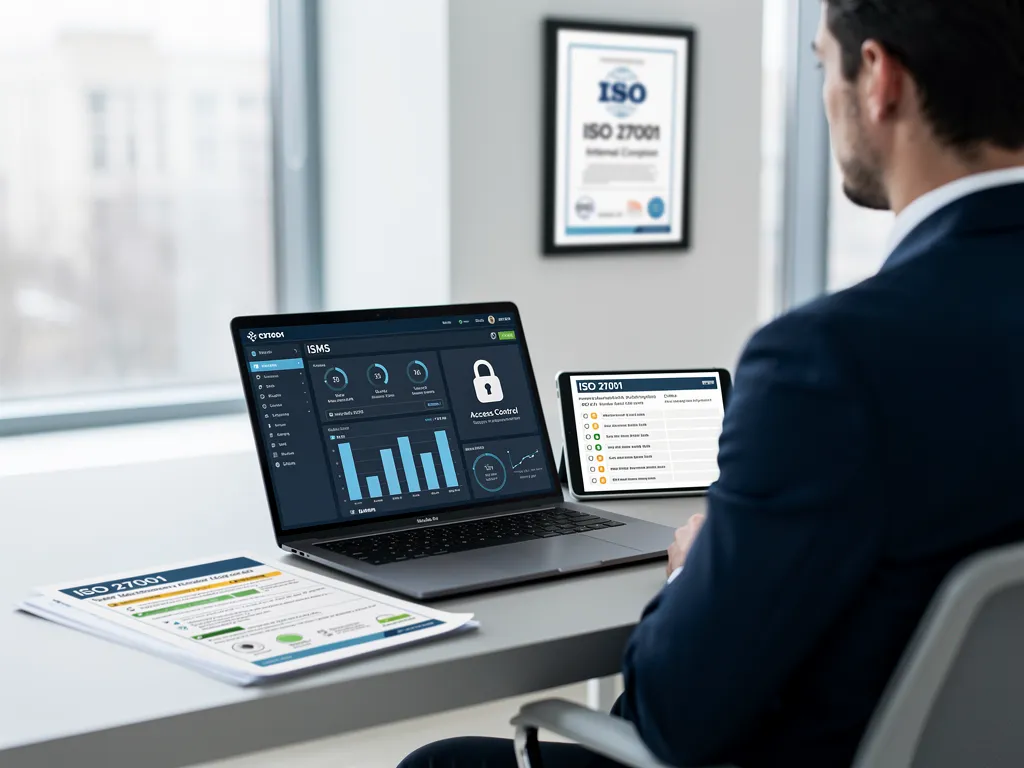
An ISO 27001 internal audit systematically evaluates an organisation’s Information Security Management System (ISMS) against the requirements of ISO/IEC 27001:2022 and internal policies to ensure ongoing compliance and effectiveness. This article explains what an ISO 27001 internal audit is, how Clause 9.2 frames audit obligations, and why regular, impartial audits are central to resilience, regulatory confidence, and certification readiness. Readers will learn how to plan an audit programme, execute evidence-based audits, report findings with actionable corrective actions, and select tools that balance manual insight with automated monitoring. Practical checklists, EAV comparison tables, step-by-step how-to guidance, and sector-aware examples for SMEs, government bodies, NGOs and infrastructure providers are included to help you operationalise internal audits. The guide also outlines where human-led advisory adds value and how to use expert resources to prepare for certification audits. Read on to convert audit theory into a predictable, repeatable process that sustains ISMS improvement and supports management decision-making.
What Is an ISO 27001 Internal Audit and Why Is It Essential for Compliance?

An ISO 27001 internal audit is a planned, independent review of the ISMS that verifies conformity with ISO/IEC 27001:2022 requirements and the organisation’s audit criteria, delivering objective evidence about the system’s performance. The mechanism is straightforward: auditors review documented controls, test their operation, interview process owners, and produce findings that inform corrective action and management review. The specific benefits are improved compliance assurance, strengthened risk treatment, and clearer readiness for external certification audits. Internal audits also identify systemic weaknesses early and create documented inputs for management review, closing the loop on continuous improvement.
This section summarises the core benefits internal audits deliver and prepares the reader for Clause 9.2 specifics.
Internal audits deliver three immediate benefits:
- Compliance Assurance: They verify controls and ISMS alignment with ISO/IEC 27001:2022 and applicable legal or regulatory requirements.
- Risk Reduction: Audits detect control gaps and prioritise risk treatments to reduce incident likelihood.
- Certification Readiness: Regular internal checks produce evidence and corrective action histories that streamline external audits.
These benefits show why an audit programme should be designed deliberately and in line with Clause 9.2, which we now detail.
What Are the Key Requirements of ISO 27001 Internal Audits According to Clause 9.2?
Clause 9.2 requires organisations to plan, establish, implement and maintain an internal audit programme that is documented, periodic, and aligned with the ISMS scope and risks. Audits must be impartial and objective, so auditor competence and freedom from conflicts of interest are essential; records of audit criteria, scope, frequency and results must be kept as evidence. In practice this means scheduling audits based on risk and importance, defining clear audit criteria (ISO clauses, SoA controls, legal obligations), and ensuring documented follow-up of non-conformities until closure. The updated ISO/IEC 27001:2022 emphasises risk-based scheduling and clearer traceability between audit findings and risk treatment plans, so audit programmes should map directly to risk registers and the Statement of Applicability.
These obligations naturally transition into how audits feed continual improvement and risk treatment processes in an ISMS.
ISO 27001:2022 Internal Audit in Project Management In the latter part of the project, we carried out an internal audit , auditing them according to ISO 27001:2022 requirements.
How Do Internal Audits Support Continuous Improvement and Risk Management in ISMS?
Internal audits identify non-conformities and performance trends that become inputs to corrective actions, risk treatment plans, and management review, creating a practical PDCA (Plan–Do–Check–Act) loop for the ISMS. By providing objective evidence of control effectiveness and gaps, audits enable root-cause analysis and prioritisation of remediation, which reduces exposure and improves resilience. Audits also validate whether implemented risk treatments are effective over time and whether controls remain appropriate as threats and business contexts evolve. Connecting audit outputs to the management review ensures senior leadership receives actionable insights for resource allocation and ISMS strategy.
With the role of audits in improvement established, the next step is designing an audit programme that aligns scope, schedule and auditor competence to organisational risk.
How Do You Plan an Effective ISO 27001 Internal Audit Program?

Planning an effective audit programme begins with a clear scope, risk-based frequency, defined criteria and identified responsibilities to ensure audits cover critical processes and controls systematically. The planning mechanism maps ISMS boundaries, control criticality and legal/regulatory obligations into a schedule that balances coverage and auditor capacity. The specific result is a documented programme that demonstrates impartiality, repeatability and traceability from audit objectives through to follow-up and records. This planned approach supports consistent evidence generation and makes management review more meaningful.
Below is a practical checklist-style set of planning steps you can use as a starting point.
- Define scope and objectives: Determine which sites, functions and controls fall within the ISMS boundaries and set measurable audit objectives.
- Create a risk-based schedule: Prioritise high-risk processes and critical controls for more frequent audits.
- Assign auditors and responsibilities: Select auditors based on competence and independence; name owners for follow-up actions.
- Set criteria and methods: Use ISO clauses, policies, SoA and legal requirements as audit criteria and document sampling and evidence methods.
- Document and communicate the programme: Publish the audit programme and keep records to demonstrate planning and impartiality.
These steps lead directly into tactical elements such as scope statements and auditor selection, which are covered in the subsections below.
To compare common programme components and responsibilities, review this practical EAV table.
| Audit Component | Responsibility | Rationale |
|---|---|---|
| Scope (sites/functions/controls) | ISMS Manager / Process Owners | Ensures boundaries match business activities and regulatory interfaces |
| Frequency (annual/quarterly/risk-based) | Audit Programme Owner | Prioritises audits by residual risk and criticality |
| Reporting & Follow-up | Lead Auditor / Treatment Owners | Provides traceability from finding to corrective action and closure |
This comparison highlights trade-offs between broader coverage and audit resources; next we examine how to define scope and criteria in practice.
How to Define the Scope and Criteria for Your ISO 27001 Internal Audit?
Defining scope means mapping the ISMS boundary to organisational processes, locations, assets and interfaces so audits focus on relevant risks and obligations. Criteria should include the ISO/IEC 27001:2022 clauses, the Statement of Applicability (SoA), internal policies, and applicable legal or contractual requirements to create objective benchmarks for assessment. For multi-site organisations, tailor scope by criticality—sample high-risk sites more frequently while rotating lower-risk areas to maintain coverage. Use clear scope statements (for example, “Customer data processing and associated infrastructure within EU operations”) and document the rationale so audit selection is transparent and defensible.
Clear scope and criteria enable targeted evidence collection and smoother linkage of findings to risk treatment and management review.
What Are the Best Practices for Selecting and Training Competent Internal Auditors?
Auditor competence combines knowledge of ISO/IEC 27001, audit techniques, and contextual understanding of the organisation’s technology and regulatory environment; impartiality is equally important. Practical steps include formal training in ISO 27001 auditing, mentorship with experienced auditors, practical assessments, and periodic competency reviews tied to audit performance. Consider external expertise for complex technical or regulated areas to avoid conflicts of interest and strengthen credibility. Record training, qualifications and audit assignments to demonstrate competence during certification audits and to satisfy Clause 9.2 documentation requirements.
These practices create a reliable audit capability that supports precise evidence collection, which we cover next in the step-by-step audit process.
What Are the Step-by-Step Processes to Conduct an ISO 27001 Internal Audit?

An effective internal audit follows a predictable sequence: preparation, document review, on-site or remote evidence collection, interviews and testing, reporting of findings, and follow-up verification. The mechanism links every audit activity to an expected deliverable—such as observation notes, sampled evidence, or a non-conformity record—ensuring transparent traceability and defensible conclusions. The outcome should be an audit report with objective findings, graded non-conformities where needed, and a corrective action plan that ties into the ISMS risk treatment process. Structured execution reduces ambiguity and improves the value of audit inputs into management review and continuous improvement.
Below is a mapping of audit steps to objectives and expected deliverables to use as a checklist during execution.
| Audit Step | Objective | Deliverable / Evidence |
|---|---|---|
| Preparation & Planning | Clarify scope, criteria and sample selection | Audit plan, scope statement, checklist |
| Document & Records Review | Verify documented controls and prior results | Document annotations, evidence matrix |
| On-site/Remote Testing & Interviews | Confirm implementation and operation of controls | Interview notes, test records, screenshots/log extracts |
| Reporting & Follow-up | Communicate findings and assign corrective actions | Audit report, non-conformity records, action tracker |
How to Collect Evidence and Review ISMS Documentation During the Audit?
Collecting evidence requires a methodical approach: identify the key documents (SoA, risk register, treatment plans, policies, procedures), select representative samples, and verify traceability between records, configurations and operational activities. Use sampling techniques proportional to the control’s criticality, retain copies or references to evidence, and record timestamps and who provided each item. Objective evidence types include signed policies, configuration screenshots, access logs, training records and incident reports; ensure each finding cites specific documents and shows how the evidence supports the conclusion. Good evidence management simplifies verification and closure during follow-up.
Having thorough evidence supports clear interview questioning and reduces ambiguity when identifying non-conformities.
ISO 27001 Auditing: Evidence Collection and Assurance The auditor should collect and check relevant evidence to be assured that the user
What Interview Techniques Help Identify Non-conformities and Improvement Opportunities?
Effective interviews use open, non-leading questions, verification by triangulation, and observational checks to confirm that documented procedures match actual practice. Start with factual questions—ask the interviewee to describe recent tasks or show a record of activity—then probe with follow-ups to uncover inconsistencies between claimed practice and evidence. Triangulate answers against records and observations, and avoid hypotheticals or leading prompts that bias responses. Document verbatim responses where relevant, and summarise agreements and discrepancies in the audit notes to preserve context for findings and corrective action planning.
Clear interview techniques improve the accuracy of findings and feed directly into report preparation and corrective action discussion.
How Should You Report and Follow Up on ISO 27001 Internal Audit Findings?

An effective audit report is concise, evidence-based and prioritised, providing an executive summary, scope, methodology, detailed findings, and recommendations that link to risk treatment and management review. The mechanism ties each finding to objective evidence, a severity classification, an owner and target date for corrective action, which supports measurable closure and verification. The result is a transparent corrective action workflow where root-cause analysis, action assignment, verification evidence and effectiveness checks are recorded, ensuring non-conformities are addressed and lessons are institutionalised.
The structure below is a practical template you can adapt for consistent reporting.
- Executive Summary: Brief headline results and critical risks identified.
- Scope & Objectives: What was audited and why.
- Methodology: Sampling, evidence types and interview approach.
- Findings & Evidence: Clear statements of non-conformities or observations with referenced evidence.
- Recommendations & Action Items: Owners, deadlines and verification criteria.
This template prepares organisations for corrective action management and links audit outputs into management review and continuous improvement.
What Is the Structure of an Effective ISO 27001 Internal Audit Report?
A strong report opens with an executive summary that highlights high-risk findings and suggested immediate actions, then documents scope, objectives and methods so readers understand the basis for conclusions. The main body lists findings with an objective statement, the referenced evidence, the clause or control involved, and a recommended action with an owner and deadline. Appendices can hold detailed evidence matrices, interview summaries and test scripts for traceability. Phrase findings in neutral, evidence–based language to preserve objectivity and ensure stakeholders can act without ambiguity.
A well-structured report naturally leads into a corrective action process that prioritises root-cause analysis and verification, which we outline next.
How to Manage Non-conformities and Implement Corrective Actions Post-Audit?
Managing non-conformities starts with root-cause analysis—techniques such as the 5 Whys or fishbone diagrams help move from symptoms to systemic causes—and then defining corrective actions that address those root causes rather than surface deficits. Assign clear owners, measurable deadlines and verification methods; document evidence of implementation and perform effectiveness checks to confirm the issue is resolved. Record closures with supporting evidence and bring significant trends to management review to adjust policies or resources. This closure and verification process ensures audit findings translate into durable ISMS improvements rather than temporary fixes.
Strong corrective action governance closes the audit loop and strengthens organisational resilience for future audits and certification.
What Tools and Resources Can Support Your ISO 27001 Internal Audit and Compliance Monitoring?
Tools and resources for internal audits range from simple checklists and templates to compliance monitoring software that centralises evidence, automates control testing and creates audit trails; each option has trade-offs between depth, context and efficiency. Manual templates and checklists deliver contextual insight and are easy to adapt, while software platforms enable continuous monitoring, automated evidence collection and faster reporting cycles. The best choice is often a hybrid approach: use checklists for interviews and contextual assessments, and deploy monitoring tools for logs, configurations and repeatable control checks. The result should be a coherent workflow that balances expert judgement with automation to sustain compliance.
Below is a comparison of common tool categories to guide selection based on use case and organisational needs.
| Tool / Resource | Primary Use Case | Pros / Cons |
|---|---|---|
| Checklist & Templates | Structured interviews and evidence logging | Pros: Flexible, low cost. Cons: Manual effort, version control risk |
| Spreadsheets and Document Repositories | Record-keeping and evidence traceability | Pros: Familiar, transparent. Cons: Fragile at scale, audit trail limitations |
| Compliance Monitoring Software | Continuous control testing and centralised evidence | Pros: Automation, audit trails. Cons: Implementation complexity, cost |
This table helps teams weigh choices; practical use of checklists and software integration is described next and includes a direct resource for implementers.
- Checklist adaptation: Map checklist items to ISO clauses and SoA controls and include placeholders for evidence references.
- Version control: Maintain a revision log for each checklist version and record who approved changes.
- Evidence linkage: Link checklist items to artefacts (logs, screenshots, records) and timestamp entries for traceability.
These practical steps clarify how to use hybrid toolsets. If you want a ready-to-use checklist or tailored help integrating these tools, ACATO offers resources and support to implement them practically.
ACATO provides an ISO 27001 Internal Audit Checklist and offers a free ISO 27001 consultation to help organisations adapt templates and select appropriate tools based on scale and sector. Using a downloadable checklist combined with expert advice helps teams align audit activities to Clause 9.2 and to the ISO/IEC 27001:2022 transition requirements.
This resource integration naturally bridges into how external advisory can support audit programmes and certification preparation.
How to Use ISO 27001 Internal Audit Checklists and Templates for Compliance?
Checklists should be structured to mirror ISO clauses and control objectives so auditors can tag findings to specific requirements and the Statement of Applicability. Use checklist fields for objective evidence, severity rating, owner and reference documents to create one-pass reporting and easier aggregation for management review. Customise template sampling sizes and question depth based on control criticality and maintain version history to demonstrate governance. Properly used, checklists accelerate evidence capture and reduce post-audit administrative effort while preserving contextual judgement.
Adopting standardised templates makes reporting consistent and simplifies trend analysis across audit cycles.
What Are the Benefits of Compliance Monitoring Software Versus Manual Audits?
Compliance monitoring software offers continuous evidence collection, automated control checks and tamper-evident audit trails that accelerate discovery of exceptions and provide trend data over time. Manual audits provide in-depth contextual insight, interview-based verification and nuanced assessment of complex processes that automation cannot fully capture. A hybrid approach uses software for repetitive, high-volume checks and human auditors for interpretation, interviews and areas where judgement matters most. The combined effect is higher assurance, reduced time-to-evidence, and a pragmatic allocation of auditor effort to high-impact controls.
Balancing automated monitoring with human-led audits ensures both efficiency and contextual accuracy, preparing organisations for certification and operational resilience.
How Does ACATO Support Organizations in Maintaining ISO 27001 Internal Audit Compliance?
ACATO is a consulting firm specialising in information security, cyber security, and IT forensics with a strong focus on ISO 27001 certification and compliance. The firm’s services relevant to internal audit compliance include ISO 27001 Free Consultation, ISO 27001 Advice, ISO 27001 Gap Analysis, ISO 27001 Preparations, and an ISO 27001 Internal Audit Checklist, all delivered by experienced ISO experts who support organisations during certification audits. ACATO’s approach emphasises human-led advisory that complements automated tooling, helping SMEs, government authorities, NGOs and infrastructure providers translate audit findings into practical corrective actions and certification readiness. The practical outcome for clients is clearer audit programmes, reduced time and cost in certification preparations, and more resilient ISMS controls aligned to ISO/IEC 27001:2022.
This description sets expectations for when each offering is appropriate and how to engage expert support during audit cycles.
What Expert Consulting Services Does ACATO Offer for ISO 27001 Internal Audits?
ACATO provides advisory and hands-on services that include gap analysis to identify discrepancies versus ISO/IEC 27001:2022, preparation work to close those gaps, and internal audit support or accompaniment during certification audits. The consulting focus is on pragmatic, expert-led interventions: advising on audit programme design, assisting with evidence collation, and supporting auditor training and impartiality considerations. These services are suited to organisations that need sector-specific guidance—such as regulated entities or multi-site operations—where conventional automation tools alone may not capture contextual requirements.
When internal teams need temporary augmentation or confidence before certification, external expertise can bridge knowledge and capacity gaps.
How Can ACATO’s Free Consultation and Resources Help Prepare for Certification Audits?
During a free ISO 27001 consultation, ACATO typically clarifies your current ISMS gaps, recommends prioritised next steps, and suggests practical resources—such as the ISO 27001 Internal Audit Checklist—to accelerate readiness without guessing. The consultation’s expected outcomes include a clear action plan for closing critical non-conformities, suggested sampling strategies for internal audits, and advice on when to use external auditors or technical specialists. Organisations that follow this guidance can better target remediation efforts, reduce rework during certification, and use resources more cost-effectively.
This consultative entry point is useful for teams uncertain about the ISO/IEC 27001:2022 transition effects or those seeking tailored support to implement the audit practices described above.
Integrating ISO 27001 Audits for Organizational Efficiency audits make it possible to achieve efficiencies in the audit process whilst maintaining the benefits gained from audits such as process improvements.