

Data Loss Prevention (DLP) is a set of practices, tools and policies designed to prevent the unauthorized disclosure, exfiltration, or misuse of sensitive information. DLP works by discovering and classifying sensitive assets, monitoring flows across networks, endpoints and cloud services, and enforcing controls such as blocking, encryption and access restrictions to reduce breach impact. The result is measurable risk reduction, stronger regulatory alignment (for frameworks such as GDPR and NIS 2), and improved business continuity when incidents occur. This guide explains what DLP does, compares network, endpoint and cloud approaches, maps DLP to ISO 27001 controls, and provides actionable best practices and an incident‐response lens for SMEs and organisations. You will also find vendor‐agnostic selection guidance, EAV comparison tables, and practical steps organisations can adopt now to reduce data leakage risk. Throughout the article we reference related concepts — data exfiltration, insider threats, PII/PHI protection, encryption and access control — to give a complete, practitioner‐focused view.
What is Data Loss Prevention and Why is it Critical for Organizations?
Data Loss Prevention (DLP) is a coordinated programme of discovery, detection and enforcement designed to stop sensitive data leaving authorised boundaries. DLP operates by identifying sensitive content (for example PII, PHI or intellectual property), assessing contextual signals (who, where, how) and applying policies that prevent risky actions like unencrypted transfer or upload to unmanaged cloud storage. The mechanism combines technical controls — pattern matching, fingerprinting, machine learning classification — with organisational measures such as policy, training and vendor controls to deliver the primary benefit: protection of confidentiality and integrity of critical data. As threats rise from credential compromises, misconfigured cloud storage and insider mistakes, DLP becomes essential for regulatory compliance and operational resilience. The next subsection shows how DLP mechanics protect specific types of sensitive data and integrates with other controls like encryption and IAM to form a defence‐in‐depth strategy.
DLP protects sensitive data by combining discovery, classification, monitoring, and enforcement into a continuous workflow that reduces exfiltration and accidental disclosure. Data discovery scans repositories and endpoints to find sensitive assets and classification tags content to prioritise controls; this is followed by real‐time monitoring of transfers and contextual risk scoring to decide whether to block, quarantine or alert. Detection methods include pattern matching for structured identifiers, fingerprinting for specific documents, and machine learning classifiers for unstructured content — each method helps detect PII, PHI, or proprietary designs before they leave authorised channels. Enforcement integrates with encryption and access control (IAM) so that when a policy triggers, the system can require encryption, revoke access, or prevent transmission entirely. This layered approach reduces false positives while keeping legitimate workflows moving, and leads into the next section which compares where best to deploy network, endpoint and cloud DLP solutions.
Further research highlights the importance of sophisticated detection mechanisms, moving beyond simple algorithms to more advanced text classification for identifying sensitive content.
Text Classification Algorithms for Data Loss Prevention Businesses, governments, and individuals leak confidential information, both accidentally and maliciously, at tremendous cost in money, privacy, national security, and reputation. Several security software vendors now offer “data loss prevention” (DLP) solutions that use simple algorithms, such as keyword lists and hashing, which are too coarse to capture the features what makes sensitive documents secret. In this paper, we present automatic text classification algorithms for classifying enterprise documents as either sensitive or non-sensitive. Text classification for data loss prevention, P Manadhata, 2011
How Does Data Loss Prevention Protect Sensitive Data?
Data Loss Prevention protects sensitive data by executing a sequence of discovery, classification, monitoring, and enforcement actions across organisational assets. First, discovery locates data in file shares, endpoints, databases and cloud stores while classification assigns sensitivity labels that drive policy decisions and prioritise enforcement. Second, detection uses a mix of techniques — regular expressions and dictionaries for structured identifiers, cryptographic fingerprinting for known documents, and supervised machine learning for contextual classification — to recognise sensitive content in motion and at rest. Third, enforcement options range from blocking transfers and quarantining files to applying encryption and logging events for audit, which reduces successful exfiltration and supports incident investigation. These mechanisms work best when integrated with IAM and encryption, because policy enforcement can tie directly to identity and data protection controls, improving accuracy and reducing unnecessary workflow disruption.
What Are the Main Types of DLP Solutions: Network, Endpoint, and Cloud?
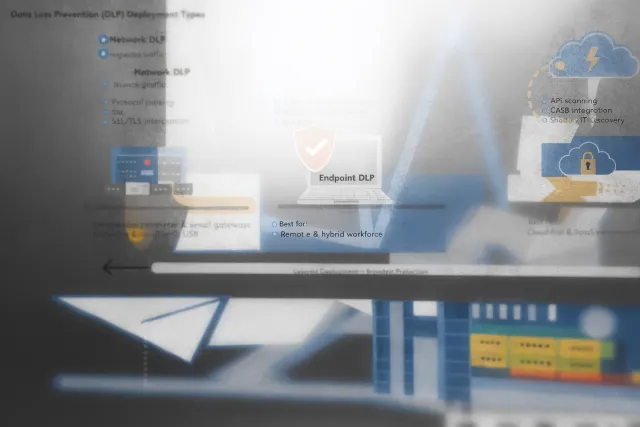
Understanding the three primary DLP types helps organisations choose where to focus controls depending on architecture and risk profile. Network DLP monitors traffic at egress points and inspects protocols such as email, web uploads and FTP, making it strong for perimeter and egress control but limited when traffic is encrypted or when users work off‐network. Endpoint DLP uses agents on laptops and servers to enforce policies locally — it is effective for remote and hybrid work because it can control USB use, screen captures, and local file moves, but it requires deployment and maintenance across devices. Cloud DLP integrates via APIs or proxy controls to secure SaaS applications and cloud storage, offering visibility into shadow IT and native cloud flows while depending on vendor APIs and configuration. Hybrid deployments that combine these hyponyms — network data loss prevention, endpoint data loss prevention and cloud data loss prevention — often provide the broadest protection and the next table summarises detections, deployment and best use cases for each type.
Below is a compact comparison to help SMEs and infrastructure providers weigh options and plan a layered deployment.
| DLP Type | Detection Method / Deployment | Best Use Case |
|---|---|---|
| Network DLP | Inline inspection of egress traffic, protocol parsing, SSL/TLS interception where lawful | Perimeter and egress control for on‐premise data and email gateways |
| Endpoint DLP | Agent‐based file and process monitoring, host‐based blocking, device control | Remote and hybrid workforce protection, controlling removable media and local exfiltration |
| Cloud DLP | API scanning, CASB integration or proxy‐based inspection for SaaS and cloud storage | Cloud‐first organisations and discovery of shadow IT and SaaS data flows |
This table shows that no single DLP type solves every scenario; a combination calibrated to your environment typically produces the best results. The following section maps these practical DLP measures to ISO 27001 governance to make controls auditable and sustainable.
ACATO — a consulting firm specialising in information security, cyber security, and IT forensics — supports organisations evaluating DLP readiness and can provide a free consultation to scope DLP requirements for SMEs and public bodies. Integrating early‐stage advisory helps translate technical detection into policy and governance, which shortens the path to effective enforcement and reduces compliance uncertainty. Organisations should prioritise a risk‐driven scoping session before selecting tooling, and expert‐led scoping can reveal hidden dependencies like third‐party storage or unmanaged endpoints that influence vendor choice.
How Does ISO 27001 Certification Enhance Data Loss Prevention?
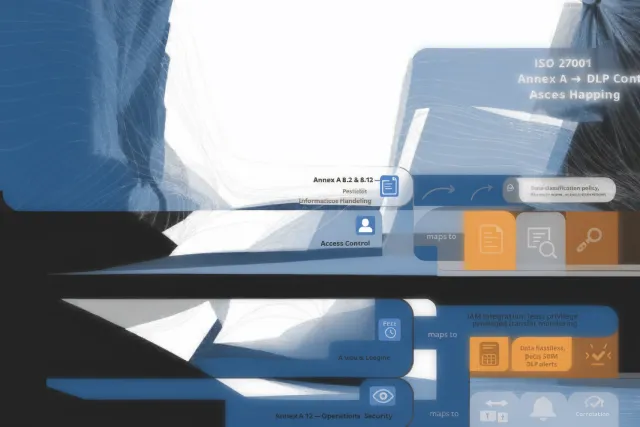
ISO 27001 strengthens DLP by turning tactical controls into a governed, auditable management system that codifies roles, responsibilities, risk assessment and continuous improvement. Certification drives formal scoping, asset inventory and control selection from Annex A so that DLP measures are not ad hoc but part of a documented ISMS; this improves repeatability and demonstrates due diligence to regulators and customers. Operationally, ISO 27001 enables traceability: classification decisions, risk acceptance and corrective actions are recorded so DLP policies can be audited and refined against incidents. The table below maps Annex A controls, particularly Annex A 8.2 and 8.12, to concrete DLP measures so technical teams and auditors share the same language for compliance and risk mitigation. This governance‐to‐technology mapping clarifies what evidence auditors expect and helps SMEs plan practical milestones toward certification.
| ISO 27001 Control / Annex A 8.12 | Objective | Operational DLP Control / Example |
|---|---|---|
| Annex A 8.2 (Information classification) and 8.12 (Handling of assets) | Protect assets from leakage and loss | Data classification policy, discovery scans, access restrictions tied to sensitivity |
| Annex A 9 (Access control) | Ensure appropriate user access | Integration of DLP with IAM to enforce least privilege and monitor privileged transfers |
| Annex A 12 (Operations security) | Maintain secure operations | Logging and monitoring of data flows, SIEM correlation of DLP alerts for incident detection |
This mapping shows how ISO 27001 requirements translate into tangible DLP activities and evidence. With controls mapped, organisations can define measurable metrics — classification coverage, time‐to‐detect, and blocked exfiltration attempts — to drive continual improvement and compliance readiness.
What is ISO 27001 Annex A 8.12 and Its Role in Data Leakage Prevention?
Annex A 8.12 focuses on the handling of assets and requires organisations to define responsibilities and protection measures for information assets, making it directly relevant to data leakage prevention. Implementing Annex A 8.12 means documenting asset ownership, setting classification schemes, and defining handling rules that feed DLP policies and enforcement actions. Operational controls that satisfy this clause include scheduled discovery scans, mandatory sensitivity labels on high‐risk repositories, and retention/disposal rules that reduce exposed data volumes. Auditors expect linked documentation: asset registers, classification guidelines, and evidence that technical systems enforce handling rules, which together make DLP auditable and repeatable. This structured approach reduces ambiguity about why a DLP rule exists and who is accountable when exceptions arise, and it naturally leads into practical SME certification pathways described below.
How Can SMEs Achieve ISO 27001 Certification to Strengthen DLP?
SMEs can achieve ISO 27001 certification by following a focused roadmap: scope definition, asset inventory and classification, risk assessment, control selection, documentation, implementation and internal audit leading to certification audit. Scoping should prioritise systems that process PII/PHI or critical intellectual property, because concentrating on high‐value data makes DLP and Annex A 8.12 implementation tractable. Risk assessments inform which DLP controls to deploy first — for example, prioritising endpoint agents for mobile workforces or cloud DLP for SaaS‐reliant teams — and documentation should include policy templates, control procedures and evidence collection plans. Options for SMEs include in‐house implementation, consultant‐assisted programmes, or managed services that provide continuous monitoring and operational support; each option balances cost, speed and internal capacity and selecting the right path determines how quickly DLP becomes effective and auditable.
What Are Best Practices and Strategies for Effective Data Breach Prevention?
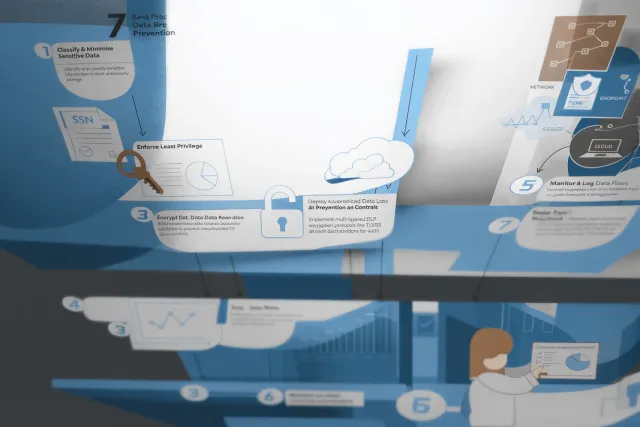
Effective data breach prevention requires coordinating people, process and technology into a repeatable programme that emphasises prevention, detection and response. Technology choices — DLP tooling, encryption, and IAM — deliver capability, while policies and training ensure users understand acceptable data handling and reporting channels. Monitoring and incident response are central: detection without response leaves organisations exposed, so playbooks and forensic readiness must be in place to contain and investigate exfiltration quickly. The list below provides a concise, actionable checklist of high‐impact practices that organisations can prioritise to reduce breach likelihood and shorten mean time to containment when incidents occur. After the list, a mapping table shows implementation steps, responsible roles and tooling to help operationalise each best practice.
The following seven best practices give a structured progression from governance to technical controls and continuous improvement.
- Classify and minimise sensitive data: Identify PII/PHI/IP, reduce unnecessary copies, and apply retention limits.
- Enforce least privilege: Use role‐based access and just‐in‐time privileges to limit standing access to sensitive assets.
- Deploy layered DLP controls: Combine network, endpoint and cloud DLP to cover different exfiltration vectors.
- Encrypt data in transit and at rest: Apply strong encryption tied to key management policies to protect data if exfiltrated.
- Monitor and log data flows: Centralise logs and correlate DLP alerts into SIEM for detection and investigation.
- Maintain an incident response playbook: Define detection, containment, forensic, recovery and reporting steps specific to data exfiltration.
- Test and train regularly: Run tabletop exercises, simulate exfiltration scenarios and train staff on reporting and data handling.
| Best Practice | Implementation Steps | Responsible Role / Tooling / Metric |
|---|---|---|
| Data classification | Classify repos, apply labels, remove duplicates | Data owner / DLP discovery / % of data classified |
| Least privilege | RBAC review, JIT access, access reviews | IT ops / IAM tools / orphaned accounts removed |
| Layered DLP | Deploy agents, API connectors, network inspection | Security ops / Endpoint & CASB / blocked exfil events |
The table clarifies who does what and how to measure success; organisations that link these metrics into governance reviews reduce semantic distance between auditors and operational teams and improve overall DLP efficacy.
Which Sensitive Data Protection Best Practices Should Organizations Follow?
Protecting PII, PHI and intellectual property starts with data minimisation and effective classification to reduce the attack surface and prioritise controls where they matter most. Implement retention policies that remove stale data, tokenisation or encryption for high‐risk fields, and vendor management controls that require third parties to meet comparable protections. Metrics that indicate progress include the percentage of classified sensitive data, mean time to detect unauthorised transfer, and percentage of high‐risk repositories with encryption and DLP coverage. Regularly review data flows involving third parties and include contract clauses mandating secure handling and incident notification to manage supply chain risk. These practices naturally map into the policy lifecycle and incident response planning covered in the next subsection.
How to Develop and Enforce Effective DLP Policies and Incident Response Plans?
Developing DLP policies begins with clear roles and responsibilities, a classification scheme, permitted workflows and exception processes; enforcement mechanisms should be technical where feasible and supported by training and audits. An incident response playbook for data exfiltration should define identification, containment, eradication, recovery and lessons‐learned phases, with explicit triggers for regulatory notification and preservation of forensic evidence. Testing the playbook through tabletop exercises and simulated incidents validates controls and highlights weak links such as slow detection or incomplete logging. Enforcement is strengthened by automating policy actions where safe, maintaining a clear exception approval process, and scheduling periodic audits to ensure policy adherence and continuous improvement, which feeds back into classification and risk assessment.
How Can Cloud Data Loss Prevention Secure Remote and Hybrid Work Environments?
Cloud Data Loss Prevention secures hybrid and remote models by filling visibility gaps in SaaS applications and cloud storage, while endpoint DLP complements cloud controls to protect device‐local assets. Cloud DLP uses API scanning or proxy‐based inspection to find and control sensitive data in cloud‐native flows, while endpoint agents enforce policies on devices that operate outside corporate networks. Identity and access management integration is critical: tying DLP decisions to authenticated identities reduces false positives and enables contextual enforcement such as blocking downloads when a user’s risk score is elevated. The following subsection explains common challenges in cloud and remote models and practical mitigations, then offers guidance on selecting cloud DLP that matches SME operational constraints.
What Are the Challenges of Protecting Data in Cloud and Remote Work Models?
Protecting data in cloud and remote work models faces three core challenges: lack of visibility into SaaS and cloud storage, inconsistent endpoint hygiene across diverse devices, and complex third‐party data flows that bypass central controls. Shadow IT and unmanaged SaaS applications create blind spots where sensitive data can accumulate outside sanctioned controls, while personal or unmanaged devices often lack the same protections as corporate endpoints. Third‐party integrations and data transfers between vendors amplify complexity because control boundaries are distributed and logging may be incomplete. Mitigations include API‐based discovery for SaaS, enforcing endpoint baselines with agent deployment, and contractual vendor controls to ensure visibility and incident reporting, which together reduce the most common routes of cloud‐era exfiltration. The complexities of securing data in cloud and SaaS environments are further underscored by studies exploring technology-agnostic approaches to prevent breaches.
Cloud Security & Technology-Agnostic DLP for SaaS Breaches News of personal and confidential data breaches, theft, and loss incidents (DLI) has become an almost daily occurrence and appears on the increase. Cloud-based DLIs lead to sensitive data exposure, credential theft, financial loss, extortion, consumer loss of confidence, and sometimes business closure. Software-as-a-Service (SaaS) applications are at the forefront of prevalent cloud services. SaaS applications are accessed from browsers, IoT devices and Application Programming Interfaces (API), presenting a broad attack surface for would-be cybercriminals. Specific studies on SaaS-related data leakage prevention (DLP) measures are limited, dated, technology-focused and product-specific. This research took a technology-agnostic approach to explore perceptions on SaaS-related DLP measures, data breaches and leakage and propose a set of critical success factors (CSF) for reducing the associated risks. Cloud Security: A survey of Information Communication Technology (ICT) and Cybersecurity professionals’ perception on Data Loss Prevention (DLP) measures for …, 2022
Which Cloud DLP Solutions Are Effective for SMEs and Infrastructure Providers?
Selecting cloud DLP should be vendor‐agnostic and prioritise API coverage, scalability, false‐positive tuning, and operational overhead to match organisational capability and budget. For SMEs, managed DLP services or MSSP offerings often provide faster time‐to‐value because they include policy tuning and alert triage, while larger infrastructure providers may prefer in‐house platforms integrated with SIEM and SOAR for scale. Evaluate API vs proxy approaches: API connectors are lighter‐weight and preserve privacy while proxies offer richer real‐time control but require routing changes and more maintenance. Consider the total cost of ownership — licensing, integration, and ongoing tuning — and whether a managed service is required to maintain effective protection, which naturally leads organisations to consider specialist advisory and managed support. As organizations navigate the complexities of multi-cloud environments, the integration of artificial intelligence and machine learning becomes increasingly vital for dynamic and intelligent DLP strategies.
AI-Enhanced DLP Strategies for Multi-Cloud Environments Organizations are rapidly adopting multi-cloud environments, combining public, private, and hybrid cloud services to achieve optimal flexibility, scalability, and cost-efficiency. However, this complex cloud ecosystem introduces significant data security challenges, particularly in safeguarding sensitive information. Traditional Data Loss Prevention (DLP) solutions, which rely on static rules and manual configurations, struggle to keep up with the dynamic and diverse nature of multi-cloud infrastructures. Enter AI-enhanced DLP strategies, which harness the power of artificial intelligence (AI) and machine learning (ML) to offer real-time, intelligent solutions that evolve with the cloud landscape. AI-Enhanced Data Loss Prevention (DLP) Strategies for Multi-Cloud Environments, 2024
- Selection criteria for cloud DLP include API coverage, false‐positive management, and integration with identity services.
- Managed DLP is a practical option for SMEs with limited security operations resources.
- Prioritise vendors that support key SaaS apps used by the organisation to ensure rapid coverage.
How Does ACATO Support Organizations with Data Loss Prevention and Compliance?
ACATO provides consulting and advisory services that align governance, ISO 27001 certification readiness and practical DLP implementations for SMEs, government bodies and infrastructure providers. ACATO is a consulting firm specialising in information security, cyber security, and IT forensics, and core offerings include ISO 27001 certification, IT security consulting, digital forensics, incident response, and cyber attack monitoring. Typical engagements focus on scoping sensitive assets, mapping Annex A controls to operational DLP measures, and helping organisations choose an appropriate mix of network, endpoint and cloud DLP to meet risk and budget constraints. ACATO emphasises a holistic approach — from proactive governance to reactive incident response — and offers free consultations to help organisations prioritise next steps and estimate effort, which is useful for leaders deciding between in‐house, consultant‐assisted or managed DLP paths.
What Are ACATO’s ISO 27001 Consulting and Cyber Security Services for DLP?
ACATO’s ISO 27001 consulting services guide organisations through scoping, risk assessment, control mapping and audit preparation with a focus on DLP‐relevant Annex A controls. Their advisory typically includes identifying where PII/PHI and IP reside, recommending suitable classification and retention policies, and defining evidence collection for certification audits. In parallel, ACATO can advise on technical selection — endpoint agents, cloud API connectors, and network controls — and help build an implementation roadmap that balances cost and compliance. For organisations that lack internal security operations, ACATO can recommend managed options and operational processes to ensure policies remain effective, while supporting the transition from project implementation to ongoing assurance and monitoring.
How Do Incident Response and Digital Forensics Help Mitigate Data Breaches?
Incident response (IR) and digital forensics limit damage by enabling rapid containment, preserving evidence and determining the scope and vector of data exfiltration for remediation and reporting. A fast IR process halts active exfiltration, isolates affected systems and escalates containment actions while forensic collection preserves chain‐of‐custody for legal and regulatory needs. Forensics then reconstructs attacker activity, identifies compromised accounts or misconfigurations, and produces a scope‐of‐impact report that informs notification obligations and remediation plans. Integrating IR and forensics into DLP programmes ensures that when a prevention control fails, organisations can respond decisively, learn from the incident, and tune detection and policy settings to reduce recurrence.
What Are Common Questions About Data Loss Prevention Answered?
This section answers common, searchable questions about DLP with concise, actionable responses that clarify types, importance and next steps for organisations. The format below is designed to be snippet‐friendly and to provide immediate guidance; each answer ends with a short prompt to seek tailored consultation when specific legal or sector constraints apply. After the Q&A pairs there is a short list pointing readers at next practical steps they can take to improve their DLP posture.
What Are the Three Types of Data Loss Prevention?
The three primary types of DLP are network DLP, endpoint DLP and cloud DLP: network DLP inspects egress traffic and enforces perimeter controls; endpoint DLP enforces policies on devices through agents to control local exfiltration; and cloud DLP uses API or proxy integrations to discover and control data in SaaS and cloud storage. Hybrid deployments combining these types are common because they cover different exfiltration vectors and complement each other. If your organisation uses a mix of remote work and cloud apps, consider a blended approach and consult specialists for a scoping session to prioritise controls.
Why is DLP Especially Important for SMEs and Government Authorities?
DLP is critical for SMEs and government authorities because both face regulatory scrutiny and reputational damage when sensitive data is lost, yet often have constrained security budgets and complex third‐party dependencies. SMEs risk customer trust and fines under regulations like GDPR, while public‐sector organisations must protect citizen data and critical infrastructure; both need measurable controls and audit evidence. Prioritising classification, least privilege and targeted DLP controls yields high risk reduction for limited investment, and organisations handling regulated data should seek focused risk assessments to identify the most impactful controls to deploy first.
Practical next steps organisations can take now:
- Conduct a short discovery scan to identify where sensitive data resides.
- Run a risk‐driven control prioritisation workshop to decide between endpoint, network or cloud DLP focus.
- Schedule a tabletop incident exercise to test detection and response assumptions.
These steps lead naturally into selecting vendors, scope refinement, and, where helpful, engaging advisory partners for implementation and managed support.