
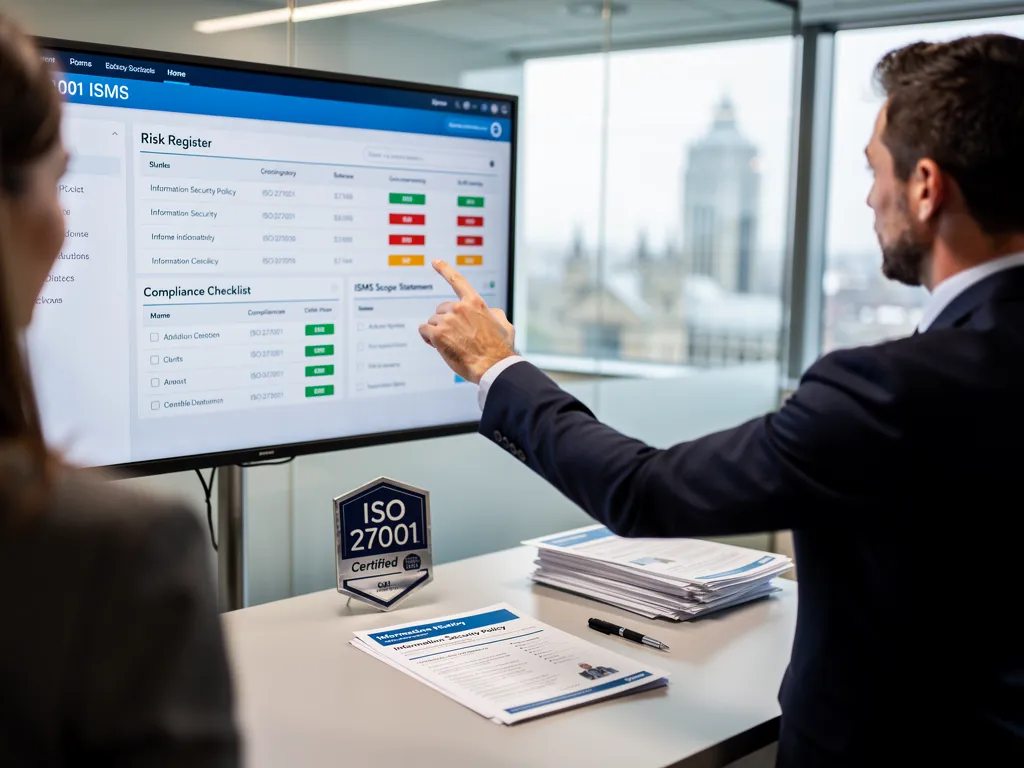
Implementing ISO 27001 creates a structured Information Security Management System (ISMS) that reduces risk, enables certification, and strengthens organisational resilience against cyber threats. This guide explains what ISO 27001:2022 requires, how an ISMS operates in practice, and the step-by-step implementation roadmap that leads to certification and ongoing improvement. Many organisations struggle with scope definition, documentation overload, and translating Annex A controls into measurable actions; this article offers clear procedures, practical checklists, and consultant-aligned callouts to bridge those gaps. You will find focused sections on gap analysis, risk assessment and treatment, documentation and internal audit preparation, the restructured Annex A controls from the 2022 update, business value and compliance alignment, UK cost and timeline considerations for SMEs, and how ACATO supports each phase with a free consultation offer. Read on for actionable lists, EAV tables that compare activities and effort, and concrete next steps to move from planning to certification readiness.
What Is ISO 27001 and How Does an ISMS Protect Your Business?

ISO 27001 is a certifiable information security standard that mandates a risk-based management system to protect confidentiality, integrity and availability of information assets. The ISMS mechanism combines documented policies, repeatable risk assessment and treatment processes, and a control set derived from Annex A so organisations can identify, control and monitor security risks over time. Adopting ISO 27001 shifts security from one-off projects to a continual improvement cycle, which reduces incident likelihood and improves regulatory alignment. Understanding the standard’s scope and operational mechanics is the first practical step toward designing an ISMS that matches organisational priorities and compliance needs.
What Are the Key Principles and Scope of ISO 27001:2022?
ISO 27001:2022 emphasises a risk-based approach, leadership commitment, documented governance and continual improvement through management review and corrective action. Scope-setting requires clear boundaries: identify in-scope assets, services, locations and supporting suppliers, and record exclusions with justification so auditors understand organisational limits. Key principles include proportional controls relative to risk, evidence-based decision making, and integration with broader compliance frameworks such as data protection and critical-infrastructure obligations. Practical scope guidance: focus initially on a key business domain or service where confidentiality, integrity or availability risks have direct commercial or regulatory impact, then expand the ISMS iteratively.
How Does an Information Security Management System Work?
An ISMS operates through the Plan-Do-Check-Act (PDCA) cycle: establish policies and objectives (Plan), implement controls and training (Do), monitor performance and audit results (Check), and apply corrective improvement (Act). Core components include an information security policy, risk register, Statement of Applicability (SoA), documented procedures and metrics to measure control effectiveness. Implementation examples: a quarterly vulnerability review feeds the risk register, which updates the SoA and triggers remediation tasks with owners and timelines. Monitoring and periodic management review ensure the ISMS adapts to changing threats, which drives continuous reduction of residual risk and improved audit readiness.
What Are the Essential Steps for ISO 27001 Implementation?

Successful ISO 27001 projects follow a structured sequence from commitment through certification, with clarity on deliverables and effort at each step. Typical phases include management commitment and scoping, gap analysis, risk assessment and treatment, documentation and training, internal audits and certification audit preparation. Each phase produces tangible artefacts: scope statement, gap report, risk register and SoA, documented policies and procedures, training records, and internal audit reports ready for Stage 1 and Stage 2 certification. Below is a concise numbered roadmap to guide teams and stakeholders through the primary activities required for ISMS establishment and certification.
Management commitment and scope definition: secure leadership support, define the ISMS boundary, set security objectives and assign roles.
Gap analysis and current-state assessment: map current controls to ISO 27001:2022 requirements and identify deficiencies in people, process and technology.
Risk assessment and risk treatment planning: inventory assets, score risks, select treatment options and produce the SoA and Risk Treatment Plan.
ISMS documentation and controls implementation: author policies, procedures and operational controls, and deliver targeted training and awareness.
Internal audit and management review: perform internal audits, address nonconformities, and conduct management review to validate readiness.
Certification audit preparation and external audit: run pre-certification checks, collate evidence, host Stage 1 and Stage 2 audits, and close findings.
This stepwise roadmap clarifies dependencies: for example, a comprehensive gap analysis informs the risk assessment scope, which in turn determines documentation needs and remediation tasks. Organisations can prioritise steps based on risk appetite and resource availability to accelerate critical controls first.
Introductory table: implementation steps compared by typical deliverables and relative effort for a UK SME.
Phase | Typical Deliverables | Typical effort/impact |
|---|---|---|
Scoping & Leadership | Scope statement, objectives, roles | Moderate effort; high impact on project clarity |
Gap Analysis | Gap report, recommendations, prioritised actions | Low-to-moderate effort; informs remediation plan |
Risk Assessment | Asset inventory, risk register, risk scores | High effort initially; critical for targeted controls |
Documentation & Controls | Policies, SoA, procedures, training records | High effort; long-term compliance foundation |
Internal Audit & Review | Audit reports, corrective actions, management review | Moderate effort; validates readiness for certification |
This comparison helps teams prioritise workstreams and allocate internal resources effectively before external support is engaged.
How ACATO can help: ACATO offers targeted support for gap analysis, risk assessment and ISMS documentation to accelerate those phases while saving client time. Their consultancy support focuses on translating gaps into prioritised remediation and producing the policy, SoA and procedural artefacts needed for audit evidence. These concise interventions reduce internal workload and keep the project on schedule.
How Do You Conduct an ISO 27001 Gap Analysis and Define Your ISMS Scope?
A gap analysis systematically compares current practice against ISO 27001:2022 controls and clauses to produce a gaps register and remediation roadmap. Begin by interviewing key stakeholders, mapping information assets, and reviewing existing policies, technical controls and supplier arrangements to identify missing or ineffective controls. Deliverables include a ranked gaps report, suggested control mappings to Annex A and a high-level timeline for remediation activities. Effective scope-setting narrows initial implementation to critical assets or services so teams can demonstrate control effectiveness quickly and expand the ISMS later.
What Is the Process for Risk Assessment and Risk Treatment Planning?
Risk assessment requires selecting a methodology (qualitative or quantitative), defining criteria, identifying threats and vulnerabilities against asset values, and scoring likelihood and impact to populate a risk register. The risk treatment plan documents selected treatments—accept, mitigate, transfer or avoid—and maps each treatment to owners, completion dates and evidence to be included in the SoA. Reassessment intervals and monitoring metrics are defined to ensure the ISMS reflects current threat conditions. A clear SoA links each Annex A control decision to identified risks and ensures auditors can trace treatment rationales.
How Do You Develop ISMS Documentation and Policies?
ISMS documentation should include mandatory documents (Information Security Policy, SoA, Risk Treatment Plan, statement of scope) and supporting procedures for access control, incident management, change control and supplier security. Policy development and procedure development should run in parallel, with each policy mapped to the procedures that implement it, so auditors can trace a stated commitment through to the operational step that enforces it. Use templated structures with version control, approval workflows and clear owner assignment to reduce revision friction and ensure consistent evidence during audits. Recommended practices: single-source policy documents with linked procedures, a central document register, and automated versioning where possible to maintain audit trails. Documentation is not an end in itself; it must reflect implemented controls and operational evidence to be effective.
What Are the Internal Audit and Certification Audit Preparation Steps?
Internal audits assess compliance and effectiveness against ISO 27001:2022 clauses and planned arrangements, producing nonconformities that feed corrective actions and management review. Plan internal audits with documented criteria, sample evidence requests and auditor independence to mirror certification expectations and reduce surprises. Stage 1 certification typically checks ISMS readiness and documentation; Stage 2 validates implementation and effectiveness across sampled processes. Preparing audit packs, running mock audits and remediating findings early reduces the risk of major nonconformities during external assessment.
What Are the ISO 27001:2022 Annex A Controls and Updates?

Annex A provides the catalogue of control objectives and controls that organisations use to treat identified risks; the 2022 revision reorganised and reduced controls to a more outcome-focused set. The update collapsed overlapping controls and emphasised pragmatic, measurable outcomes while introducing new controls that address modern risks such as cloud security and software supply chain considerations. Understanding control categories—organisational, people, physical and technological—helps translate Annex A into operational requirements and supports a concise SoA during certification. The practical impact for implementers is twofold: update mappings from legacy control sets and prioritise controls with high residual risk or regulatory relevance.
Introductory table: mapping Annex A categories to example controls and implementation actions.
Control category | Example controls | Practical implementation actions |
|---|---|---|
Organisational | Governance, roles, supplier security | Define ownership, vendor security requirements, contractual clauses |
People | Awareness, background checks, training | Deliver role-based training, maintain training records, implement HR screening |
Physical | Facility access, equipment protection | Enforce access logs, secure server rooms, CCTV where required |
Technological | Access control, encryption, logging | Deploy MFA, encrypt data at rest/in transit, centralise logs for monitoring |
Which Organizational, People, Physical, and Technological Controls Are Required?
Organisational controls establish governance: assign security roles, review policies and set supplier-security criteria that reflect contract-level obligations. People controls address awareness, competence and screening to ensure personnel understand and follow security procedures; training records form key audit evidence. Physical controls limit access to facilities and assets through locks, visitor procedures and environmental protections for critical hardware. Technological controls include identity and access management, encryption, secure configuration and monitoring; combining these controls with logging and incident response processes ensures that technical measures are demonstrably effective.
What Are the New ISO 27001:2022 Controls and Their Impact on Your ISMS?
The 2022 revision added controls that focus on secure development, cloud service security and supplier relationships, requiring clearer documentation of software supply chain risk and cloud configurations. Implementation impact includes updating procurement and supplier management processes, enhancing secure development lifecycle practices, and ensuring cloud deployments meet baseline security requirements. For many organisations the effort concentrates on updating the SoA, mapping new controls to existing practices, and documenting compensating measures where direct implementation is not feasible. Auditors will expect explicit traceability from risks to treatment actions and evidence of how new controls are considered in the risk treatment plan.
What Are the Benefits and Business Value of ISO 27001 Certification?

ISO 27001 certification delivers measurable business advantages: it reduces breach likelihood through systematic risk management, supports regulatory alignment, and strengthens commercial trust in procurement processes. Certification also provides a repeatable framework for incident response, which shortens recovery timelines and reduces long-term costs associated with data loss and reputational damage. Organisations often see benefits in supplier and customer confidence, improved insurance positioning, and clearer governance that supports business continuity. These outcomes make ISO 27001 a strategic investment that both mitigates risk and unlocks commercial opportunities in regulated or security-sensitive supply chains.
ISO 27001 drives specific compliance synergies and operational gains:
Regulatory alignment: Mapping ISMS controls to GDPR and NIS obligations reduces overlap and simplifies audits.
Commercial advantage: Certification is frequently a procurement requirement or evaluation criterion for suppliers.
Resilience and cost reduction: Fewer incidents and faster recovery limit business disruption and potential fines.
These business drivers explain why leadership support is essential to fund and prioritise ISMS activities across departments.
How Does ISO 27001 Improve Data Security and Regulatory Compliance?
ISO 27001 improves data security by enforcing a repeatable risk assessment process that identifies where data are vulnerable and prescribes proportionate controls to reduce exposure. The standard’s emphasis on documentation, monitoring and continual improvement aligns directly with GDPR accountability requirements and provides evidence of technical and organisational measures. For NIS 2.0 and other infrastructure obligations, the ISMS’s supplier management and incident reporting processes support compliance by formalising roles, thresholds and response actions. Organisations that map ISMS controls to regulatory clauses can streamline audits and demonstrate consistent, documented compliance decisions.
Regulatory Framework Cross-References
ISO 27001’s Annex A controls map directly onto specific regulatory obligations, which is why organisations frequently use the ISMS as evidence for wider compliance programmes. Under GDPR Article 32, controllers and processors must implement “appropriate technical and organisational measures” to protect personal data; ISO 27001’s risk assessment and control framework provides a structured, auditable way to satisfy this requirement, though ISO 27001 certification alone does not replace GDPR’s specific legal duties, such as determining lawful bases for processing or conducting Data Protection Impact Assessments. Organisations seeking full privacy coverage typically combine ISO 27001 with a privacy-specific extension, such as ISO 27701, or targeted GDPR documentation.
NIS 2.0 imposes resilience, incident-reporting and supply-chain security obligations on operators of essential services and digital service providers. A mature ISMS and its Annex A controls provide a strong foundation for these obligations, though sector-specific extensions are often required to meet NIS 2.0’s full scope. Organisations already holding ISO 27001 certification can also reuse mapped evidence, such as policies, logs and audit results, when pursuing complementary frameworks like SOC 2, reducing duplicated audit effort.
What Competitive Advantages and Cost Savings Can Certification Deliver?
Certification supports procurement wins and customer trust by providing an independent assurance of security practices, which helps organisations access larger contracts and reduce due-diligence friction. Cost savings arise from avoided incidents, lower remediation expense and a stronger negotiating position with insurers and partners. A simple ROI vignette: formal risk treatment reduces a high-likelihood incident’s impact through targeted controls, which can be modelled to show net savings versus remediation and reputational costs. For precise ROI estimates, organisations should assess incident frequency, potential impact and control costs and consider booking advisory analysis for a tailored business case.
How Much Does ISO 27001 Implementation and Certification Cost in the UK?

Costs for ISO 27001 implementation and certification vary considerably depending on scope, organisational maturity and resource availability; UK SMEs typically see a range from lower-effort internal programmes to higher-cost, consultant-led implementations. Key cost drivers include the breadth of scope, number of sites, complexity of IT estate and the degree of existing documentation and controls. Certification audit fees add a separate component that depends on the chosen certification body and the audit effort required to sample processes. Because numeric ranges depend on organisation-specific factors, a tailored estimate after an initial gap analysis is the most reliable way to budget for a project.
Introductory table: cost components for UK SMEs with qualitative ranges and assumptions.
Cost component | Typical UK SME range | Notes/assumptions |
|---|---|---|
Consultancy support | Low / Moderate / High | Depends on engagement model and scope complexity |
Internal resource time | Low / Moderate / High | Based on staff availability and existing maturity |
Certification audit | Low / Moderate / High | Varies by certification body and travel/administration |
Remediation tools/controls | Low / Moderate / High | Dependent on technical controls required |
What Factors Influence ISO 27001 Consultant and Audit Fees?
Several factors shape consultant and audit fees: the defined scope (single service vs enterprise-wide), the maturity of existing information security controls, the complexity of IT and cloud environments, and the number of locations or suppliers to be assessed. Engagement models—advisory workshops, full managed documentation or blended support—change consultant time commitment; shorter, focused engagements cost less than end-to-end managed projects. Certification bodies price audits based on sample size, travel and auditor days; organisations with well-documented evidence and successful internal audits commonly incur lower external audit effort. Carefully scoping and prioritising high-risk areas can reduce both consultant and audit time.
Scope narrowness reduces effort.
Established documentation lowers consultancy hours.
Cloud and supply-chain complexity increase audit sampling.
These factors guide budgeting and decisions about where to invest internal effort versus external support.
What Is the Typical Timeline for ISO 27001 Certification for SMEs?
Typical SME timelines range from a focused 6-month programme for organisations with solid existing controls to 12 months or more for teams implementing controls broadly while balancing business-as-usual. Key milestone durations: gap analysis and scoping (2–4 weeks), risk assessment and treatment planning (2–6 weeks), documentation and control implementation (8–20 weeks depending on scope), internal audits and remediation (4–8 weeks), and certification audit scheduling (dependent on certification body availability). Fast-track approaches concentrate on critical controls first and use templates to compress documentation time, while standard timelines prioritise full coverage and more extensive testing.
Tips to accelerate timeline:
Secure visible management commitment early.
Use templates and proven documentation frameworks.
Allocate a dedicated project lead to coordinate remediation.
Prioritising high-risk services and using targeted consultant support both reduce time-to-certification.
How Can ACATO Support Your ISO 27001 Implementation Journey?

ACATO is a UK-based consultancy specialising in ISO 27001 information security and certification support that provides gap analysis, ISMS documentation services, risk assessment and management, training and internal audit preparation. Their approach focuses on simplifying certification through expert support, saving clients time on documentation, and guiding organisations through certification audits with experienced ISO advisers. ACATO emphasises alignment with GDPR, assists in protecting organisations from cybercrime, and positions ISO 27001 work to improve business resilience and ESG considerations. For organisations seeking to move from planning to certified ISMS, ACATO offers a free consultation to scope needs and recommend practical next steps.
What ISO 27001 Consulting and Certification Support Services Does ACATO Offer?
ACATO’s services cover the core implementation tasks teams commonly outsource: ISO 27001 consulting, certification support, ISMS documentation authoring, gap analysis, risk assessments and treatment planning, role-based training and awareness, plus internal audit preparation. Deliverables typically include a gap report with prioritised actions, an editable document set (policy templates, SoA, procedures), a populated risk register and a certification readiness plan. Engagement models range from advisory hours to managed documentation packages and hands-on audit support for Stage 1 and Stage 2 readiness. These options let organisations pick support levels that match internal capacity and desired speed to certification.
How Does ACATO Help Overcome Common Implementation Challenges?
Common implementation obstacles include gaining management buy-in, avoiding documentation overload and operating with limited internal resources; ACATO mitigates these by framing security work in business terms and providing pragmatic, prioritised remediation plans. Practical interventions include pre-filled templates to reduce authoring time, workshop-led risk assessments to build cross-functional ownership, and mock audits to surface evidence gaps before external assessment. Case-style examples: where documentation demands stall progress, ACATO’s document bundles and review cycles accelerate approvals while preserving auditability. These time-saving approaches reduce friction and keep certification projects on schedule.
How Can You Book a Free ISO 27001 Consultation with ACATO?
Prepare: collate an asset list and current policies.
Request consultation: book a no-obligation discovery call.
Receive roadmap: get a clear next-step plan and options for support.