

Preparing for an ISO 27001 audit begins with a clear understanding of the standard and a practical, stage-specific plan to align your ISMS with auditor expectations. This guide explains what ISO/IEC 27001:2022 requires, how to run an effective gap analysis, which documents and Annex A controls matter in evidence collection, and how to schedule internal and external audits to minimise risk. Organisations commonly struggle with incomplete documentation, unclear control ownership, and insufficient evidence for technical controls; this article shows precise steps to close those gaps, including sample checklists, remediation priorities, and timelines. You will get a stage-by-stage walkthrough covering Stage 1 documentation review and Stage 2 on-site assessment, detailed internal audit practices, and a remediation matrix for common nonconformities. Throughout, semantic keywords like ISO 27001 audit preparation, ISMS audit preparation, Statement of Applicability, and internal audit checklist are used to connect concepts and create actionable outputs you can implement immediately.
What Is ISO 27001 and Why Is Audit Preparation Essential?
ISO/IEC 27001:2022 is an information security management standard that specifies requirements for establishing, implementing, maintaining, and continually improving an ISMS. The mechanism is a risk-based management system: identify risks, select controls (Annex A), document rationale in the Statement of Applicability (SoA), and demonstrate continual improvement through monitoring and management review. Certification proves to customers and regulators that information security is managed systematically, reducing breach likelihood and supporting procurement and regulatory requirements. Preparing for an audit shortens certification timelines and reduces failure risk by ensuring documentation, control implementation, and evidence mapping are in place before external assessors arrive. The next subsection summarises the core ISO 27001 clauses so you can map obligations to organisational processes.
What Are the Core Requirements of ISO 27001 Certification?
ISO 27001 is structured around Clause 4 through Clause 10, covering the ISMS lifecycle from context to continual improvement. Clause 4 (context) requires scoping and stakeholder needs; Clause 5 (leadership) demands top management commitment and defined roles; Clause 6 (planning) mandates risk assessment and treatment planning; Clause 7 (support) covers competence, awareness, and documentation; Clause 8 (operation) focuses on implementing controls and processes; Clause 9 (performance evaluation) requires monitoring, internal audit and management review; Clause 10 (improvement) addresses nonconformity and corrective action. This clause-level view helps teams assign ownership for each requirement and create measurable objectives tied to risk treatment plans. Understanding clause responsibilities leads into how audit preparation strengthens operational security and supplier confidence.
How Does Preparing for an ISO 27001 Audit Improve Your Information Security?
Audit preparation exposes gaps in policies, procedures, and evidence that, when remediated, strengthen everyday security operations. The reason is simple: auditors require objective evidence—logs, training records, configuration snapshots—that forces organisations to operationalise controls rather than merely draft policies. Practical benefits include faster incident response due to clarified procedures, improved supplier assurance during contract evaluations, and reduced audit cycles because evidence is organised and accessible. A focused audit readiness program typically reduces incident recurrence by improving control ownership and introducing routine monitoring KPIs. This operational improvement naturally leads to performing a formal gap analysis to convert findings into a time-boxed remediation plan.
How Do You Conduct an Effective ISO 27001 Gap Analysis?
A gap analysis benchmarks your current ISMS against ISO 27001 requirements and Annex A controls to produce a prioritised remediation roadmap. The mechanism involves evidence collection, control mapping, risk rating, and producing a gap register that links each gap to risk impact and remediation effort. This step identifies missing documents, unimplemented controls, training shortfalls, and technical evidence gaps such as missing patch records or log retention. A clear gap register accelerates audit preparation by converting findings into owners, deadlines, and verification criteria so teams can focus on high-impact fixes first. The following ordered steps give practical guidance to run a concise, audit-focused gap analysis.
What Are the Key Steps in Performing a Gap Analysis for ISO 27001?
- Define scope and stakeholders, clarifying systems, assets, and boundaries for the ISMS.
- Collect evidence: policies, procedures, configuration files, logs, training records, and past audit reports.
- Map existing controls to Annex A and relevant clauses, marking implemented, partially implemented, and missing items.
- Rate each gap for likelihood and business impact to prioritise remediation using a simple risk matrix.
- Produce a gap register with owners, remediation actions, deadlines, and verification criteria for internal audit.
- Present a remediation timeline to management for resource allocation and monitoring.
These steps create the structured inputs for a project plan and help focus resources where they reduce the greatest risk, which is crucial when timelines are constrained.
ISO 27001:2022 Framework for Compliance and Gap Analysis This research paper presents a comprehensive framework for achieving ISO 27001:2022 compliance and enhancing information security practices. The analysis begins with an exploration of the ISO 27001:2022 standard and its vital role in modern cybersecurity. It details a dynamic web-based framework, developed using React JS, that catalogues and explains all 93 controls specified by the standard. The framework aids organizations in conducting gap analyses and evaluating adherence to controls.The research emphasizes the synergy of automated analysis through the framework and human assessment of internal policies. By manually assessing confidential documents, organizations gain a nuanced perspective on their security measures. The paper advocates for a holistic approach to addressing gaps, incorporating industry best practices. By bridging these gaps and implementing missing controls, organizations bolster their information security posture and proactively mitigate cyber threats. In essence, this research guides organizations in navigating complex information security landscapes while safeguarding critical assets. Enhancing Information Security Management System using ISO controls-based framework, 2022
How Can a Gap Analysis Lead to a Successful Audit Preparation Plan?
A gap analysis becomes the backbone of the audit readiness plan by translating findings into concrete tasks, owners, and milestones with measurable acceptance criteria. The reason this works is that auditors look for traceable evidence: who performed a control, when, and how it was verified; the gap register supplies that traceability when remediations are implemented and documented. A sensible mini-timeline splits work into assessment, remediation, verification, and mock audit phases, assigning owners and setting deadlines no closer than two weeks before a Stage 1 submission. Sample milestones might include completing the risk assessment and SoA, running two internal audits, and producing management review minutes. Clear task ownership and verification steps feed directly into internal audits and Stage 1 documentation packaging.
Under some circumstances, external support speeds the gap-to-certification path. ACATO offers gap analysis support and can assist with writing ISMS documentation to save internal time, presenting remediation priorities in an auditable format that aligns with certification body expectations. This external option is one efficient path among several for organisations short on internal capacity.
What Are the Mandatory Documents and Controls for ISO 27001 Audit Compliance?
ISO 27001:2022 requires a concise set of documented information plus records demonstrating operation and monitoring of the ISMS. The mechanism is that auditors verify both the existence of required documents and evidence they are applied: policies without application are insufficient. Required items include the ISMS scope, information security policy, risk assessment and treatment methodology, Statement of Applicability (SoA), risk treatment plan (RTP), objectives and performance indicators, competence records, internal audit reports, management review records, and nonconformity and corrective action records. Preparing these documents with version control, retention notes, and indexed evidence reduces friction in Stage 1 and Stage 2 reviews. Below is a quick-reference table summarising key documents, their audit purpose, and practical templates or examples.
This table helps auditors and ISMS owners see required artifacts and typical evidence types before packaging documents for Stage 1.
| Document | Purpose in Audit | Example / Template |
|---|---|---|
| ISMS Scope Statement | Defines boundaries and interfaces auditors check | Scope template with asset list |
| Information Security Policy | Demonstrates leadership commitment and objectives | One-page policy with management sign-off |
| Risk Assessment Methodology | Shows how risks are identified and rated | Risk matrix + scoring rules |
| Statement of Applicability (SoA) | Justifies selected Annex A controls | SoA template mapping controls to status |
| Risk Treatment Plan (RTP) | Shows selected controls and remediation deadlines | RTP matrix with owners and deadlines |
These documents form the core of what auditors review in Stage 1 and expect to see applied during Stage 2, so preparing them with linked evidence accelerates certification.
Which Documents Are Required for ISO 27001:2022 Certification?
A practical checklist reduces the chance of missing items when compiling Stage 1 evidence. Required documentation includes scope, policy, SoA, risk assessment and treatment outputs, objectives, documented procedures where applicable, competence and training records, internal audit programme and reports, management review minutes, and records of corrective actions. Optional but helpful evidence includes configuration baselines, access control lists, backup logs, and supplier security assessments. Use version-controlled folders and an index that maps each document to relevant clauses and Annex A controls to streamline auditor navigation. Proper labelling of evidence and a short cover note explaining the scope and where to find key items reduces auditor time and supports a smoother review.
- ISMS scope statement: defines the boundaries, assets, and interfaces the certification covers
- Information security policy: a leadership-endorsed statement of security objectives and commitment
- Statement of Applicability (SoA): justifies which Annex A controls are selected, implemented, or excluded
- Risk assessment and treatment methodology and outputs: documents how risks are identified, rated, and treated
- Security objectives and performance indicators: measurable targets used to track ISMS performance
- Documented procedures where applicable: process-level detail supporting consistent control operation
- Competence and training records: evidence that staff have the skills and awareness required for their roles
- Internal audit programme and reports: evidence that the ISMS is being checked for conformity
- Management review minutes: records of leadership oversight and decision-making on the ISMS
- Corrective action records: documented evidence that nonconformities are identified, resolved, and verified
How Do Annex A Controls Impact Your Audit Preparation?
Annex A is a catalogue of control objectives and controls; its role is to provide options that should be considered and either implemented or explicitly excluded with justification in the SoA. The mechanism is control selection: for each Annex A control you must record whether it is applicable, implemented, and what evidence proves its operation. A simple mapping example is: Annex A control A.9.2 (user access provisioning) → implemented via documented access procedure → evidence: access request forms, account creation logs, and recent access reviews. Prioritise Annex A controls using the gap analysis risk rating so resource-limited organisations focus on high-impact technical and organisational controls first. Mapping decisions in the SoA with concise rationale prevents auditors from flagging unjustified exclusions and speeds verification during Stage 2.
How Do You Plan and Execute an ISO 27001 Internal Audit?
Internal audits verify that the ISMS operates as intended and supply evidence for management review under Clause 9.2. The mechanism is a planned, objective evaluation: audit planning, document review, fieldwork (interviews and sampling), nonconformity reporting, and verification of corrective actions. Internal audits should be risk-focused, sampling higher-risk controls more frequently and checking evidence such as logs, training records, and configuration snapshots. A reliable internal audit programme schedules audits across the year, ensures auditor impartiality, and records findings with measurable corrective action timelines. The next subsection outlines the stages you should follow to make internal audits an effective readiness tool.
What Are the Stages of an ISO 27001 Internal Audit?
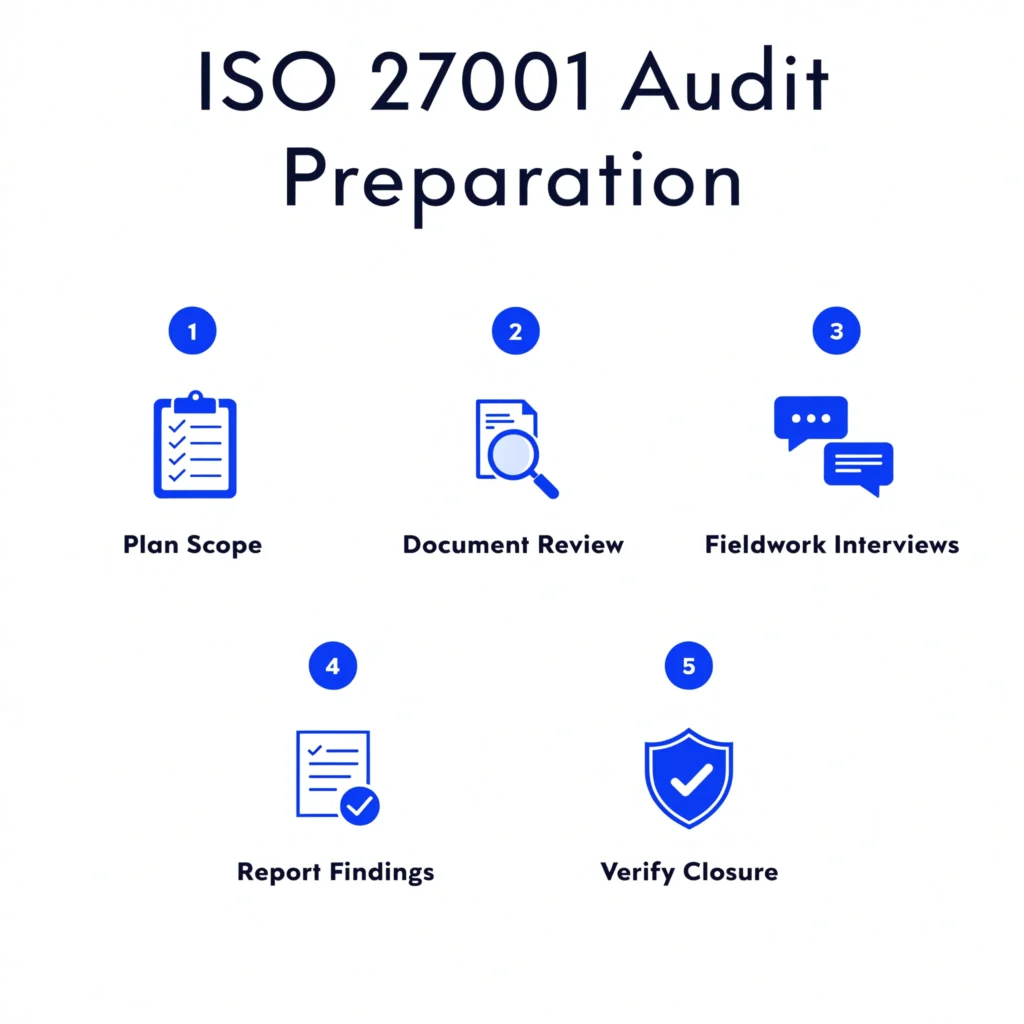
Internal audits follow a predictable sequence that yields usable outputs for certification readiness. Start with audit planning: define scope, criteria and sample sizes, then conduct a document review to identify obvious gaps. Fieldwork involves interviews with control owners, evidence sampling (logs, access lists, backups), and verification of process execution. Reporting should classify findings as observations, minor or major nonconformities, and include root cause suggestions and corrective action targets. Finally, verification confirms remedial measures and records closure; completed internal audits provide demonstrable evidence to certification bodies and feed directly into management review discussions.
- Plan: Scope, criteria, schedule, and auditor assignment.
- Review: Document checklists and pre-audit evidence review.
- Fieldwork: Interviews, observations, and evidence sampling.
- Report: Findings, classifications, and recommended corrective actions.
- Verify: Confirm actions closed and record objective evidence.
This staged approach builds the evidential trail auditors expect and supports continuous improvement cycles.
Underpinning effective audits, ACATO offers internal audit support and training services to help organisations develop competent internal auditors and design audit schedules aligned with certification milestones. Bringing experienced auditors into training accelerates capability building while keeping internal resources focused on remediation.
How Can Staff Training Enhance Internal Audit Effectiveness?
Training elevates audit quality by teaching evidence collection, interview techniques, and how to write objective findings aligned to ISO clauses. Effective training covers audit criteria, sample selection, control verification methods, and report writing templates, combined with role-play exercises and mock interviews. Regular refresher sessions reduce common findings such as inadequate evidence of competence or inconsistent procedure execution. Training investment yields measurable benefits: improved evidence quality, fewer repeated nonconformities, and faster corrective action closure times. Well-trained auditors also improve engagement with control owners, making internal audits a constructive mechanism for organisational learning rather than merely a compliance exercise.
What Should You Expect During the ISO 27001 External Certification Audit?
The external certification audit typically occurs in two stages: Stage 1 is a documentation review and Stage 2 is an on-site assessment of implementation and effectiveness. Stage 1 checks that required documents exist and that the ISMS scope and SoA are coherent; Stage 2 validates that controls operate as claimed via interviews, demonstrations, and sampled evidence. Common pitfalls include incomplete SoAs, missing evidence for technical controls (patch records, log retention), and lack of recent internal audit or management review records. Preparing a concise evidence index, ensuring control owners are briefed, and scheduling time for auditor requests reduces time on-site and the risk of findings. The table below compares Stage 1 and Stage 2 focuses and typical evidence.
This comparison clarifies auditor expectations and helps you package materials efficiently for each stage.
| Audit Stage | What Auditor Checks | Typical Evidence / Outputs |
|---|---|---|
| Stage 1 (Documentation) | Completeness of ISMS documents and scope validity | Scope, policy, SoA, risk assessment, RTP, internal audit schedule |
| Stage 2 (On-site implementation) | Operational effectiveness of controls and objective evidence | Interviews, logs, configurations, incident records, training records |
| Surveillance | Continued compliance and improvement since certification | Management review minutes, corrective action records, internal audits |
Preparing distinct, labelled bundles for Stage 1 and Stage 2 reduces ambiguity and supports a smoother certification pathway.
How Do You Navigate the ISO 27001 Stage 1 Documentation Review?
Stage 1 is an opportunity to demonstrate that your ISMS is mature enough for on-site assessment; auditors seek coherent documentation, consistent scope, and risk-based control selection. Provide a cover summary that lists included documents, maps them to ISO clauses, and points auditors to critical evidence such as the SoA and recent internal audit reports. Address minor findings quickly by documenting interim controls or planned remediation with owners and dates; auditors accept planned actions if they are realistic and tracked. Packaging documents with an index and short evidence notes makes the review efficient and signals organisational readiness for Stage 2.
What Are Best Practices for Passing the Stage 2 On-site Audit?
Stage 2 requires demonstrating that controls are implemented and effective across sampled processes. Prepare control owners with briefings and mock interviews, ensure evidence systems (logs, backups, change records) are accessible, and schedule key staff to be available during auditor visits. Demonstrate technical controls with recent screenshots or exportable logs and show chain-of-custody for records like access changes and incident reports. Run a final internal audit and a short mock Stage 2 to rehearse interviews and evidence retrieval. These practices reduce the likelihood of major nonconformities and shorten the certification timeline.
How Do You Address Nonconformities and Maintain ISO 27001 Certification?
Handling nonconformities promptly and systematically is central to maintaining certification and improving security posture. A corrective action lifecycle—identify, root cause analysis, action plan, implement, verify—ensures issues are closed with verifiable evidence and prevents recurrence. Surveillance audits test that corrective actions were effective and that the ISMS continues to meet requirements; organisations should track KPIs such as time-to-close, recurrence rate, and audit finding categories. Common nonconformities often arise from missing evidence, inconsistent procedure execution, or insufficient risk treatment justification; a remediation matrix helps assign root cause types and recommended corrective actions. The table below provides a quick-reference remediation matrix for common finding types.
| Nonconformity Type | Likely Root Cause | Recommended Corrective Action / Verification |
|---|---|---|
| Incomplete SoA | Lack of decision rationale | Document selection/exclusion rationale and evidence; management sign-off |
| Inadequate risk assessment | Weak methodology or missing assets | Re-run assessment with defined methodology; attach asset register |
| Missing training records | Poor recordkeeping | Conduct make-up training, update records, and audit attendance logs |
| Insufficient technical evidence | Log retention or collection gaps | Configure retention, export logs, and provide recent samples to auditor |
This remediation matrix helps teams choose proportional corrective actions and verification steps.
What Are Common Nonconformities Found During ISO 27001 Audits?
Auditors frequently find incomplete or poorly justified SoAs, risk assessments lacking scope or asset context, missing evidence of staff competence, and inconsistent application of documented procedures. Technical evidence gaps such as missing patch records, incomplete log retention, or untested backups are common for organisations without automated tooling. Quick fixes include creating short evidence packs, documenting interim compensating controls, and scheduling competence updates. Addressing these early in the remediation timeline reduces the likelihood of major findings and streamlines surveillance audits.
How Can Corrective Actions and Surveillance Audits Support Ongoing Compliance?
Corrective actions create a documented trail from finding to resolution that auditors review during surveillance; effective actions include root cause analysis, time-boxed remediation, and objective verification steps. Surveillance audits focus on whether corrective measures were effective and whether the ISMS shows evidence of continual improvement, so tracking KPIs like time-to-close and recurrence rates is valuable. Establish a cadence for management review that integrates internal audit results and surveillance preparation, and schedule periodic mock surveillance checks to validate evidence availability. This disciplined loop of detect→correct→verify→improve keeps the ISMS resilient and audit-ready.
For organisations that prefer a consultant-assisted remediation pathway, ACATO’s experienced ISO experts can accompany clients through corrective action planning and verification, and support document writing to ensure evidence meets certification body expectations. If you need help converting gap analysis outputs into audit-grade documentation or want external auditors to train internal teams, a short consultation can prioritise the highest-impact actions.
This final assistance note invites practical next steps: if your team needs hands-on support for gap analysis, document creation, or internal audit training, consider booking a free consultation with ACATO’s ISO experts who can help scope a time-boxed path to certification and provide written ISMS documents to reduce internal workload.