
Essential Guide to Documenting Policies for ISO 27001 Audit

Crafting ISO 27001 Audit-Ready Policy Documents: Essential Guide and Templates
By following this structured approach to documenting policies for ISO 27001 audit readiness, security teams will achieve clarity, consistency, and confidence in every audit cycle.
Effective documentation of ISO 27001 policies is the cornerstone of audit preparedness, ensuring demonstrable compliance and streamlined certification processes. Organizations often struggle with identifying mandatory policy artifacts, writing clear statements, sourcing reliable templates, preparing for auditor scrutiny, and sustaining policy currency. This guide maps the five critical themes you must master:
- Defining mandatory ISO 27001 policy documents
- Developing policies for audit success
- Leveraging auditor-approved templates
- Confirming audit-readiness with checklists and assessments
- Maintaining and improving policy documents over time
What Are the Mandatory ISO 27001 Policy Documents You Need?
ISO 27001:2022 mandates a baseline set of documents to evidence an effective Information Security Management System (ISMS), because these records define scope, responsibilities, risk treatment and control selection—key proof points during an audit. For example, the Information Security Policy and Statement of Applicability are compulsory artifacts that frame risk decisions and control applicability.
Before examining each document, here is the prioritized list of required ISO 27001 policy artifacts:
- ISMS Scope Statement – Defines boundaries and context of information security.
- Information Security Policy – Sets high-level objectives, principles and management direction (Clause 5.2).
- Risk Assessment & Treatment Methodology – Outlines risk identification, analysis and evaluation processes.
- Statement of Applicability (SoA) – Justifies inclusion or exclusion of Annex A controls with implementation status.
- Risk Treatment Plan – Details selected controls, responsibilities and timelines.
These mandatory policy documents establish the foundation for every subsequent section on policy development and audit preparation.
Which ISO 27001:2022 Documents Are Essential for Audit Readiness?
Key ISO 27001:2022 documents structure the ISMS evidence trail and support audit queries.
Information Security Management Systems
Key ISO 27001:2022 documents structure the ISMS evidence trail and support audit queries. These documents clarify organizational context, demonstrate leadership commitment, and provide traceability of risk decisions, enabling auditors to verify compliance efficiently.
Source: ISO 27001:2022 Standard
- ISMS Scope Statement clarifies organizational context and asset boundaries.
- Information Security Policy demonstrates leadership commitment and security objectives.
- Risk Assessment Report and Treatment Plan provide traceability of risk decisions.
- Statement of Applicability records control applicability against Annex A.
Together, these deliver transparent risk management and control selection, enabling auditors to verify compliance efficiently and prepare for certification.
How Does the Information Security Policy Fit Into ISO 27001 Requirements?
The Information Security Policy (Clause 5.2) articulates management’s commitment, objectives, and directives. It defines roles, authorizes resources, and communicates risk appetite. By documenting topics such as confidentiality, integrity and availability goals, this policy channels all ISMS processes and serves as the apex document that auditors review first.
What Role Does the Statement of Applicability Play in Policy Documentation?
A Statement of Applicability (SoA) links risk treatment decisions to actual controls by listing each Annex A control, its selection rationale, implementation status, and reference to supporting procedures. This ensures auditors can trace why controls were accepted or excluded, bolstering transparency in policy compliance.
How Do Risk Assessment and Treatment Documents Support Policy Compliance?
Risk Assessment and Treatment reports underpin policy accuracy by identifying threats, evaluating risk levels, and prescribing controls. They supply justification for policy statements and SoA entries, creating a cohesive narrative of risk management that auditors validate against actual practice.
How Do You Write Effective ISO 27001 Policies for Audit Success?
Developing ISO 27001 policies requires a structured lifecycle that transforms risk insights and scope definition into authoritative directives, because clear, risk-informed policies guide implementation and ease audit scrutiny. For instance, linking each policy clause to specific risk treatment steps ensures measurable compliance outcomes.
ISO 27001 Policy Development and Implementation
The development of ISO 27001 policies requires a structured approach, transforming risk insights into clear directives to guide implementation and ease audit scrutiny. Linking each policy clause to specific risk treatment steps ensures measurable compliance outcomes.
Source: ISO 27001:2022 Standard
What Are the Key Steps in the ISO 27001 Policy Development Lifecycle?
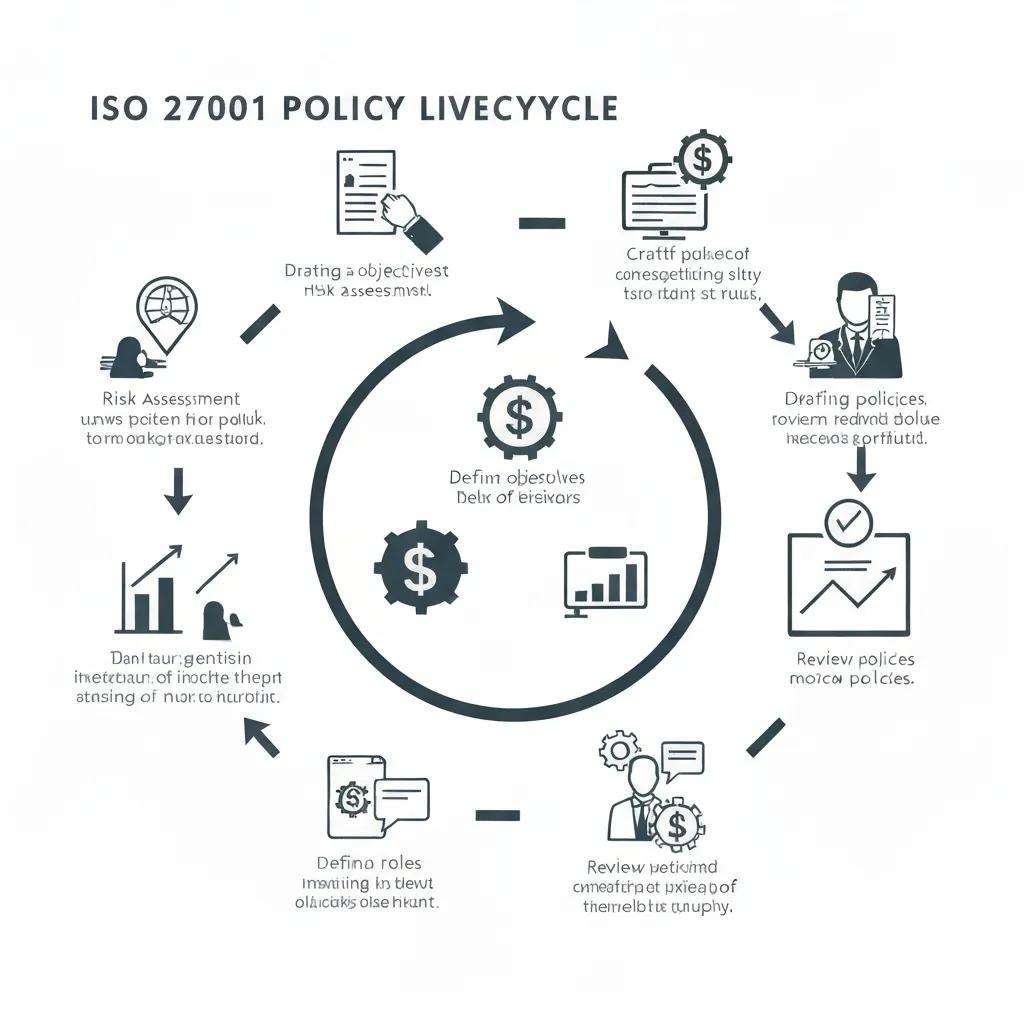
- Initiate with Risk Context – Gather risk assessment outputs and scope boundaries.
- Draft High-Level Objectives – Align policies to organizational goals and risk appetite.
- Define Roles and Responsibilities – Assign ownership for each policy area.
- Map Controls to Objectives – Reference Annex A controls directly in policy clauses.
- Review and Approve – Engage top management for formal endorsement.
- Communicate and Train – Distribute policies and conduct awareness sessions.
This lifecycle ensures every policy is traceable from risk identification to management review, promoting audit success.
How Should You Define ISMS Scope and Objectives for Policy Creation?
Defining ISMS scope involves documenting organizational units, information assets, and interfaces in detail. Clear scope alignment grounds policy statements in real-world contexts, for example specifying remote offices or cloud services, which auditors will verify against system inventories during reviews.
How Can Risk Assessment and Treatment Be Integrated Into Policies?
Integrate risk findings by referencing risk levels and treatment actions within policy clauses. For example, a policy section on access control can cite the risk rating for privileged accounts and mandate multi-factor authentication as the prescribed treatment measure.
What Are Best Practices for Policy Review, Approval, and Communication?
- Scheduled Reviews – Plan annual or context-triggered policy reviews.
- Management Sign-Off – Secure formal approval from executive leadership.
- Version Control – Use document control numbering and change logs.
- Targeted Training – Tailor awareness to impacted teams.
- Publication Channels – Distribute via intranet, emails and training platforms.
Consistent review and communication maintain policy relevance and demonstrate continual improvement during audits.
Which ISO 27001 Policy Document Templates Can Simplify Your Compliance?

Prebuilt, auditor-approved templates accelerate policy drafting by embedding required sections and control mappings, because they ensure consistency and completeness from the start. For instance, templates from recognized providers include built-in SoA tables and change-control fields.
Where Can You Find Auditor-Approved ISO 27001 Policy Templates?
Numerous reputable ISO practitioners publish free and commercial templates. Industry portals and consulting websites often vet templates against the 2022 standard. Leveraging these resources reduces drafting time and aligns content with auditor expectations.
How Do You Customize ISO 27001 Policy Templates for Your Organization?
Begin by updating scope and context fields, then map Annex A controls to your risk treatment outcomes. Adjust ownership, approval workflows, and review frequencies to match internal governance processes. This tailoring creates a unique policy set that reflects organizational structure and risk posture.
What Are the Benefits of Using Policy Templates for Audit Readiness?
- Efficiency – Templates embed standard sections, saving drafting time.
- Consistency – Uniform structure across policy types simplifies audits.
- Accuracy – Pre-mapped controls reduce errors in SoA and risk treatment.
- Scalability – Templates adapt easily to evolving scope or new assets.
Templates form a reliable foundation for documenting policies for ISO 27001 audit success.
How Can You Ensure Your ISO 27001 Policies Are Audit-Ready?
Audit readiness hinges on structured self-assessment, objective evidence of compliance, and familiarity with auditor expectations, because proactive checks reveal gaps before certification reviews. For example, cross-referencing policies with live control evidence prevents last-minute surprises.
What Is Included in an ISO 27001 Policy Audit Checklist?
Introducing a concise table to benchmark policy attributes and evidence:
| Policy Artifact | Evidence Required | Audit Impact |
|---|---|---|
| Information Security Policy | Signed management approval | Confirms leadership commitment and scope |
| Statement of Applicability | Control selection rationale | Verifies Annex A alignment and risk decisions |
| Risk Treatment Plan | Implementation records | Demonstrates control deployment status |
| Versioned Change Log | Document control register | Shows ongoing policy maintenance |
How Do Internal and External Audits Assess Policy Compliance?
Internal auditors verify policy adherence by reviewing documentation, interviewing stakeholders, and sampling control evidence. External auditors from accredited bodies focus on mandatory artifacts, SoA consistency, and control effectiveness. Linking policy statements to evidence logs mitigates nonconformities.
For guidance on selecting the right certification partner, see “ISO 27001 certification bodies.”
What Common Audit Findings Should You Avoid in Policy Documents?
- Missing Sign-Offs – Unapproved or outdated policies.
- Incomplete SoA Entries – Controls listed without rationale.
- Scope Drift – Policies that omit new business units or technologies.
- Lack of Evidence – No records of risk treatment or control testing.
Avoiding these pitfalls secures smoother audit outcomes.
How Should You Maintain and Update ISO 27001 Policy Documents Over Time?
Sustained compliance demands regular reviews, continuous improvement processes, and tool-assisted governance, because evolving risks and technologies require policy adjustments. For example, automated reminders ensure review cycles are never missed.
How Often Should ISO 27001 Policies Be Reviewed and Updated?
Organizations should review policies at least annually and whenever significant changes occur in business context, technology, or regulations. Trigger events include new service launches, infrastructure changes, or updated legal requirements, each prompting a policy revision cycle.
What Processes Support Continual Improvement of Policy Documents?
- Change Control Board – Reviews and approves policy amendments.
- Lessons Learned Sessions – Capture insights from incidents and audits.
- Performance Metrics – Monitor policy adherence through KPIs.
- Stakeholder Feedback – Incorporate end-user input into policy refinements.
These processes embed flexibility and responsiveness into policy management.
How Can Automation Tools Help Manage ISO 27001 Policies Efficiently?
Automation platforms streamline version control, review schedules, and evidence collection. They generate dashboards showing policy status, track approval workflows, and send reminders for upcoming reviews. By reducing manual overhead, these tools bolster policy integrity and audit preparedness.
Policies maintained through automated governance remain aligned with organizational change and audit expectations.
Effective audit-ready policy documentation for ISO 27001 combines mandatory artifacts, clear development lifecycles, reliable templates, rigorous readiness checks, and continuous maintenance. By embedding structured processes and leveraging proven templates, organizations can demonstrate compliance confidently and sustain robust information security management over time.
Frequently Asked Questions
What are the consequences of non-compliance with ISO 27001?
Non-compliance with ISO 27001 can lead to significant consequences, including legal penalties, loss of business reputation, and potential financial losses. Organizations may face fines or sanctions from regulatory bodies, and they risk losing customer trust if they cannot demonstrate effective information security management. Additionally, non-compliance can hinder the ability to secure contracts, especially with clients who require adherence to international standards. Ultimately, failing to comply can compromise an organization’s overall security posture and operational integrity.
How can staff training improve ISO 27001 compliance?
Staff training is crucial for improving ISO 27001 compliance as it ensures that employees understand their roles in maintaining information security. Training programmes can educate staff on the importance of policies, risk management, and their specific responsibilities within the ISMS. By fostering a culture of security awareness, organizations can reduce the likelihood of human error, which is often a significant factor in security breaches. Regular training sessions also help keep employees updated on policy changes and emerging threats, enhancing overall compliance.
What role does management play in ISO 27001 implementation?
Management plays a pivotal role in the implementation of ISO 27001 by demonstrating leadership commitment and providing necessary resources. Their involvement is essential for establishing a culture of security within the organization, as they set the tone for compliance and risk management. Management is responsible for approving policies, ensuring that objectives align with business goals, and supporting training initiatives. Their active participation in the audit process also reinforces the importance of adherence to ISO standards across all levels of the organization.
How can organizations measure the effectiveness of their ISO 27001 policies?
Organizations can measure the effectiveness of their ISO 27001 policies through various methods, including internal audits, performance metrics, and compliance assessments. Key Performance Indicators (KPIs) can track policy adherence, incident response times, and the frequency of security breaches. Regular reviews and audits help identify gaps in compliance and areas for improvement. Additionally, feedback from staff and stakeholders can provide insights into the practical application of policies, ensuring they remain relevant and effective in addressing current security challenges.
What are the common challenges faced during ISO 27001 implementation?
Common challenges during ISO 27001 implementation include resistance to change, lack of management support, and insufficient resources. Employees may be hesitant to adopt new policies or practices, especially if they perceive them as burdensome. Additionally, without strong leadership backing, initiatives may lack direction and momentum. Resource constraints, whether financial or personnel-related, can also hinder the development and maintenance of an effective ISMS. Addressing these challenges requires clear communication, training, and a commitment to fostering a security-focused culture.
How can organizations stay updated with changes in ISO 27001 standards?
Organizations can stay updated with changes in ISO 27001 standards by subscribing to relevant industry publications, joining professional associations, and participating in training workshops. Regularly reviewing updates from the International Organization for Standardization (ISO) ensures that organizations are aware of any revisions or new requirements. Engaging with consultants or experts in ISO compliance can also provide valuable insights into best practices and emerging trends. Additionally, attending conferences and networking events can facilitate knowledge sharing among peers in the field.
Conclusion
By implementing a structured approach to ISO 27001 policy documentation, organizations can achieve enhanced audit readiness and compliance confidence. This guide highlights the essential documents and best practices that streamline the certification process, ensuring clarity and consistency. To further support your journey, explore our collection of auditor-approved templates designed to simplify your policy development. Start transforming your compliance efforts today and secure your organization’s information security management.