
Optimize Incident Response with Mean Time to Resolve (MTTR)
Mean Time to Resolve: Measuring Incident Response Efficiency for Cybersecurity and ISO 27001 Compliance
Mean Time to Resolve (MTTR) measures the average time required to fully resolve a cybersecurity incident from detection through verification of remediation, and it is an essential incident response metric that links operational performance to business risk. Recent industry analysis shows that faster resolution reduces downtime, limits data exposure and lowers remediation costs, making MTTR a core KPI for resilience and ISO 27001-aligned information security management systems. In this guide you will learn clear MTTR definitions, step-by-step calculation methods, benchmarking approaches, and practical strategies — including automation, playbooks and training — to reduce MTTR in cloud, ransomware and infrastructure incidents. We also explain how ISO 27001 incident management supports MTTR improvement and how related metrics such as MTTD, MTTA and MTTC interact with resolution time. For organisations seeking expert support, ACATO provides consulting, incident response, IT forensics and ISO 27001 certification assistance and offers a free consultation to assess MTTR improvement opportunities. The sections below map definitions to practical calculations, operational levers, standards alignment and how specialist services can accelerate measurable MTTR reduction.
What is Mean Time to Resolve and Why Does It Matter?
Mean Time to Resolve (MTTR) is the average duration between the initial detection of an incident and the point at which full remediation and verification are completed, and it matters because it quantifies the time that systems, data and services remain vulnerable or degraded. Measuring MTTR provides a single operational KPI that links technical response performance to business outcomes such as downtime cost, customer impact and regulatory exposure. Organisations that prioritise MTTR can target investments where they most reduce exposure, and MTTR also serves as evidence in management reviews and incident post-mortems. Understanding MTTR in context requires recognising its lifecycle elements—detection, diagnosis, remediation and verification—which are explored below to show where interventions produce the largest improvements.
How is MTTR Defined and What Are Its Variations?
MTTR has several industry variations—Mean Time to Repair, Mean Time to Recover, Mean Time to Resolve and Mean Time to Remediate—each emphasising a different phase of the incident lifecycle, and organisations choose the term that best matches operational scope. For example, Mean Time to Repair is common in physical or infrastructure contexts where the focal activity is hardware repair, whereas Mean Time to Remediate often applies to security incidents that require patching, configuration changes and forensic validation. A simple formula for MTTR is total resolution time divided by number of incidents over a defined period; using consistent start and end markers (for example, detection timestamp to verification timestamp) is crucial to avoid measurement drift. Clarifying the chosen definition up-front ensures comparisons across teams and external benchmarks remain meaningful and actionable.
What Are the Key Components of MTTR in Incident Response?
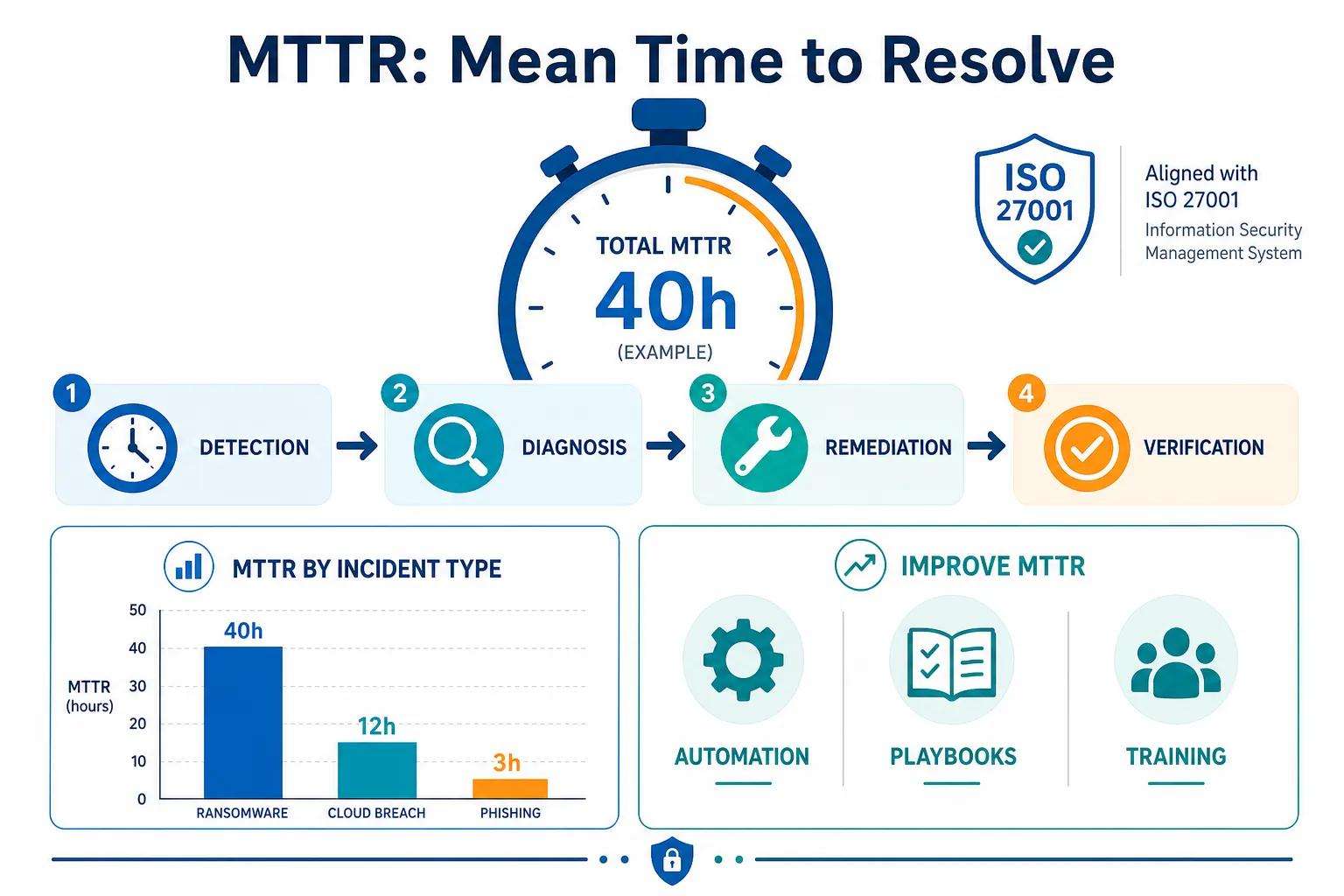
MTTR comprises distinct components that sum to total resolution time: detection time, diagnosis time, remediation (repair) time and verification time, and each component has different root causes and improvement levers. Detection time depends on monitoring coverage such as SIEM, sensor placement and alerting thresholds; diagnosis time reflects analyst triage skills, log quality and tool interoperability; remediation time involves patching, rollback, containment and coordination with stakeholders; verification time ensures the issue is confirmed resolved and threat actors are eradicated. Measuring component-level times highlights where most delay occurs, and focusing on the largest contributor—often diagnosis or verification—delivers the fastest MTTR improvements when paired with targeted process changes.

How Do You Calculate and Benchmark MTTR Effectively?
Calculating MTTR effectively requires consistent data capture from incident logs and ticketing systems, a clear formula and sensible grouping by severity, type and environment to produce actionable benchmarks. The basic MTTR formula is total resolution time for a set of incidents divided by the number of incidents in that set, but accuracy depends on consistent start/end markers and normalization by incident severity or type. Data hygiene—synchronised timestamps, timezone handling and audit-quality logs—is essential because inconsistent records produce misleading MTTR values that undermine trend analysis. The guidance below gives a stepwise method and benchmarking approach that teams can apply using existing SIEM, ticketing and forensic records to generate reliable MTTR figures for management and ISO 27001 evidence.
What Is the Step-by-Step MTTR Calculation Method?
- Define start and end events (e.g., detection alert timestamp → verification-of-remediation timestamp) to ensure consistency across incidents.
- Extract timestamps from authoritative sources such as SIEM alerts, ticketing logs and forensic reports and convert to a single timezone and format.
- Calculate resolution time for each incident as the difference between end and start timestamps, then group incidents by severity or type for meaningful averages.
- Compute MTTR by dividing the sum of resolution times by the number of incidents in the group, and capture per-component metrics (MTTD, diagnosis, remediation, verification).
- Record the calculation method and cadence in an ISMS metric statement so auditors and stakeholders can validate the approach.
These steps create a defensible MTTR figure, and grouping by incident type—ransomware, cloud misconfiguration, or credential compromise—yields targeted benchmarks that inform where to invest to reduce resolution time.
Introductory context and an example table below illustrate how to apply the formula to real incident types and produce clear benchmarks.
This EAV-style breakdown shows how grouping by incident type yields different MTTR values and clarifies where process improvements will be most impactful. Using type-specific MTTR helps teams prioritise investments in detection, containment or forensic capabilities where they will reduce overall exposure most effectively.
What Are Industry Benchmarks and What Constitutes a Good MTTR?
Industry benchmarks vary by sector, incident type and organisational scale; there is no universal “good” MTTR but ranges help set expectations and targets for improvement. For example, high-severity ransomware incidents might have benchmarks measured in days for many organisations, while phishing compromises often resolve in hours with mature processes; essential context includes severity weighting, detection maturity and availability of automation. When interpreting benchmarks, compare similar organisations (SMEs vs infrastructure providers) and combine external benchmarks with internal trending—showing continuous MTTR reduction over quarters is often more persuasive than a one-off comparison. Benchmark tables and a short list below summarise typical ranges and the interpretive caveats teams should apply.
- Typical sectors to benchmark against include SMEs, government agencies, NGOs and infrastructure providers.
- Benchmarks must be adjusted for detection capability differences such as SIEM coverage and endpoint telemetry density.
- Improvement goals should couple MTTR targets with MTTD and MTTA reductions to avoid shortening verification at the expense of thoroughness.
Using benchmarks as directional targets rather than rigid thresholds helps teams set achievable goals and demonstrates progress during management review and ISO 27001 audits.
What Strategies Can Reduce MTTR and Improve Incident Response Time?
Reducing MTTR requires an operational mix of better detection, faster triage and automation, robust playbooks, and human factors such as training and defined roles, and the most efficient programmes combine these elements with continuous measurement. Automation and AI reduce human latency in triage and remediation, while well-crafted incident playbooks standardise actions and reduce decision-making time. Training and regular exercises build muscle memory so teams execute playbooks quickly under stress, and forensics capability shortens investigation and verification phases. The list below highlights top strategy categories and how they produce measurable MTTR improvements.
- Automation & Orchestration: Automates repetitive triage and containment tasks to cut diagnosis and remediation time.
- Playbooks & Runbooks: Standardise response steps and communications to reduce reliance on ad-hoc judgement.
- Training & Exercises: Increase team readiness and reduce human error during high-pressure incidents.
These strategies deliver complementary benefits: automation accelerates technical steps, playbooks ensure correct sequence and communication, and training ensures people enact procedures effectively; the following table compares expected impacts on detection, acknowledgement and resolution.
How Does Automation and AI Accelerate MTTR Reduction?
Automation and AI accelerate MTTR by removing repetitive manual tasks, enriching alerts with contextual data and executing containment actions at machine speed, which shortens diagnosis and remediation windows. Integrating SOAR with SIEM enables automated enrichment of events, scripted containment plays (such as isolating endpoints) and prioritised escalations that reduce time-to-acknowledge and time-to-contain. AI-assisted triage can surface the likely root cause and recommended remediation steps, but it performs best when paired with curated playbooks and quality telemetry; poor data leads to incorrect automation decisions. Accounting for interoperability (SIEM, endpoint telemetry and ticketing) and governance controls prevents automation from causing unintended disruption, and combining automation with human oversight provides both speed and safety in high-impact incidents.
What Role Do Incident Response Plans and Team Training Play?
Incident response plans and regular team training reduce MTTR by clarifying roles, decisions and escalation paths so teams spend less time resolving coordination questions during an incident and more time executing remediation. Structured playbooks that include predefined containment, communication and forensic steps let responders follow proven sequences that minimise error and speed recovery, while RACI-style role definitions remove ambiguity about responsibilities. Exercises — tabletop, simulated live drills and red-team scenarios — reveal process gaps and test tooling under stress, creating opportunities to refine playbooks and automation logic. Embedding learning from exercises into continuous improvement cycles ensures that training converts into persistent MTTR reductions rather than temporary gains.
How Does ISO 27001 Incident Management Support MTTR Improvement?
ISO 27001 structures incident management within an ISMS and supports MTTR improvement by mandating processes for detection, reporting, analysis and corrective action, while requiring measurement and continual improvement that aligns with MTTR as a KPI. The standard’s incident management clauses and Annex controls require documented procedures, defined roles and records of incidents and actions, which create the audit trail necessary to measure and demonstrate MTTR improvements. Embedding MTTR into the ISMS ensures management oversight, integrates MTTR into risk treatment plans and links resolution performance to management review and corrective actions, thereby institutionalising continuous reduction of resolution times. The subsections below cover specific ISO requirements and practical integration steps for MTTR measurement within an ISMS.
What Are ISO 27001 Requirements for Incident Management?
ISO 27001 requires organisations to establish processes for information security incident reporting, assessment, response and corrective action, and to maintain records that demonstrate those processes are followed and effective. Relevant outputs include an incident response policy, documented procedures, assigned responsibilities and recorded evidence of incident handling and outcomes; these artefacts support both operational response and auditor verification. The standard also requires monitoring and measurement of controls, which is where MTTR can be formalised as a performance indicator; demonstrating defined measurement cadence and improvement actions aligns the ISMS with operational reality. Ensuring procedures specify data sources, timestamps and roles for validation makes MTTR calculation auditable and reproducible for certification purposes.
How to Integrate MTTR Metrics into an ISMS Framework?
Integrating MTTR into an ISMS involves defining a KPI statement that specifies the MTTR formula, incident grouping rules, measurement frequency and reporting owners, and then embedding that KPI into performance monitoring and corrective action processes. A practical KPI definition includes scope (incident types), start/end markers, calculation cadence (monthly/quarterly) and acceptance thresholds tied to risk appetite; this feeds into management review, internal audit and continual improvement cycles. Reporting should include component breakdowns (MTTD, diagnosis, containment, verification) and trend analysis that supports corrective actions and resource allocation. By making MTTR a documented metric within the ISMS, organisations create a governance loop that turns measurement into sustained operational improvement and audit evidence.
What Are Other Critical Incident Response Metrics Related to MTTR?
MTTR sits within a family of incident response metrics — Mean Time to Detect (MTTD), Mean Time to Acknowledge (MTTA), Mean Time to Contain (MTTC), and Mean Time Between Failures (MTBF) — that together describe detection-to-recovery performance and resilience. Each metric captures a different phase of the lifecycle and helps teams prioritise interventions: reducing MTTD shortens the time an attacker has unfettered access, improving MTTA reduces triage delay, and faster MTTC limits immediate impact while remediation completes. Understanding the relationships among these metrics allows teams to target investments that yield the largest reduction in overall exposure and to avoid optimising one metric at the expense of another, for example by shortening MTTR but increasing recurrence due to incomplete containment.

What Is Mean Time to Detect and Its Relationship to MTTR?
Mean Time to Detect (MTTD) measures the average time from incident onset to first detection and is a critical upstream driver of MTTR because earlier detection provides more options for containment and faster remediation. Reducing MTTD often yields outsized benefits for MTTR, especially in fast-moving threats like ransomware or active exfiltration, because early detection frequently translates into simpler containment and smaller remediation scopes. A short scenario makes this concrete: detecting anomalous encryption activity within minutes can allow automated containment and rollback that keeps MTTR to hours rather than days. Therefore, investments in SIEM coverage, telemetry density and detection engineering that reduce MTTD directly contribute to lowering MTTR and limiting business impact.
This table clarifies when each related metric should be the primary focus, and it helps teams sequence investments to reduce overall resolution time and harm.
How Do Mean Time to Acknowledge and Mean Time to Contain Impact Response Efficiency?
Mean Time to Acknowledge (MTTA) measures average time from alert to first human acknowledgement, while Mean Time to Contain (MTTC) measures time from detection to effective containment; both metrics are immediate levers that shorten MTTR when improved. Faster acknowledgement reduces the window in which automated or manual escalation is delayed, and quicker containment limits lateral movement and scope, simplifying remediation and verification. Practical interventions include tuned alerting to reduce noise, rostered on-call processes to ensure rapid acknowledgement, and pre-authorised containment plays in automation platforms to remove bureaucratic delays. Prioritising MTTA and MTTC together often produces rapid MTTR reductions because containment and acknowledgement cut straight into the longest component times in many incidents.
How Can ACATO Help Organizations Enhance MTTR and Cyber Resilience?
ACATO offers consulting, incident response, IT forensics, cyber security and ISO 27001 certification audit support, designed to reduce MTTR by combining technical capability with ISMS alignment and continuous improvement. For organisations such as SMEs, government bodies, NGOs and infrastructure providers, ACATO’s certified experts support establishing measurable incident processes, implementing automation and playbooks, and preparing ISMS artefacts for audit-readiness — all focused on lowering resolution time and strengthening resilience. The firm positions ISO 27001 delivery as a competitive advantage, linking certification activities to operational improvements such as formalised MTTR KPIs and evidence collection that demonstrate control effectiveness. Organisations seeking an initial assessment of MTTR and resilience can engage ACATO for a free consultation to prioritise interventions and outline a roadmap to measurable MTTR reduction.
What Incident Response Services Does ACATO Provide to Reduce MTTR?
ACATO’s incident response and IT forensics capabilities focus on rapid containment, forensic investigation and remediation support that directly shorten diagnosis and verification phases of MTTR while preserving evidence for root-cause analysis. Services include hands-on incident response support to contain active threats, forensic analysis to identify scope and eradication steps, and post-incident reporting that feeds corrective actions into the ISMS; these outcomes translate to faster recovery and improved prevention. The practical next step for organisations is an initial diagnostic engagement during which ACATO experts evaluate telemetry, playbooks and tool integration to recommend targeted automation or process changes that reduce MTTR and demonstrate resilience improvements for auditors and stakeholders.
How Does ACATO Support SMEs, Government, and NGOs in ISO 27001 Compliance?
ACATO delivers ISO 27001 consulting and certification support tailored to the needs of SMEs, government entities and NGOs by producing ISMS documentation, conducting gap assessments and preparing organisations for certification audits while embedding MTTR measurement into the management system. Typical deliverables include incident management procedures, KPI definitions (such as MTTR), evidence collection templates and audit-readiness checklists that map technical controls to ISO requirements and operational objectives. By aligning certification activities with operational improvements, ACATO helps clients not only achieve certification but also realise measurable reductions in MTTR and improved operational resilience, ensuring that compliance work delivers tangible security performance benefits.
- To begin: request a free consultation to assess current MTTR, detection coverage and ISMS alignment.
- Next: prioritise interventions (automation, playbooks, training) based on expected MTTR impact and resource constraints.
- Finally: embed MTTR into ISMS monitoring and management review to sustain improvements and demonstrate audit-readiness.
This consultative approach emphasises outcomes—reduced MTTR, stronger detection and ISO 27001 readiness—rather than prescriptive one-size-fits-all solutions, enabling organisations to realise resilience gains that align with their operational context and risk appetite.