
Explore Hands-On Learning in Interactive Security Exercises
Enhancing Incident Response with Interactive Security Exercises
Interactive security exercises are structured, experiential activities that allow teams to practise detection, containment and recovery from cyber incidents in realistic conditions, improving incident response speed and coordination. These hands-on cybersecurity training methods — including tabletop exercises, phishing simulations, cyber range sessions and live incident drills — accelerate decision-making, expose gaps in technical controls and produce documented evidence for continual improvement. Readers will learn how interactive exercises reduce human risk, map to compliance frameworks like ISO 27001 and NIS 2, and which exercise types suit different audiences such as SMEs, government authorities, NGOs and infrastructure providers. The article explains practical design elements (scenario realism, metrics, roles, tooling), delivery options, and measurable outcomes that demonstrate ROI and regulatory readiness. Finally, the guide shows how a specialist consultant can align exercises to an organisation’s ISMS and follow through with forensic post-mortems and remediation planning. Throughout, we integrate core concepts like incident response drills, security awareness training, and cyber range training to help practitioners implement repeatable, auditable exercises.
Why Are Interactive Security Exercises Essential for Cyber Resilience?
Interactive security exercises are essential because they translate policy into practiced behaviour, revealing human, process and technical gaps before real incidents occur and thereby strengthening cyber resilience. By simulating pressure and ambiguity, exercises improve decision speed, coordination between teams and the practical use of incident playbooks, producing measurable reductions in detection and containment times. Recent studies indicate simulated practice and iterative feedback significantly lower human error rates and improve compliance evidence collection for audits. The following list highlights primary resilience benefits organisations gain from routine interactive exercises, and the summary that follows explains how those benefits connect to compliance and process improvement.
- Human error reduction and measurable behaviour change through repeated simulations.
- Faster incident response coordination, with clearer escalation and communication paths.
- Identification and remediation of plan and logging gaps through after-action reviews.
- Compliance and audit preparedness by generating documented evidence of testing and improvement.
These benefits make exercises a practical bridge between theoretical controls and operational readiness, which prepares teams for the kinds of decisions they will face during real incidents and sets up the next discussion on how exercises specifically improve incident response skills.
How Do Hands-On Cybersecurity Exercises Improve Incident Response Skills?
Hands-on cybersecurity exercises improve incident response by putting teams through realistic detection-to-recovery scenarios that focus on timelines, role clarity and coordinated actions, which shortens time-to-detect and time-to-contain. Practising under controlled stress develops decision-making speed and prioritisation, while role-based injects force teams to exercise communication, escalation and technical containment steps across IT, legal and leadership roles. Concrete examples include timed containment tasks where metrics such as minutes-to-isolate and minutes-to-block are recorded, showing before-and-after improvement across repeat exercises. An anonymised example: after three quarterly drills, a mid-sized organisation reduced mean time to contain a simulated ransomware incident by over 40 percent, improving recovery sequencing and stakeholder communications. These practical improvements feed directly into compliance evidence and inform updates to incident playbooks, which leads into the role of exercises in meeting standards like ISO 27001 and NIS 2.
What Role Do Interactive Exercises Play in Compliance with ISO 27001 and NIS 2?
Interactive exercises supply documented evidence required by ISO 27001 and NIS 2 by demonstrating the organisation’s ability to detect, respond and learn from incidents as part of an ISMS continual improvement cycle. Exercise outputs — scenario descriptions, timelines, action items, remediation plans and post-exercise forensic reports — map to clauses on incident management, risk treatment and continual improvement, providing auditors with clear artefacts.
While interactive exercises are crucial for demonstrating compliance, it’s worth noting the specific requirements of current standards.
NIS2 & ISO 27001 Compliance: The Role of Security Exercises
ISO 27001:2022-compliant organization like Mondi transition toward compliance with the NIS2 directive. The current version of ISO 27001:2022 does not explicitly require conducting any exercises or simulated testing.
Von ISO 27001: 2022 zu NIS2–Lücken und Überschneidungen identifizieren From ISO 27001: 2022 to NIS2-Identifying Gaps and Overlaps, 2022
Organisations can use a simple checklist to align exercise outputs to requirements: documented objectives, participant lists, test results vs KPIs, corrective actions and follow-up verification. Regularly scheduled exercises create the repeatable evidence trail auditors seek, and they make it easier to prioritise remediation tasks that reduce regulatory risk. The next section compares the main exercise types to help organisations choose the right mix for preparedness.
What Types of Interactive Security Exercises Enhance Organizational Preparedness?
Interactive security exercises come in distinct formats that target different audiences and learning objectives, from decision-focused tabletop exercises to technically demanding cyber range training for SOC teams. Choosing a balanced exercise programme—combining tabletop, phishing simulation, cyber range and full incident drills—ensures both leadership and technical teams gain relevant, measurable skills. The table below compares common exercise types by duration, audience, objectives and expected measurable outcomes to support selection and scheduling decisions. After the table, a short list clarifies where each format is most valuable and a summary ties the formats back to organisational readiness.

Table takeaway: combine formats to exercise policy, human behaviour and technical controls so that evidence covers management, staff and technical capabilities.
- Tabletop exercises validate leadership decisions and escalation before technical testing.
- Phishing simulations measure and improve human vigilance as part of awareness training.
- Cyber range sessions build technical detection, hunting and containment capabilities.
- Live incident drills test end-to-end continuity and operational recovery under realistic constraints.
Selecting a mix ensures organisational preparedness spans governance, people and technology, leading naturally into a description of how a specialist delivers customised hands-on training.
How Do Tabletop Exercises Simulate Real-World Cyber Incidents?
Tabletop exercises simulate real incidents through facilitated, scenario-driven discussions that progress via timed injects, forcing decision points and exposing process gaps without deploying live attacks. A facilitator presents a concise scenario brief, participants assume role responsibilities, and injects (new facts or complications) arrive at defined intervals to prompt decisions on containment, communications and escalation. Expected artefacts include action lists, revised escalation paths, communications templates and documented gaps for remediation tracking. Facilitators record decision times and rationales to produce a structured after-action report that supports policy updates and ISMS evidence. Running effective tabletops requires realistic scenarios, senior participation and a mapped escalation framework, which is the foundation before moving to technical simulations like phishing campaigns.
What Are the Benefits of Phishing Simulation Training for Employee Awareness?
Phishing simulation training provides quantifiable insight into human risk by measuring click-through rates, report rates and time-to-remediate, enabling targeted awareness interventions where they will have most impact. Campaigns paired with immediate behavioural feedback and follow-up micro-training reduce susceptibility and reinforce reporting behaviours, and metrics allow comparison across departments and roles. Ethical design—using realistic but safe templates and clear consent frameworks—maintains trust while improving vigilance. Over time, organisations can expect reduced click rates and faster remediation metrics, which in turn lower the probability of credential compromise or lateral spread during real incidents. These measurable outcomes make phishing simulations a cost-effective component of any security awareness training programme.
How Does ACATO Deliver Customized Hands-On Security Training?
ACATO delivers customised hands-on security training through a structured approach that begins with assessment and scoping, then moves into bespoke scenario design, delivery and forensic-led after-action reporting that aligns with organisational priorities and compliance needs. The delivery model adapts to sector and maturity: virtual tabletop workshops for leadership, on-site technical sessions for IT teams, and cyber range events for SOC skill development. ACATO maps exercises to ISO 27001 and NIS 2 controls during scoping and produces documented remediation plans and evidence artefacts suitable for audits. The following table compares delivery options to help decision-makers select a format aligned with resources and target audiences, followed by a brief summary that explains how these options translate into measurable outcomes.

This delivery comparison highlights how choice of mode affects logistical needs and learning depth, and demonstrates ACATO’s flexible options for matching exercise intensity to organisational constraints.
ACATO’s service mapping focuses on building repeatable evidence and remediation tracking so organisations can close gaps identified during exercises and show auditors clear improvement paths. The next sections explain ACATO’s forensic integration and how cyber range designs differ by audience.
What Is ACATO’s Approach to Integrating Incident Response Drills and IT Forensics?
ACATO integrates incident response drills with IT forensics by following a drill → capture → analyse → remediate workflow that converts exercise activity into actionable forensic intelligence and policy updates. During drills, forensic capture methods are employed to record telemetry and logs where possible; afterwards, analysts reconstruct timelines, identify detection blind spots and recommend logging or monitoring improvements. The output is a prioritized remediation plan with evidence-based recommendations for detection rules, logging retention and process changes to shorten mean time to detect. An anonymised outcome commonly shows improved log coverage and faster forensic triage, which improves future detection and containment—linking practical drills to measurable technical improvements. This integration supports continuous improvement and compliance documentation for auditors.
How Are Cyber Range Trainings Designed for SMEs and Government Authorities?
Cyber range trainings are modular and tailored to participant skill levels, with scaled complexity for SMEs and more rigorous, regulation-focused scenarios for government authorities. For SMEs, modules often prioritise common threats, playbook adherence and simple containment steps over advanced toolchains, enabling cost-effective skill-building within limited resources.
For government authorities, scenarios include critical infrastructure impacts, inter-agency coordination and stricter evidence capture to support public accountability.
Indeed, specialized training environments like cyber ranges are particularly effective for enhancing the defensive capabilities of critical infrastructure teams.
Cyber Range Training for Critical Infrastructure Defense
skills in defending critical infrastructure from types of cyberattacks, they can benefit from training in the simulated environments of cyber ranges.
Incident response drills on cyber ranges, LF Sikos, 2024
Typical session lengths vary from half-day technical labs for SMEs to multi-day simulations for government teams, with skill assessments to measure capability improvements. Modular design ensures relevance and scalability, so organisations can expand the programme as maturity and resource availability grow.
What Are the Key Components of Effective Interactive Security Exercises?
Effective interactive security exercises combine realistic scenarios, clear objectives, role definitions, appropriate tooling, measurable KPIs and rigorous post-exercise reporting to turn practice into permanent capability improvements. Scenario realism uses plausible threat vectors and timing to evoke authentic responses, while defined KPIs such as time-to-detect, time-to-contain and remediation completion rates enable objective measurement. Clear role definitions and communication pathways prevent confusion during an incident and help identify organisational single points of failure.
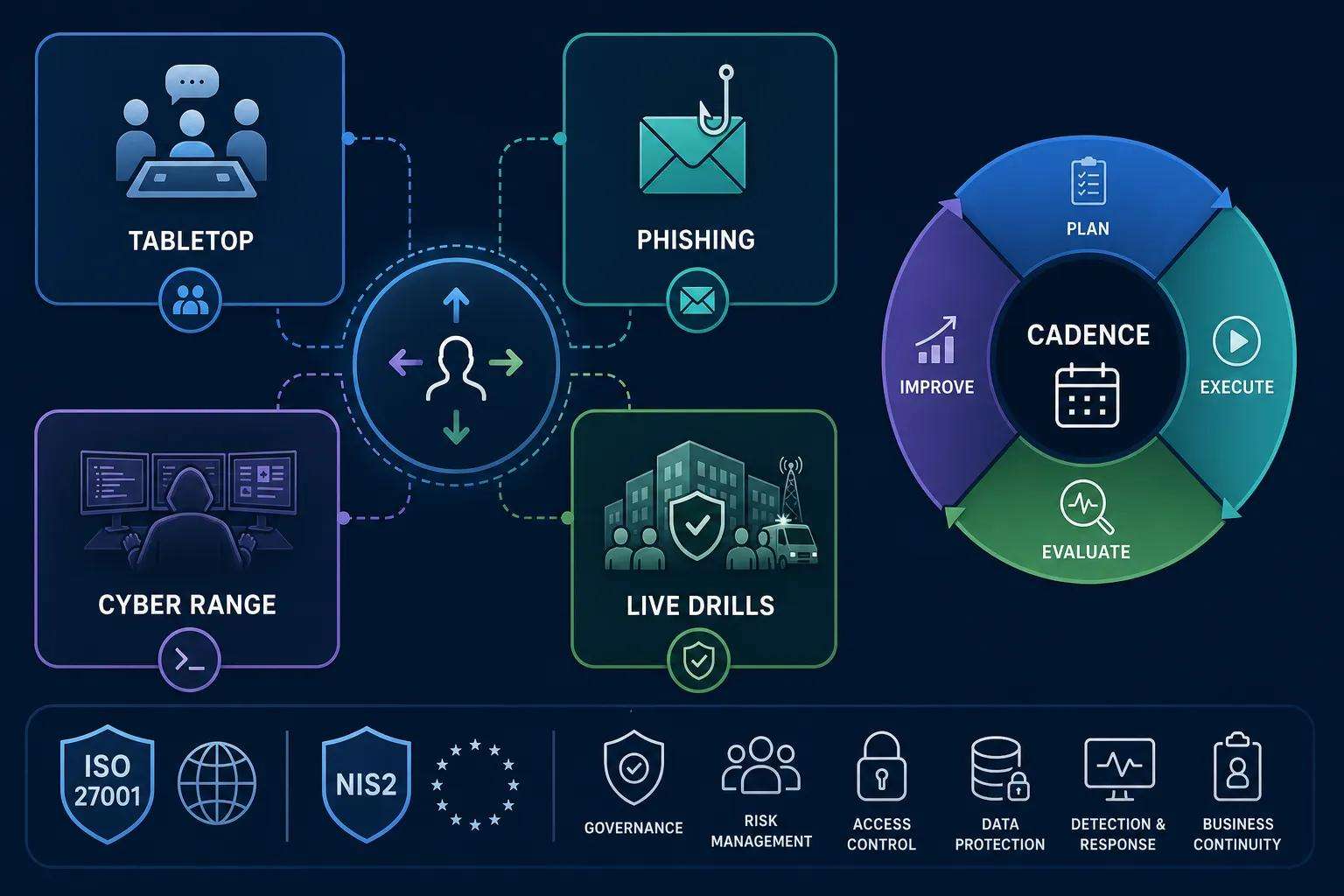
This mapping clarifies how each component contributes to both learning and compliance, enabling teams to prioritise investments.
- Realistic scenarios that mirror organisational risk and critical assets.
- Measurable KPIs and reporting frameworks tied to business objectives.
- Defined roles and communications pathways for every exercise participant.
- Post-exercise forensic analysis and tracked remediation to close identified gaps.
When customising these components, ACATO’s capabilities include forensics-led post-mortems and compliance mapping to ISO 27001 and NIS 2 as examples of professional delivery that produce auditable artefacts and measurable improvement.
How Do Realistic Scenarios and Measurable Outcomes Enhance Learning?
Realistic scenarios and measurable outcomes enhance learning by aligning stress, complexity and fidelity with actual organisational threats, which increases knowledge retention and produces quantifiable improvement in operational metrics. Scenarios that incorporate real assets, typical user behaviour and realistic timelines prompt participants to apply policies and tools as they would in an incident, revealing latent weaknesses. Measurable outcomes—like reduced time-to-detect, faster containment and completed remediation tasks—allow teams to track progress across iterations and justify investment in controls. A short example: a team that measured and reduced time-to-block malicious traffic over three exercises demonstrated both behaviour change and technical tuning benefits. These measurable improvements feed the continual improvement cycle and lead directly into why iteration matters.
Why Is Continuous Improvement Critical in Security Awareness Training?
Continuous improvement is critical because threat landscapes and organisational contexts change frequently, so one-off training does not sustain behavioural or technical resilience over time. The iterative cycle—train, test, measure and adjust—ensures lessons learned are implemented, retention is reinforced and evolving threats are addressed with updated scenarios. Recommended cadences vary by exercise type: phishing simulations monthly to quarterly, tabletop exercises quarterly to biannual, and full cyber range or live drills annually or when major changes occur. Role-based refreshers and micro-learning sustain gains between major exercises and create a documented trail of improvement. Regular iteration supports both maturity growth and audit readiness by demonstrating planned, measured enhancement over time.
How Can Organizations Benefit from Implementing Interactive Security Exercises?
Organizations benefit from interactive security exercises through reduced operational risk, faster recovery from incidents, demonstrable compliance evidence and measurable improvements in staff readiness and communication under pressure. Exercises uncover single points of failure and validate continuity plans, reducing downtime and protecting revenue and reputation. They also deliver concrete ROI by shortening detection and containment times and by informing targeted investments in tooling and logging where gaps are proven. The following list outlines organisation-specific advantages for SMEs, government entities, NGOs and infrastructure providers, followed by a short explanation of how a specialist partner can help convert exercise outputs into remedial action.
- Reduced risk from quicker detection and containment that limits lateral movement and data exposure.
- Improved operational continuity through validated playbooks and tested recovery steps.
- Stronger audit posture by generating documented testing evidence and improvement plans.
- Behavioural change across staff that reduces human-driven breach likelihood.
After identifying these benefits, many organisations choose to partner with a consultant to implement exercises and follow up on remediation. ACATO helps realise these advantages by designing tailored exercises, delivering forensic-led after-action reports, and providing remediation plans that map directly to ISO 27001 and NIS 2 requirements; organisations can request a demonstration or a free consultation for ISO 27001 and ISO 42001 to explore tailored options. The next H3 provides a scenario showing how risk mitigation and continuity improve through exercises.
What Risk Mitigation and Operational Continuity Advantages Do These Exercises Provide?
Exercises mitigate risk by validating contingency plans, exercising backup and restore procedures, and revealing dependencies that could cause prolonged outages, which improves operational continuity during real incidents. A simulated ransomware scenario, for example, surfaces gaps in backup verification, third-party dependencies and communication chains; addressing those gaps reduces recovery time and limits operational impact. By validating playbooks in practice, teams learn how to sequence containment, recovery and communications to maintain essential services. Measured improvements such as reduced time-to-recover and fewer manual workarounds translate directly into less downtime and lower incident costs, reinforcing the value of investment in regular exercises.
How Do Hands-On Trainings Strengthen Security Posture for NGOs and Infrastructure Providers?
Hands-on trainings strengthen security posture for NGOs and infrastructure providers by providing low-cost, high-impact exercise models that prioritise critical assets and public trust while accounting for resource constraints. Tailored, modular exercise designs focus on the most critical services and simple, repeatable containment steps that fit limited staffing and budget realities. For infrastructure providers, emphasis on continuity, interdependencies and regulator-facing evidence is critical; for NGOs, prioritising donor trust and service continuity guides scenario selection and remediation priorities. Practical recommendations include short tabletop runs combined with targeted technical drills to balance cost and effectiveness, which helps these organisations maintain essential services with limited resources.

What Are Common Questions About Interactive Security Exercises?
Common questions often focus on the types, frequency, measurable outcomes and whether to run exercises internally or engage an external provider; concise, practical answers help decision-makers create a sustainable exercise programme. The following FAQ-style list provides clear definitions of exercise types and recommended cadences, and the brief guidance afterward points to how organisations can engage specialist help or internal resources. Short pointers to specialist resources and service pages are included as places to get help if external expertise is desired.
- Tabletop: Facilitated scenario discussions to test decisions and escalation.
- Phishing: Simulated campaigns to measure human risk and improve reporting.
- Cyber Range: Hands-on technical labs for SOC and incident response skill-building.
- Live Drills: End-to-end simulations that test recovery and continuity plans.
These concise mappings show which format addresses specific needs, and organisations should use them to select a mix tailored to risk, maturity and regulatory obligations. For those seeking external support, ACATO provides ISO 27001 awareness training, incident response and IT forensics, and IT security consulting services that map to these exercise types and help convert results into remediation plans and audit-ready artefacts.
What Are the Different Types of Cybersecurity Exercises and Their Purposes?
Cybersecurity exercises vary in purpose: tabletop exercises validate governance and decisions, phishing campaigns measure human risk and awareness, cyber ranges build technical detection and response skills, and live drills validate operational recovery and continuity. Each type serves a distinct role in a maturity pathway: leadership and policy validation through tabletops, human behaviour change via phishing simulations, technical capability through cyber ranges, and system-level recovery via live drills. Organisations should map these types to their primary objectives—policy proofing, staff vigilance, technical skills, or continuity assurance—and schedule them accordingly. Choosing the right combination ensures coverage across governance, people and technology.
How Often Should Organizations Conduct Hands-On Security Training?
Recommended cadences balance learning science with operational practicality: phishing simulations are effective monthly to quarterly to maintain vigilance and measure behaviour change, tabletop exercises are recommended quarterly to biannually to test decision-making and playbooks, and full-scale cyber range or live simulations are typically annual or triggered by major changes such as M&A or significant system updates. Regular micro-learning and role-based refreshers between major exercises sustain gains and keep documentation current for audits. Scheduling exercises at these cadences creates a rhythm of train → test → measure → adjust, which keeps preparedness aligned with evolving threats and organisational changes.
This article has outlined practical exercise types, design components, delivery options and measurable outcomes so organisations can implement interactive security exercises that strengthen incident response, demonstrate compliance and reduce operational risk.