
Effective Incident Response Planning to Combat Data Breaches
Incident Response Consulting: Preparing for and Responding to Cyber Attacks with Expert Services
Incident response consulting defines a structured, expert-led approach to prepare for, detect, contain and recover from cyber attacks while preserving evidence and meeting regulatory obligations. Recent trends show that faster, coordinated responses reduce operational downtime and data loss, and the right consulting engagement strengthens forensic readiness, compliance with standards like ISO/IEC 27001, and alignment with NIS 2 Directive and GDPR obligations. This article explains how incident response planning and cyber incident management services work across the lifecycle, how digital forensics supports remediation and legal action, and what emergency cyber response teams should mobilise in the first 48–72 hours. You will learn the essential IR phases, practical containment and eradication tactics, how to build a tailored Incident Response Plan (IRP), and how to structure tabletop exercises and post-incident reviews for continuous improvement. The guidance emphasises actionable checklists, forensic methods for evidence preservation, and communication templates that reduce regulatory risk and reputational damage. Read on for a step-by-step map to strengthen your organisation’s cyber resilience and to understand when to engage specialised incident response consulting and digital forensics support.
What Are the Essential Phases of Incident Response Consulting?
Incident response consulting organises actions into a lifecycle that ensures readiness, rapid detection, decisive containment, thorough eradication, measured recovery, and disciplined lessons learned. The mechanism is simple: preparation creates capability, detection triggers triage, containment limits impact, eradication removes the threat, recovery restores services, and lessons learned reduce recurrence. The primary benefit of this structured lifecycle is predictable, auditable outcomes—reduced downtime, preserved evidential integrity, and compliance with frameworks like NIST SP 800-61 Revision 2 and ISO/IEC 27001. Below is a concise list designed for quick featured-snippet capture and operational checklists that teams can reference during an incident.
The six standard phases and a one-line action for each are listed to aid operational clarity and to support security incident handling procedures as part of incident response planning.
- Preparation: Build policies, IR roles, tooling, and backups to enable rapid response and evidence preservation.
- Identification: Detect anomalies, validate incidents, and prioritise based on impact and critical assets.
- Containment: Apply short-term and long-term containment to stop spread while preserving forensic data.
- Eradication: Remove malware, close exploited vectors, and patch vulnerabilities to prevent recurrence.
- Recovery: Restore services in stages, validate integrity, and monitor for re-infection.
- Lessons Learned: Conduct post-incident reviews to update IRP, controls, and training.
This ordered lifecycle supports repeatable incident management and prepares organisations for regulatory reporting, which is the next practical step when a breach is confirmed.
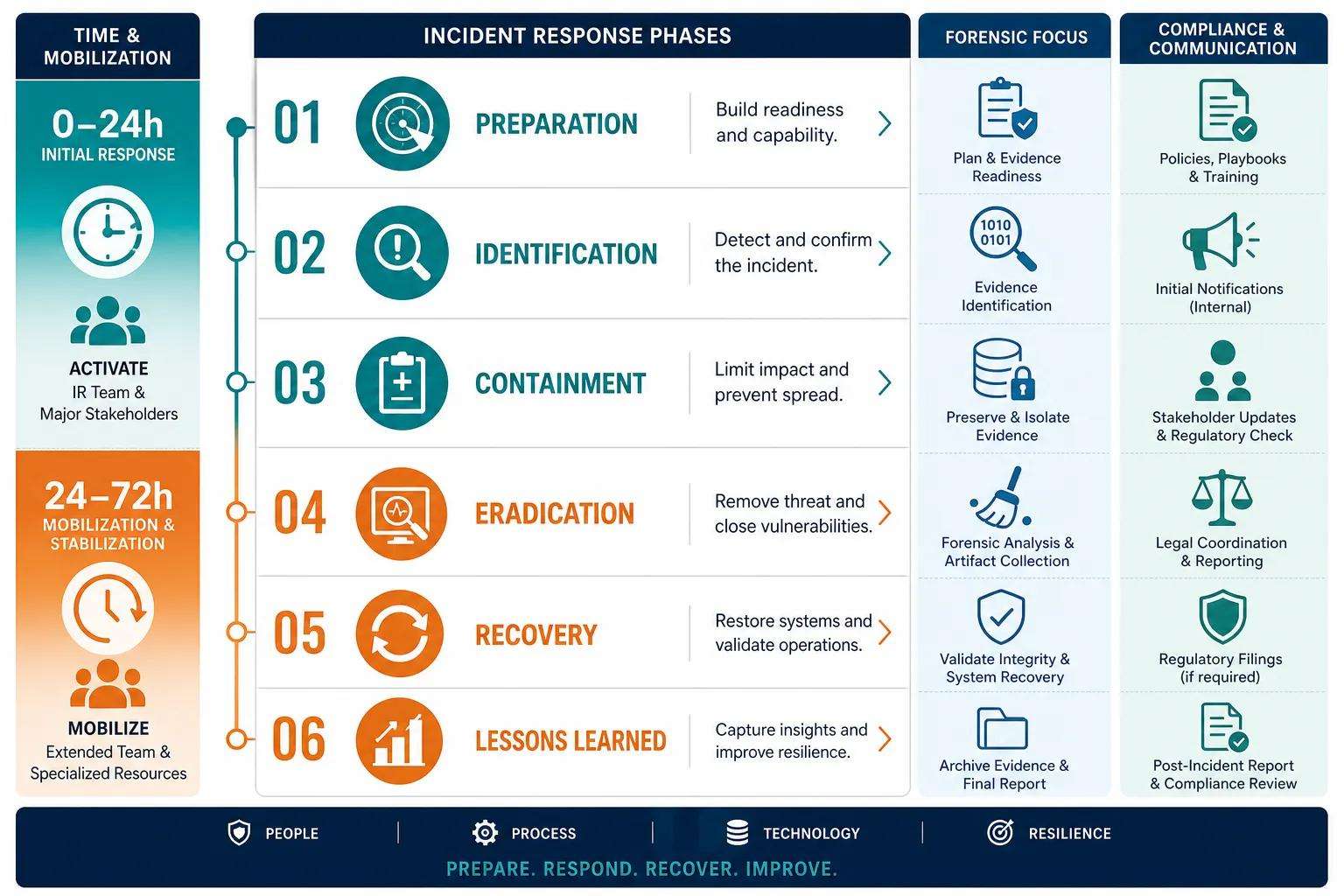
Different phases require different deliverables and outcomes; the table below summarises tasks and expected value for each phase to help teams allocate resources and define success metrics.
This EAV representation equips security leaders with a compact blueprint for incident response consulting that links activities to measurable outcomes and prepares teams for the operational and compliance tasks that follow.
How Does Preparation Strengthen Cyber Incident Readiness?
Preparation is the foundation of effective incident response planning, comprising documented IRPs, role definitions, playbooks, tooling, and periodic exercises that together create resilience. Mechanistically, preparation aligns people, process and technology so that detection events escalate to known decision paths; the specific benefit is faster containment and legally defensible evidence preservation. Organisations should create an IR roles matrix that maps incident types to response leads, technical contacts, legal counsel, and communications owners so decisions are clear during stress. Measurable readiness indicators include mean time to detect (MTTD) targets, recovery time objectives (RTOs) for critical systems, and testing frequency for tabletop and live drills. Establishing backups, SIEM correlation rules, and forensic capture capabilities ensures that when an incident occurs, teams can act quickly while maintaining chain-of-custody for investigative and regulatory needs.
Indeed, a robust Incident Response Plan (IRP) serves as the foundational blueprint for an organization’s entire response strategy, outlining critical elements like scope and roles.
Incident Response Plan: Strategy, Scope & Roles
The incident response plan forms the blueprint and strategy for responding to events and incidents. It contains the purpose, scope, definitions, and elements of incident response. Roles and responsibilities, definitions and escalation steps are common elements addressed in the incident response plan. The purpose presents the team with the “why” behind the plan. Why does the cybersecurity team care about planning for events and incidents? And why will time and money be invested in improving the entity’s ability to successfully respond to incidents? The scope of the plan highlights the authorization given the incident response team to take necessary steps when dealing with events.
The incident response strategy, 2018
Preparation naturally leads into detection and triage, because a well-prepared organisation has the telemetry and processes to identify incidents early and prioritise response.
What Steps Are Involved in Identification and Containment?
Identification begins with detection through telemetry—SIEM alerts, endpoint detection, threat hunting—and proceeds with triage to validate and scope the incident so that containment decisions are proportional to risk. The reason this works is that accurate identification reduces false positives and focuses limited response resources on high-impact events, delivering quicker breach containment strategies and better forensic preservation. Triage checklists should capture affected assets, data sensitivity, initial attack vector, IOCs, and immediate containment options; containment choices range from network segmentation and host isolation to firewall rule changes and credential revocation. Consider trade-offs between short-term containment (immediate isolation to stop spread) and long-term containment (controlled remediation to maintain availability) to avoid unnecessary business disruption. During identification, teams should document every action and preserve volatile data—this step sets up forensic analysis and supports regulatory reporting.
Well-executed containment reduces blast radius and prepares the environment for eradication and recovery activities that follow.
How Does ACATO Support Effective Data Breach Management?
ACATO provides incident response and digital forensics consulting focused on rapid assessment, evidence preservation, and regulatory support, with certified international experts who prioritise ISO/IEC 27001 alignment and NIS 2 Directive and GDPR obligations. The mechanism of ACATO’s support is a coordinated incident retainer and on-call mobilisation that blends technical containment, forensic capture, and compliance documentation to shorten recovery timelines and defend against regulatory penalties. Typical engagement deliverables include a rapid incident assessment, forensic image collection, containment recommendations, remediation roadmaps, and regulatory reporting support tailored to the organisation’s sector. Below is a comparison table that outlines core services, deliverables, and typical impact timelines to help decision-makers understand what to expect during a breach response engagement.
This concise service table clarifies how incident response consulting translates into tangible outcomes and helps organisations plan engagement thresholds and response retainer expectations.
Below is a practical checklist for the first 24–72 hours to guide internal teams before or alongside external support arriving, summarising best practices for rapid assessment and containment.
The first 24–72 hours checklist contains prioritised actions teams should take immediately upon breach confirmation.
- Identify and Isolate: Capture affected host and network identifiers, then isolate compromised endpoints to stop lateral movement.
- Preserve Volatile Data: Perform memory captures and collect ephemeral logs to retain forensic evidence before reboots.
- Initiate Stakeholder Notification: Alert internal IR leads, legal counsel, and relevant third-party responders promptly.
- Apply Short-Term Containment: Implement access changes, revoke credentials, and adjust network controls to limit damage.
- Document Every Action: Maintain an incident log with timestamps to support regulatory reporting and post-incident analysis.
These immediate steps focus the response; following them helps ensure the environment is stable enough for deeper forensic work and supports subsequent regulatory notifications.
ACATO’s Incident Response and Digital Forensics offerings are available to support organisations of any size, including SMEs, government authorities, NGOs, and infrastructure providers, and ACATO offers free consultations to assess needs and engagement options. This availability allows organisations to quickly decide whether to activate an emergency response retainer or to proceed with internal handling supplemented by forensic advisory support.

What Are Best Practices for Rapid Incident Assessment and Containment?
Rapid assessment succeeds when teams follow a condensed triage approach: validate, prioritise, capture evidence, and stabilise affected systems while minimising further disruption. The core mechanism involves assigning a severity score, mapping affected assets, capturing volatile evidence, and selecting containment measures that balance operational continuity and security. Best practices include capturing memory images before reboot, aggregating relevant logs from endpoints and cloud services, and applying compensating controls such as temporary network segmentation. A practical timeline recommends completing initial scoping and containment decisions within 24 hours and completing forensic imaging within 48–72 hours to preserve admissible evidence. Designating clear internal roles and pre-authorised external contacts accelerates decision-making and reduces confusion during high-pressure incident response scenarios.
Following these containment steps prepares the organisation for eradication, remediation, and regulatory reporting that will follow as part of a complete breach response.
How Is Regulatory Compliance Ensured During Breach Response?
Regulatory compliance during breach response requires documenting the incident, retaining evidence, and meeting notification timelines set by GDPR and NIS 2 Directive while preserving defensible chains of custody for forensic artifacts. The mechanism is documentation: contemporaneous logs, incident reports, and forensic evidence form the basis for regulator engagement and demonstrate due diligence. Key actions include recording the scope of affected personal data, maintaining timestamps of discovery and containment, and preparing regulator-facing summaries that explain impact and mitigation. Organisations should also preserve logs and images for legal review and avoid speculative public statements; these precautions protect legal defensibility and support audit trails. Proper IR documentation supports post-incident review and remediation planning, which reduces regulatory risk and speeds recovery.
This emphasis on regulatory adherence is further underscored by research into the specific challenges of GDPR compliance and data breach notification.
GDPR Compliance & Data Breach Notification
The research is limited to computer security incident response and data breach notification, but there are other important considerations when securing a system, including
GDPR compliance: Incident response and breach notification challenges, 2020
Good regulatory hygiene during response transitions naturally into structured incident response planning and readiness activities to prevent reoccurrence.
What Strategies Enhance Incident Response Planning and Preparedness?
Effective incident response planning combines a tailored IRP, integrated detection tooling, defined roles and escalation paths, and continuous validation through exercises and training; together these strategies increase organisational cyber resilience. The mechanism of a robust IR program is iteration: establish policies, test them frequently, collect metrics, and refine playbooks to reflect evolving threats such as ransomware and phishing. Important components include integrating threat intelligence into SIEM rules, aligning playbooks with NIST incident response framework implementation, and setting measurable targets for detection and recovery. Below is a stepwise how-to that guides teams through building an IRP tailored to organisational needs and highlights common pitfalls to avoid.
Further emphasizing the importance of structured planning, recent research highlights how well-defined incident response procedures are crucial for mitigating cyber threats.
Incident Response Planning & Cyber Threat Procedures
This findings examines the implementation of incident response planning and procedures in internet security, focusing on their effectiveness in tone down cyber threats. The research investigates the role of practice directions in guiding incident response processes, from threat detection to recovery. The findings indicate that practice directions serve as essential guidelines for incident response teams, aiding in the efficient handling of security incidents. However, further analysis reveals areas where improvements are needed to address emerging challenges, particularly in legal and administrative domains. This study highlights the importance of continuously refining incident response strategies to sustain organizational resistance against evolving cyber threats
Incident response planning and procedures, MF Zolkipli, 2024
Below is a step-by-step approach suitable for teams developing an IRP; the numbered format supports checklist-style implementation and featured-snippet optimisation.
- Scope and Asset Inventory: Identify critical systems, sensitive data, and third-party dependencies to prioritise protection and response.
- Define Roles and Escalation: Create an IR roles matrix with decision authority, technical leads, legal and communications contacts.
- Develop Playbooks: Write playbooks for common incident types (ransomware, data breach, phishing) with clear containment and evidence-preservation steps.
- Tooling and Integrations: Configure SIEM, SOAR, and endpoint tools to automate detection and initial response workflows where possible.
- Validate and Maintain: Run tabletop exercises, live drills, and periodic reviews to test assumptions and update the IRP.
This structured process helps teams create a living IRP that reflects operational realities and can be adapted as threats evolve. For organisations that need hands-on assistance to tailor and implement an IRP, ACATO provides consultancy support and offers free consultations to scope bespoke plans and validation exercises.
How to Develop an Incident Response Plan Tailored to Your Organization?
Developing a tailored IRP begins with scoping critical assets, mapping dependencies, and defining acceptable downtime and data-loss thresholds to inform escalation and recovery priorities. The reason this tailored approach is effective is that it aligns response actions with business risk and regulatory obligations, ensuring that containment and recovery efforts target what matters most. Practical templates should include incident classification matrices, communications checklists, forensic evidence capture procedures, and escalation charts that specify decision authorities. Validation steps include tabletop exercises to test decision-making, technical drills for containment workflows, and after-action reviews to update the IRP based on lessons learned. Avoid common pitfalls such as overly generic playbooks, missing legal input, or untested communication scripts; these gaps undermine response speed and regulatory compliance.
A well-scoped IRP naturally leads to exercises and training that validate the plan under realistic pressure conditions.
Why Are Tabletop Exercises and Team Training Critical?
Tabletop exercises and team training expose gaps in the IRP and improve coordination under stress, reducing response times and preventing costly mistakes during real incidents. The mechanism is experiential learning: simulated incidents force teams to execute playbooks, make decisions, and practice communications while observers record shortcomings for remediation. Exercise formats range from discussion-based tabletops to full technical simulations and red-team engagements, and each format yields different learning outcomes—tabletops clarify roles and policies, while simulations test tooling and technical capability. Frequency recommendations usually include annual full-scenario exercises plus more frequent focused drills for high-risk workflows, with lessons captured in action items and updated playbooks. Training shortens detection and response timelines by making procedures second nature and by exposing personnel to crisis decision-making before a real incident occurs.
Exercises and training directly prepare organisations to conduct effective post-incident reviews and remediation that solidify long-term resilience.

How Does Digital Forensics Support Post-Breach Recovery and Analysis?
Digital forensics provides the technical methods and legal processes needed to collect, preserve, and analyse evidence so that root cause analysis, threat attribution, and remediation are accurate and defensible. The mechanism is disciplined evidence handling: forensics uses imaging, memory capture, log aggregation and timeline reconstruction to build factual narratives linking malicious activity to indicators of compromise. The benefit is twofold—technical recovery is informed by precise forensic findings, and legal or regulatory actions are supported by chain-of-custody and validated evidence. The table below compares common forensic methods, when to use each, and the typical evidential benefits to help practitioners choose appropriate techniques for specific incident scenarios.
This comparison helps incident teams and legal stakeholders select methods that balance evidential value with operational continuity and sets expectations for analytic timelines.
What Are the Methods for Forensic Data Collection and Preservation?
Forensic collection spans disk imaging, live memory capture, network traffic capture, and targeted cloud-log preservation; each method has pros and cons depending on volatility and legal requirements. Disk imaging creates bit-for-bit copies suitable for deep forensic analysis and long-term retention, while memory capture secures volatile artifacts like process memory and decrypted payloads that disappear on reboot. Network and cloud log preservation involves exporting relevant telemetry and API logs, and is essential for reconstructing lateral movement and exfiltration paths across distributed environments. Best practices include documenting chain-of-custody, using validated tools for imaging and hashing, and coordinating with legal to ensure evidence maintains admissibility. Proper preservation allows forensic investigation for cyber attacks to proceed without contaminating data or undermining future legal or regulatory actions.
Accurate forensic collection builds the factual timeline necessary for root cause analysis and threat actor identification.
How Is Root Cause Analysis Conducted to Identify Threat Actors?
Root cause analysis combines correlated forensic artifacts, IOCs, timeline reconstruction, and threat intelligence to test hypotheses about how the attacker gained access, what they did, and which actor or group is responsible. The process begins by aggregating artifacts—images, memory captures, logs—and creating a detailed timeline that links initial access to subsequent actions; analysts then map this timeline against known TTPs and IOCs to assess likelihood of attribution. While attribution has limitations, linking specific tools, infrastructure, or behavioural patterns to known groups strengthens remediation choices and informs whether legal or law enforcement engagement is appropriate. Findings from RCA guide containment hardening, patch prioritisation, credential resets, and supplier management to prevent similar breaches. Clear RCA reports that combine technical detail with executive summaries enable both remediation and regulatory reporting.
RCA outcomes feed into lessons learned and remediation planning that are essential for long-term risk reduction and compliance preparedness.

Professional Incident Response Consulting Services
Emergency cyber response provides rapid mobilisation, predefined SLAs, and a coordinated crisis process that reduces attack impact through immediate containment, forensic triage, and communications support. The mechanism is contractual readiness—on-call retainer or rapid engagement agreements ensure that experienced incident response consulting teams and forensic specialists can act within agreed timelines to limit damage. Typical SLA commitments focus on initial assessment within hours and containment plans within the first 24–48 hours, enabling organisations to reduce downtime and restore critical services faster. Emergency response also integrates crisis communications and regulator liaison to manage external obligations and preserve stakeholder trust. Below is a mobilisation checklist that shows what to prepare internally to make external engagements effective and rapid.
The mobilisation checklist outlines the information and steps needed to activate consulting and forensic teams during an emergency.
- On-Call Activation Info: Prepare a concise brief with incident summary, affected systems, key contacts, and access requirements for responders.
- Authorization & Access: Ensure designated signatories can approve forensic imaging and external engagement to avoid delays.
- Telemetry & Logs: Gather SIEM alerts, endpoint telemetry, and cloud logs to send to responders for immediate triage.
- Internal Liaison: Assign an internal IR lead to coordinate with external consultants and manage communications.
- Preservation Steps: Note any immediate actions taken (isolations, reboot attempts) and maintain a running incident log.
These mobilisation steps allow external emergency cyber response teams to begin effective containment and forensic work within the critical first 48–72 hours.
How Are Cyber Incident Consulting Services Mobilized During an Attack?
Consulting services are mobilised by activating pre-defined retainers or emergency engagements that specify response scope, access controls, and initial deliverables; this ensures consultants arrive with authority and context to act. The activation typically requires a short incident brief, authorisation to access affected systems or copies, and a primary contact to coordinate activities; the expected timeline includes an initial assessment within hours, forensic collection within 24–72 hours, and remediation recommendations shortly thereafter. Key deliverables in the first 48–72 hours often include a containment plan, forensic images, initial impact assessment, and communication guidance for regulators and customers. Client responsibilities usually include providing credentials for restricted access, approving urgent forensic steps, and maintaining an incident log to support joint decision-making. Clear mobilisation protocols accelerate containment and reduce the time between detection and effective remediation.
Prompt mobilisation sets the stage for effective communication and stakeholder management during the incident lifecycle.
What Are Effective Communication Strategies During a Cyber Emergency?
Effective communication during a cyber emergency balances transparency, legal defensibility, and stakeholder reassurance by following pre-drafted templates, a defined notification order, and regulator-aware language. Start by notifying internal leadership and legal counsel, then inform critical suppliers and customers according to the incident’s impact, and prepare regulator notifications per GDPR and NIS 2 Directive timelines if personal data or essential services are affected. Message templates should state known facts, actions taken, and next steps while avoiding speculation; preserve drafts and approvals as part of the incident record to support audits. Engage communications and legal teams together to manage media statements and regulator responses, and maintain a single source of truth for updates to prevent contradictory messages. Controlled, timely communications reduce reputational damage and complement technical remediation efforts.
For organisations seeking rapid support for containment, forensic analysis, and compliant communications, ACATO provides incident response and digital forensics advisory and offers a free consultation to assess engagement options and retainer needs.