
Boost Employee Awareness Programs to Combat Espionage Risks

Employee Awareness Programs: Educating Employees about Espionage Risks for Effective Corporate Security
Employee awareness programs are structured learning and behaviour-change initiatives that teach staff how espionage threatens organisations and what practical actions to take to reduce that risk. Espionage risks range from industrial and economic theft to state-sponsored intelligence collection, and current research shows that human factors remain a leading vector for data loss and competitive harm. This article explains why employees are critical first-line defenders, outlines the essential components of espionage awareness training, and maps those learning outcomes to organisational risk reduction and ISO 27001 controls. Readers will gain a practical implementation roadmap covering insider threat prevention, cyber security hygiene, and measurement approaches that drive sustained behaviour change. Where relevant, the article also explains how specialist consultancies integrate awareness training with certification and counter-espionage services, giving organisations clear next steps for building a security culture. Throughout, we use semantic relationships—hyponyms, meronyms and related entities like ISO 27001 and OPSEC—to deliver a connected, operational guide to corporate espionage prevention.
This perspective is reinforced by research highlighting the critical role of employee awareness in protecting intellectual property.
Preventing Corporate Espionage: Employee Awareness & IP Protection
Even worse, corporate espionage attacks come from both external and internal sources. Employees may not be aware of what company information is considered confidential or proprietary, or how to protect it. Therefore, it is more important to focus on preventing loss due to corporate espionage than espionage itself.
Protecting your company’s intellectual property assets from cyber-espionage, MS Bressler, 2014
What Are Espionage Risks and Why Should Employees Be Aware?
Espionage risks are deliberate efforts by external or internal actors to acquire sensitive organisational information for advantage, often through deceptive or covert tradecraft, and awareness reduces exposure by changing how staff handle and report information. The mechanism is behavioural: educated employees recognise suspicious approaches, follow reporting protocols, and apply OPSEC principles that deny attackers easy access to data and assets. The specific benefit is measurable: reduced incidence of data exfiltration, fewer successful social-engineering incidents, and improved detection timelines for investigative teams. Understanding the threat landscape is the necessary first step before designing training that results in measurable risk reduction and sharper incident response.
Which Types of Espionage Threats Target Organizations?
Espionage threats include industrial espionage, economic espionage, state-sponsored collection, and opportunistic corporate spying, each with distinct objectives and tradecraft. Industrial espionage focuses on proprietary R&D and competitive advantage, while state-sponsored actors often seek critical infrastructure or political leverage; opportunistic actors exploit weak controls or disgruntled insiders to extract value. Typical tradecraft ranges from targeted phishing and pretexting to insertion of insiders and covert physical reconnaissance, with attackers using both cyber and human pathways. Recent analyses indicate that blended campaigns combining social engineering and technical exploitation are increasingly common, making cross-discipline awareness essential.
How Do Insider Threats Contribute to Espionage Risks?
Insider threats arise from negligent, malicious, or compromised insiders who can bypass perimeter controls and export sensitive data deliberately or accidentally. Negligent insiders leak data through poor handling or misconfiguration, malicious insiders act for personal gain or coercion, and compromised insiders operate under external control following credential theft or coercive tactics. Detection signals include unusual access patterns, unexplained data transfers, and behavioural changes; combining behavioural indicators with access audits improves early identification. Addressing insider channels is central to preventing espionage because insiders possess the legitimate access and contextual knowledge attackers need to succeed.

How Can Employee Awareness Programs Mitigate Espionage Risks?
Employee awareness programs mitigate espionage by shifting human behaviour, normalising reporting, and embedding OPSEC procedures into everyday workflows so attackers encounter greater resistance. The mechanism is a combined educational and reinforcement approach: training imparts knowledge, simulations test response, and metrics measure improvement so programmes evolve. The benefit is lower successful attack rates, faster containment, and clearer audit trails for investigations. Organisations that prioritise security culture see higher reporting rates and reduced impact from attempted espionage, which collectively supports operational resilience and legal compliance.
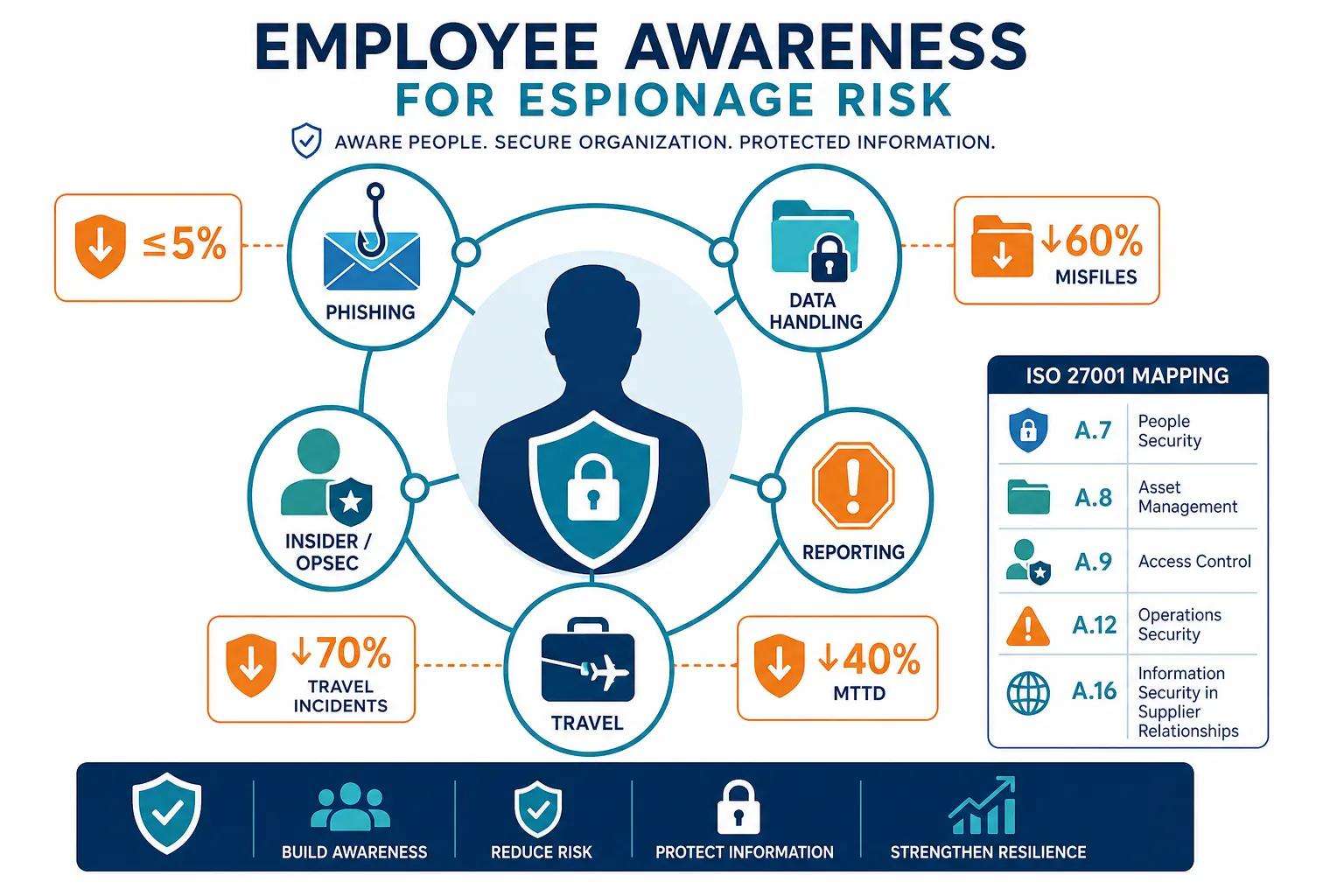
Introductory demonstration of training-to-outcome mapping precedes an implementation table that links modules to business impact and KPIs for decision-makers.
This table demonstrates how targeted modules convert into measurable business outcomes, providing a clear rationale for investment in awareness programs and the KPIs to track.
Employees and managers can operationalise mitigation through practical measures that any organisation can adopt immediately.
- Implement regular, role-based phishing simulations that replicate espionage tradecraft.
- Establish clear reporting channels and non-punitive policies for suspected espionage activity.
- Enforce data classification, least privilege access and routine access reviews.
- Train staff on OPSEC for travel and meetings, and on recognising recruitment or approach tactics.
These practical steps create a culture where suspicion is channelled into action and reporting, and the next focus is aligning these measures with cyber security controls to close technical gaps.
ACATO’s approach integrates counter-espionage expertise with awareness curricula designed to align training outcomes to ISO 27001 goals and operational requirements. As a consulting firm specialising in IT security, data protection and ISO certifications, ACATO offers tailored awareness training that emphasises counter-espionage scenarios, and their services are positioned to reinforce program governance and measurement. For organisations seeking specialist support, ACATO combines certification-aligned awareness modules with counter-espionage consulting to ensure training maps to compliance and operational risk reduction, supporting a clear path from awareness to demonstrable controls.
What Role Does ISO 27001 Play in Espionage Risk Mitigation?
ISO 27001 provides a formal information security management system (ISMS) framework that organises policies, controls and continual improvement to reduce espionage-related risks systematically. The mechanism is governance: ISO 27001 requires risk assessment, control selection and evidence of monitoring, which channel resources to protect assets and close human and technical pathways used in espionage. The benefit is twofold: practical controls reduce exposure, and certification signals maturity to partners and regulators. Mapping specific controls to espionage scenarios clarifies how compliance activities translate into operational defence.
Which ISO 27001 Controls Address Espionage and Insider Threats?
Relevant ISO 27001 control areas include human resource security, asset management, access control, cryptography, and incident management, each providing tangible mitigations for espionage vectors. A focused mapping helps security teams prioritise controls and implement concrete actions such as background checks aligned with HR processes, strict access reviews based on least privilege, and incident response playbooks for suspected espionage cases. The following table maps specific control clauses to espionage mitigation actions to make this mapping operational for practitioners.
This mapping clarifies how each control contributes to reducing espionage risk and provides practical starting points for security teams to operationalise ISO 27001.
How Does ACATO Support ISO 27001 Certification and Awareness Training?
ACATO provides ISO 27001 certification support combined with awareness training designed to align staff behaviour with ISMS requirements and counter-espionage priorities. Their documented offerings include certification support, development of required documentation, internal audits and tailored ISO 27001 awareness training that embeds espionage-specific scenarios within courses. This service model helps organisations integrate awareness into the ISMS lifecycle so training outcomes feed into risk treatment plans and audit evidence. ACATO also offers a free consultation to explain certification steps and costs, enabling organisations to evaluate resource needs and the alignment between training and compliance before committing to a programme.
How Should Organizations Implement Insider Threat Prevention Training?
Implementing insider threat prevention training requires a structured roadmap: assess risks, prioritise roles, design role-based content, deploy blended delivery, and measure outcomes to iterate. The mechanism is risk-driven design: assessments identify high-impact assets and threat vectors, which informs targeted modules that focus on behaviours linked to espionage. The benefit is efficient use of training resources and stronger protection where value and risk intersect. A clear implementation plan ensures that training is relevant, measurable, and integrated with monitoring and HR processes.
What Strategies Identify and Manage Insider Threats Effectively?
Effective strategies combine behavioural analytics, regular access reviews, and clear reporting and escalation workflows to detect and manage insider threats before they lead to espionage. Behavioural detection leverages baseline activity profiling and alerts on deviations, while access reviews ensure privilege creep is minimised; HR and security coordination supports investigations and remediation. Recommended response steps include immediate account suspension for confirmed compromises, evidence preservation for forensic analysis, and proportionate disciplinary or legal measures for malicious insiders. These layered strategies produce earlier detection and more consistent incident handling.
This table summarises detection-to-response pairings so security teams can match indicators with standard operating procedures and reduce time-to-contain.
Further research underscores the combined power of behavioral analytics and targeted cybersecurity training in effectively countering insider threats and sophisticated social engineering tactics.
Cybersecurity Training for Insider Threat & Social Engineering Mitigation
This study aims to examine the role of behavioral analytics and cybersecurity training in mitigating insider threats and social engineering tactics within Advanced Persistent Threat (APT) operations.
Mitigating Insider Threats and Social Engineering Tactics in Advanced Persistent Threat Operations through Behavioral Analytics and Cybersecurity Training, N Okika, 2025
How Can Tailored Training Enhance Employee Vigilance Against Espionage?
Tailored training increases relevance and retention by adapting scenarios, cadence and delivery to specific roles and sector threats, improving vigilance where it matters most. SMEs may prioritise practical data handling and simple reporting steps, government entities often require stricter OPSEC and travel security modules, while NGOs benefit from field-focused advice about working in high-risk environments; each customisation addresses the most likely espionage vectors for that audience. Delivery options—short microlearning modules, scenario workshops, or immersive simulations—should align with role constraints to maximise uptake. Tailoring also allows metrics to be role-specific, enabling targeted reinforcement where KPIs indicate persistent gaps.
What Are Best Practices for Cyber Security Awareness for Employees?
Cyber security awareness best practices combine technical hygiene, reporting discipline and continuous reinforcement so employees form habits that defend against espionage-driven cyber tactics. The mechanism is behavioural and technical alignment: training teaches secure behaviours while technical controls (MFA, monitoring) reduce the chance that a human error leads to exploitation. The benefit is fewer successful credential compromises, lower phishing success rates, and improved integration between people and security tooling. Organisations that make these practices routine see measurable improvements in security posture and faster investigative outcomes.
How Do Phishing and Social Engineering Tactics Relate to Espionage?
Phishing and social engineering are primary enablers of espionage because they harvest credentials, introduce malware or manipulate staff to reveal sensitive information. Attack flows often start with reconnaissance, proceed to a tailored social-engineering message, and culminate in credential capture or covert access to systems, enabling data exfiltration. Immediate red flags include unexpected requests for sensitive files, urgent tone with unusual delivery channels, and messages that bypass normal approval paths. Training should therefore focus on recognition, verification workflows and safe reporting to interrupt the attack chain early.
- Use multi-factor authentication on all privileged and externally accessible accounts.
- Maintain strict password hygiene and consider enterprise password managers for shared access.
- Keep devices patched, encrypt sensitive data at rest, and avoid using personal accounts for work tasks.
These practices, combined with reporting discipline, reduce the surface for espionage actors and lead naturally into choosing training methods that sustain behaviour change.
What Training Methods Improve Employee Response to Cyber Threats?
Effective training methods include blended learning that pairs microlearning, phishing simulations, scenario-based workshops and periodic assessments to reinforce behaviour over time. Microlearning delivers focused, repeatable modules that sustain retention; simulations provide safe, measurable tests of real-world responses; scenario workshops develop judgement in complex situations, and assessments supply KPI data for improvement. A recommended cadence mixes short monthly micro-modules with quarterly simulations and annual immersive exercises for high-risk roles. Evaluating effectiveness requires metrics such as simulation failure rates, reporting rates, and MTTD improvements to guide continuous refinement.
Indeed, studies confirm that practical experience, such as through simulations, significantly enhances employee resilience against phishing attacks compared to information alone.
Employee Phishing Awareness: Information vs. Simulated Experience
Cybersecurity cannot be ensured with mere technical solutions. Hackers often use fraudulent emails to simply ask people for their password to breach into organizations. This technique, called phishing, is a major threat for many organizations. A typical prevention measure is to inform employees but is there a better way to reduce phishing risks? Experience and feedback have often been claimed to be effective in helping people make better decisions. In a large field experiment involving more than 10,000 employees of a Dutch ministry, we tested the effect of information provision, simulated experience, and their combination to reduce the risks of falling into a phishing attack. Both approaches substantially reduced the proportion of employees giving away their password.
Informing, simulating experience, or both:
A field experiment on phishing risks, A Baillon, 2019
Why Choose ACATO for Espionage Risk Mitigation and Employee Training?
ACATO offers a combination of ISO 27001-aligned awareness training and specialist counter-espionage consulting tailored to organisations that need to connect staff behaviour to formal security controls. The value proposition emphasises expert-led certification support, training that maps to compliance and operational risk measures, and targeted counter-espionage services to investigate and remediate incidents. For organisations seeking external support, ACATO positions its services to build measurable security culture improvements while aligning with regulatory and certification requirements. The next section details the specific services they advertise so decision-makers can assess fit against their risk profile.

What Unique Counter Espionage Services Does ACATO Offer?
ACATO lists counter-espionage consulting, IT forensics, and awareness training as part of its service mix, each designed to address distinct stages of prevention and response. Counter-espionage consulting focuses on threat assessment and OPSEC improvements, IT forensics supports evidence collection and analysis after suspected incidents, and targeted awareness courses teach staff to recognise espionage tactics and follow reporting protocols. These services are presented as complementary: prevention through training, technical investigation through forensic services, and governance through certification support.
How Does ACATO Customize Training for SMEs, Government, and NGOs?
ACATO tailors training by adapting threat models, content emphasis and delivery formats to each audience: SMEs receive pragmatic, resource-efficient modules focused on immediate risks and operational data handling; government clients get stricter OPSEC, clearance-aligned scenarios and documentation support; NGOs and infrastructure providers obtain field-awareness and third-party risk modules tuned to operational contexts. This tailoring ensures relevance, improves engagement and delivers measurable KPIs aligned to each sector’s typical exposure and legal/compliance requirements. Organisations can begin with a free consultation to scope training needs, map modules to roles and estimate alignment with ISO 27001 certification steps and costs.