Comprehensive Guide to the ISO 27001 Risk Assessment Process

ISO 27001 Risk Assessment Process: A Comprehensive Guide to Identifying, Analyzing, and Treating Information Security Risks
Effective information security begins with a structured risk assessment process that identifies potential threats, quantifies their impact, and implements controls to safeguard critical assets. Organizations often struggle with fragmented assessments, unclear scopes, and inconsistent treatment strategies, leading to compliance gaps and exposure. This guide promises clarity by mapping each phase—from establishing context and scoping your ISMS to continuous monitoring—into six actionable steps. You will learn how to integrate an initial ISO 27001 gap analysis into your planning, build a comprehensive risk register, craft a Statement of Applicability, overcome common challenges, and align assessments with broader compliance frameworks.
What Are the Core Steps of the ISO 27001 Risk Assessment Process?
The ISO 27001 risk assessment process involves six core phases—context and scope, identification, analysis, evaluation, treatment, and ongoing review—that collectively ensure systematic protection of information assets.
Core Steps of the ISO 27001 Risk Assessment Process
The ISO 27001 risk assessment process is a systematic approach that involves six core phases: context and scope, identification, analysis, evaluation, treatment, and ongoing review. These phases work together to ensure the protection of information assets.
IT Governance, 5 Steps to an Effective ISO 27001 Risk Assessment (2023-07-29)
This source outlines the five key steps of the ISO 27001 risk assessment process, which aligns with the article’s description of the core phases.
How Do You Establish the Context and Scope for Risk Assessment?
Defining context and scope sets the boundary conditions for an ISO 27001 risk assessment by identifying organizational objectives, stakeholders, and applicable regulations. This phase relies on an initial ISO 27001 gap analysis to benchmark existing controls and determine where assessment efforts should focus. Key outputs include scope statements, risk criteria, and stakeholder registers that guide subsequent identification of threats and vulnerabilities.
Establishing Context and Scope
Defining context and scope is the initial phase of an ISO 27001 risk assessment, which involves identifying organizational objectives, stakeholders, and applicable regulations. This phase uses an initial ISO 27001 gap analysis to determine where assessment efforts should focus.
IT Governance, 5 Steps to an Effective ISO 27001 Risk Assessment (2023-07-29)
This source emphasizes the importance of establishing a risk management framework, which includes defining the organization’s context and scope, aligning with the article’s description of the initial phase.
What Is Involved in ISO 27001 Risk Identification: Assets, Threats, and Vulnerabilities?

Risk identification uncovers the relationships between assets, threats, and vulnerabilities to reveal potential breaches in confidentiality, integrity, and availability. A clear register of each element ensures no critical component is overlooked.
Risk Identification: Assets, Threats, and Vulnerabilities
Risk identification involves uncovering the relationships between assets, threats, and vulnerabilities to reveal potential breaches in confidentiality, integrity, and availability. A clear register of each element ensures no critical component is overlooked.
Advisera, ISO 27001 Risk Assessment, Treatment, & Management: The Complete Guide
This source supports the article’s explanation of risk identification by highlighting the need to identify assets, threats, and vulnerabilities.
Before presenting examples, the table below illustrates typical categories and their definitions:
| Asset Type | Characteristic | Example |
|---|---|---|
| Information | Sensitive data | Customer records |
| Software | Licensed applications | ERP system |
| Hardware | Physical devices | On-site servers |
| People | Roles and responsibilities | System administrators |
| Services | Operational processes | Payroll processing |
This breakdown ensures consistent identification across the organization and prepares the groundwork for quantitative and qualitative analysis.
How Is Risk Analysis Conducted: Assessing Likelihood and Impact?
Risk analysis quantifies each identified risk by evaluating the probability of occurrence and the potential severity of consequences. Qualitative methods use descriptive scales, while quantitative approaches assign numerical values to factors like financial loss or downtime.
Risk Analysis: Assessing Likelihood and Impact
Risk analysis quantifies each identified risk by evaluating the probability of occurrence and the potential severity of consequences. Qualitative methods use descriptive scales, while quantitative approaches assign numerical values to factors like financial loss or downtime.
IT Governance, 5 Steps to an Effective ISO 27001 Risk Assessment (2023-07-29)
This source supports the article’s explanation of risk analysis by emphasizing the need to analyze risks after they have been identified.
Below is a comparison of analysis approaches:
| Analysis Type | Characteristic | Application |
|---|---|---|
| Qualitative Analysis | Scales (e.g., low, medium, high) | Quick prioritization based on expert judgment |
| Quantitative Analysis | Numerical values (e.g., cost) | Precise risk scoring for financial decision-making |
These methods converge into risk levels that inform prioritization and guide treatment decisions.
How Do You Evaluate and Prioritize Risks According to ISO 27001?
Risk evaluation compares calculated risk levels against predefined risk acceptance criteria and organizational risk appetite. This step ranks risks so that limited resources target the most critical exposures first, ensuring that high-impact, high-likelihood risks receive immediate attention.
What Are the Options for Risk Treatment and Control Selection?
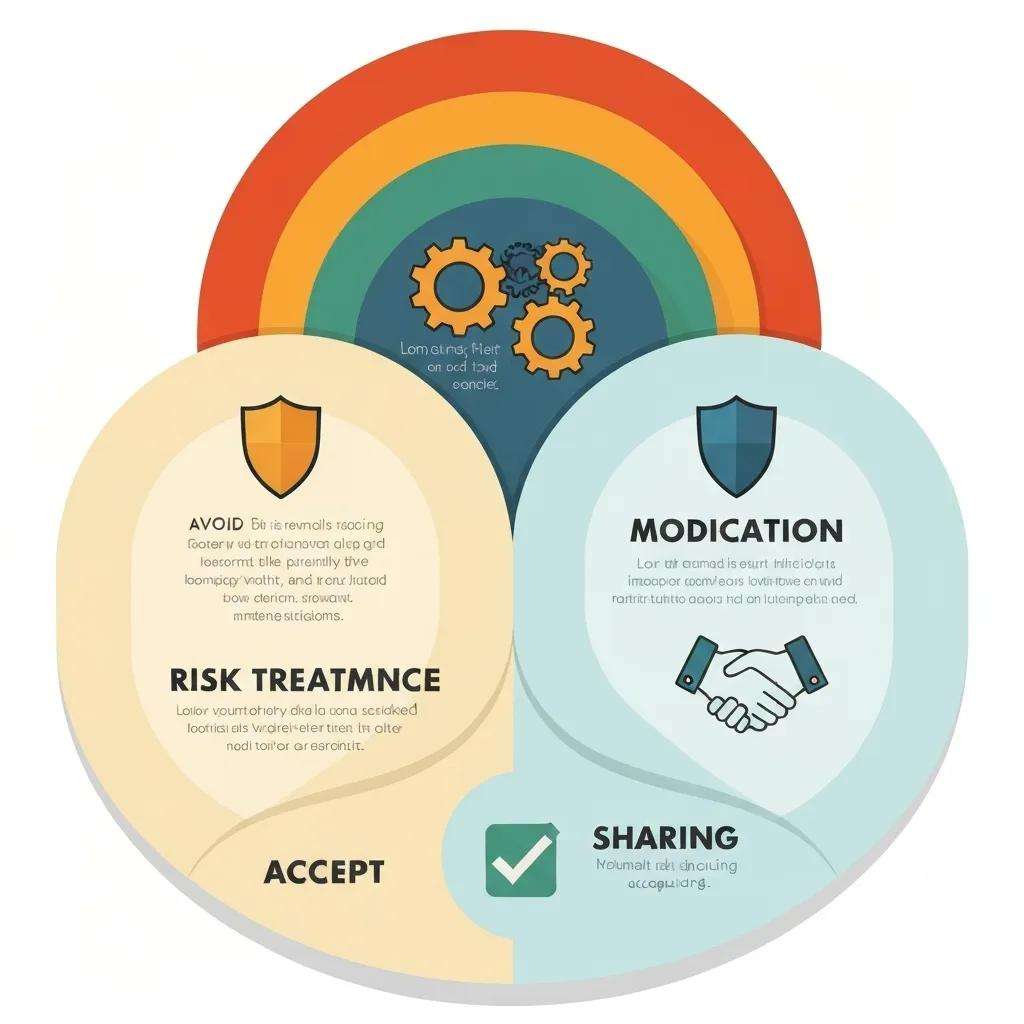
Risk treatment offers four strategic responses—avoid, modify, share, or accept—to balance risk reduction and operational requirements. Controls selected from ISO 27002 Annex A then mitigate identified risks.
- Avoid: Eliminate the activity or asset exposure entirely.
- Modify: Reduce likelihood or impact through technical, managerial, or procedural controls.
- Share: Transfer risk via insurance, outsourcing, or contractual agreements.
- Accept: Retain risk when it falls within tolerance levels.
Risk Treatment Options
Risk treatment offers four strategic responses—avoid, modify, share, or accept—to balance risk reduction and operational requirements. Controls selected from ISO 27002 Annex A then mitigate identified risks.
ISMS.online, Risk Treatment Methods in ISO 27001:2022
This source supports the article’s description of risk treatment options, which include avoidance, reduction, transfer, and acceptance.
These options enable organizations to develop a tailored risk treatment plan aligned with business objectives and compliance requirements.
How Do You Create and Use an ISO 27001 Risk Register and Statement of Applicability?
A risk register consolidates all assessment outputs, while the Statement of Applicability (SoA) documents selected controls and justifies their inclusion or exclusion.
Risk Register and Statement of Applicability
A risk register consolidates all assessment outputs, while the Statement of Applicability (SoA) documents selected controls and justifies their inclusion or exclusion.
OneTrust, What is Statement of Applicability?
This source supports the article’s explanation of the Statement of Applicability (SoA) as a core document required for ISO 27001 certification, which outlines the chosen controls and their justifications.
What Is the Purpose of the Risk Register in ISO 27001?
A risk register serves as the authoritative log of identified risks, their analysis results, evaluation decisions, and treatment plans. It provides transparency to stakeholders and guides ongoing monitoring and review activities.
How Do You Develop and Maintain the Statement of Applicability (SoA)?
The SoA lists every Annex A control, indicates whether it is implemented, and explains inclusion rationales. Maintaining the SoA requires periodic updates to reflect changes in scope, emerging threats, and control effectiveness assessments.
What Are Common Challenges and Best Practices in ISO 27001 Risk Assessment?
Organizations often face resource constraints, lack of stakeholder engagement, and inconsistent methodologies. Addressing these issues with structured frameworks and clear governance improves outcomes.
IT Governance, 5 Steps to an Effective ISO 27001 Risk Assessment (2023-07-29)
This source supports the article’s discussion of common challenges and best practices by emphasizing the importance of establishing a risk management framework.
What Implementation Challenges Are Typical in ISO 27001 Risk Assessment?
Common hurdles include difficulty in achieving comprehensive asset inventories, subjective likelihood estimates, and insufficient alignment between IT and business units. Cultural resistance to change can further delay treatment plan execution.
What Best Practices Ensure Effective Risk Assessment and Treatment?
- Cross-functional Teams: Involve stakeholders from IT, legal, and operations for balanced perspectives.
- Standardized Templates: Use risk register and SoA templates to ensure consistency.
- Regular Training: Equip staff with skills to identify evolving threats and vulnerabilities.
- Executive Reporting: Present risk dashboards to leadership for timely decision-making.
These practices build a culture of continuous improvement and ownership across the organization.
How Do You Monitor and Review Risks Continuously in ISO 27001?
Continuous Risk Monitoring
Ongoing risk management embeds continuous improvement into the ISMS, enabling prompt detection of changes in threat landscapes and control effectiveness.
Scytale, Continuous Monitoring and Frameworks: A Web of Security Vigilance (2023-04-03)
This source supports the article’s explanation of continuous monitoring as a proactive approach to identifying and addressing security risks.
What Are the Key Activities for Continuous Risk Monitoring?
Continuous monitoring involves automated alerts, periodic audits, incident trend analysis, and control performance reviews. These activities feed into the risk register to trigger reassessments when conditions change.
How Often Should Risk Reviews Be Conducted and Reported?
Risk reviews should occur at least annually or whenever significant organizational, technological, or regulatory changes arise. Reports to management ensure accountability and support timely updates to treatment plans.
How Can You Integrate ISO 27001 Risk Assessment with Your ISMS and Compliance Strategy?
Integrating Risk Assessment with ISMS and Compliance Strategy
Integrating risk assessment into the ISMS lifecycle promotes alignment between security controls, business objectives, and compliance obligations.
DSALTA, ISO 27001 Compliance: Long-Term Security
This source supports the article’s discussion of integrating risk assessment with the ISMS lifecycle to ensure long-term security and compliance.
How Does Risk Assessment Support ISMS Continuous Improvement?
Risk assessment results inform ISMS policy updates, corrective actions, and resource allocation, driving iterative enhancements in security posture and process maturity.
How Can ISO 27001 Risk Assessment Align with Other Frameworks Like GDPR and SOC 2?
Mapping risk assessment outputs to GDPR data protection requirements or SOC 2 trust service criteria streamlines audit readiness and reduces duplication of compliance efforts. This unified approach enhances overall governance, risk, and compliance efficiency.
Effective risk management transforms security from a reactive burden into a proactive enabler of business resilience. By following the ISO 27001 risk assessment process, organizations can systematically identify exposures, prioritize controls, and sustain continuous improvement. Integrating with gap analysis and complementary frameworks ensures a comprehensive compliance strategy that evolves with emerging threats. Consistent monitoring and stakeholder engagement cement a culture where security risk management drives strategic decision-making and long-term value creation.
Frequently Asked Questions
What is the importance of stakeholder engagement in the ISO 27001 risk assessment process?
Stakeholder engagement is crucial in the ISO 27001 risk assessment process as it ensures that all relevant perspectives are considered. Involving stakeholders from various departments, such as IT, legal, and operations, helps to identify potential risks more comprehensively. Their insights can lead to a more accurate risk identification and prioritization process, ultimately resulting in a more effective risk treatment plan. Engaged stakeholders are also more likely to support and adhere to the implemented controls, fostering a culture of security within the organization.
How can organizations ensure the effectiveness of their risk treatment plans?
To ensure the effectiveness of risk treatment plans, organizations should adopt a systematic approach that includes regular reviews and updates based on changing circumstances. This involves monitoring the performance of implemented controls, assessing their effectiveness, and making necessary adjustments. Additionally, organizations should provide ongoing training to staff to keep them informed about evolving threats and vulnerabilities. Engaging in continuous improvement practices, such as feedback loops and lessons learned sessions, can also enhance the overall effectiveness of risk treatment strategies.
What role does technology play in the ISO 27001 risk assessment process?
Technology plays a significant role in the ISO 27001 risk assessment process by facilitating data collection, analysis, and reporting. Automated tools can streamline the identification and evaluation of risks, making it easier to maintain an up-to-date risk register. Additionally, technology can enhance continuous monitoring efforts through real-time alerts and analytics, allowing organizations to respond promptly to emerging threats. By leveraging technology, organizations can improve the efficiency and accuracy of their risk assessments, ultimately leading to better-informed decision-making.
How can organizations measure the success of their ISO 27001 risk assessment implementation?
Organizations can measure the success of their ISO 27001 risk assessment implementation through various metrics, such as the reduction in identified risks, the effectiveness of controls, and compliance with established policies. Regular audits and assessments can provide insights into the performance of the risk management framework. Additionally, tracking incidents and breaches can help gauge the effectiveness of risk treatment plans. Feedback from stakeholders and staff can also serve as valuable indicators of the overall success and acceptance of the risk assessment process.
What are the benefits of integrating ISO 27001 risk assessment with other compliance frameworks?
Integrating ISO 27001 risk assessment with other compliance frameworks, such as GDPR or SOC 2, offers several benefits. It streamlines compliance efforts by reducing duplication of work and ensuring that all regulatory requirements are addressed in a cohesive manner. This integration enhances overall governance and risk management by providing a unified approach to compliance. Additionally, it can improve audit readiness and reduce the burden on resources, allowing organizations to focus on proactive risk management rather than reactive compliance measures.
What common mistakes should organizations avoid during the ISO 27001 risk assessment process?
Organizations should avoid several common mistakes during the ISO 27001 risk assessment process, such as neglecting stakeholder engagement, failing to maintain an up-to-date risk register, and not aligning risk assessments with business objectives. Additionally, relying solely on qualitative assessments without incorporating quantitative data can lead to inaccurate risk prioritization. Inadequate training for staff involved in the process can also hinder effectiveness. By recognizing and addressing these pitfalls, organizations can enhance the quality and reliability of their risk assessments.
Conclusion
Implementing the ISO 27001 risk assessment process empowers organizations to systematically identify and mitigate information security risks, enhancing overall resilience. By integrating this structured approach with ongoing monitoring and stakeholder engagement, businesses can ensure compliance and adapt to evolving threats effectively. Embrace the opportunity to strengthen your security posture and drive strategic decision-making. Discover more about our comprehensive resources and tools to support your ISO 27001 journey today.