
Enhance Security with a Robust Incident Management Approach
Incident Management Process: How to Effectively Respond to Security Incidents
Incident management is the structured process organizations use to detect, assess, contain, and recover from security incidents to minimize business impact and restore normal operations. A robust incident management process blends technical controls, documented playbooks, and practiced human decision-making so teams act quickly and coherently when a security incident occurs. This guide explains the incident response lifecycle, practical tasks for each phase, how ISO 27001 supports compliance, the role of digital forensics, team composition and coordination, incident-specific playbooks for ransomware, data breach, and phishing, and proactive monitoring including third-party risk. Readers will gain actionable checklists, EAV comparison tables, and clear criteria for when to escalate to external responders or forensic specialists. Throughout, we integrate best-practice signals such as SIEM/EDR telemetry, chain-of-custody preservation, and regulatory notification timing to strengthen resilience and shorten recovery times. The next section outlines the core lifecycle phases you should map in your incident response plan.
What Are the Key Phases of the Incident Response Lifecycle?
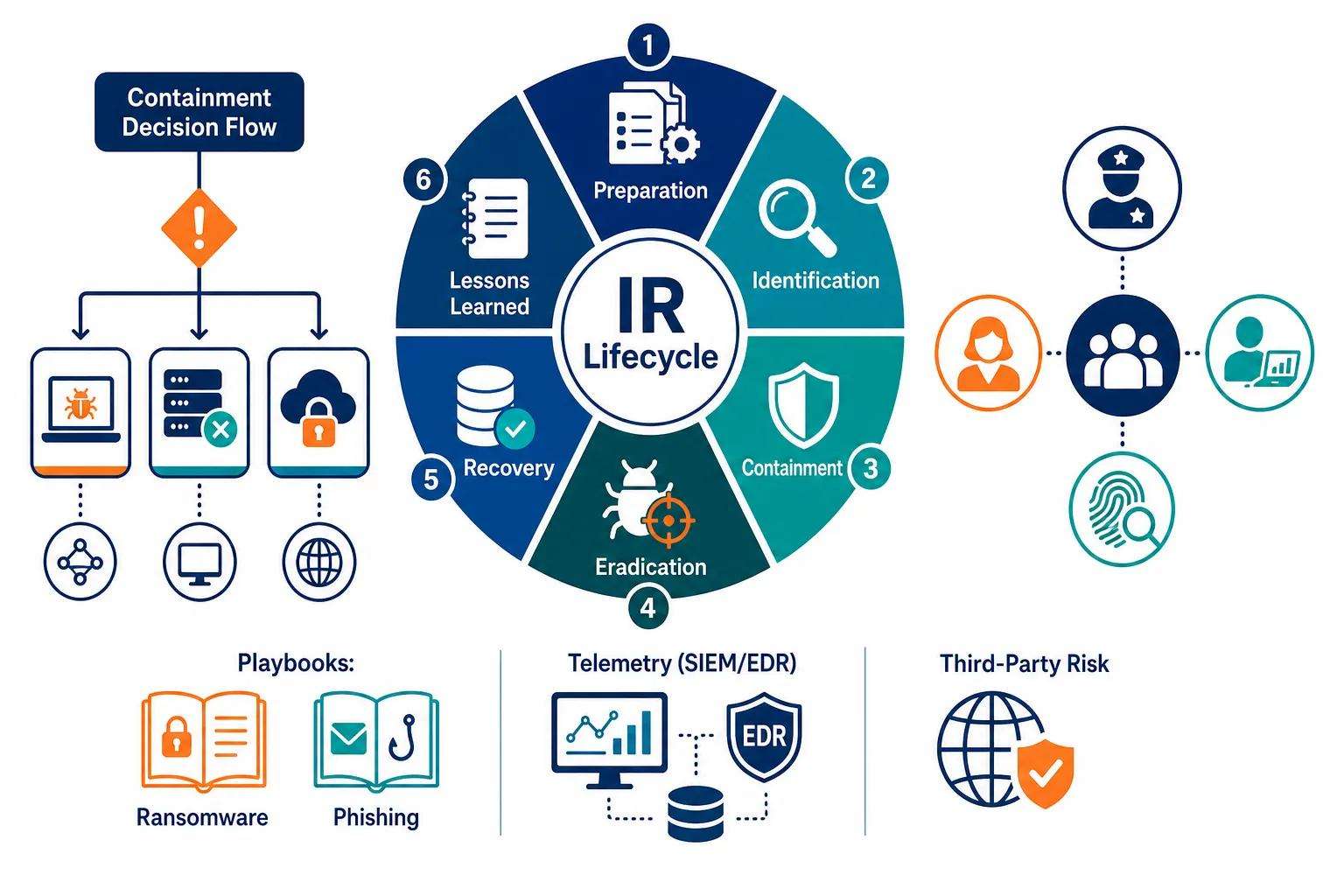
The incident response lifecycle is a six-phase sequence: Preparation, Identification, Containment, Eradication, Recovery, and Lessons Learned; each phase defines objectives, owners, and measurable outcomes to reduce time-to-detect and time-to-recover. Preparation builds policies, playbooks, and tooling to make detection effective; Identification determines whether an event is an incident and sets severity; Containment limits spread; Eradication removes root causes; Recovery restores services from known-good sources; Lessons Learned drives improvements and updates procedures. Implementing telemetry, automated alerting, and clear escalation thresholds speeds movement from Identification to Containment, improving overall resilience. The lifecycle framework below offers a concise, operational checklist to embed into tabletop exercises and runbooks so teams make predictable, auditable decisions during stress.
The six phases simplified for operational use:
- Preparation: Policies, tools, training, and forensic readiness to reduce the impact of future incidents.
- Identification: Detecting, validating, and classifying suspected incidents using telemetry and reports.
- Containment: Short-term and long-term actions to limit damage while preserving evidence.
- Eradication: Removing malware, fixing vulnerabilities, and remediating compromised credentials.
- Recovery: Restoring systems from clean backups and validating integrity before returning to service.
- Lessons Learned: Post-incident review to update controls, playbooks, and reporting for continual improvement.
Preparation is the foundation that makes the remaining phases faster and more reliable.
How Does Preparation Strengthen Incident Management?
Preparation is a combination of policy, tooling, training, and forensic readiness that reduces both the likelihood of incidents and the time required to resolve them. Well-crafted incident response plans and playbooks specify roles, escalation paths, and critical communications; tooling such as SIEM, EDR, and SOAR supply the telemetry and automation needed to shorten identification and containment time. Regular tabletop exercises and red-team drills validate assumptions, expose gaps, and embed muscle memory in the team while forensic readiness ensures evidence can be collected with minimal disruption. A short SME checklist helps translate these activities into practical cadence and priorities that inform procurement and training decisions.
Preparation checklist for SMEs:
- Documented playbooks and escalation paths: Clear owners and decision thresholds.
- Telemetry and logging strategy: SIEM/EDR coverage for critical assets and user activity.
- Exercise schedule: Tabletop and technical drills at least twice yearly.
These preparedness activities directly improve detection quality, which leads to faster and more accurate identification.
What Are the Steps in Identification and Detection of Security Incidents?
Identification starts with telemetry, user reports, and alerts that must be triaged to separate noise from actionable incidents and assign severity. Effective triage uses predefined severity criteria, threat intelligence correlation, and immediate evidence capture such as volatile memory or logs to preserve the state for later forensic analysis. Analysts should follow a decision tree that includes quick-impact containment for high-severity incidents and escalation to incident command for broader organizational impact. Ensuring identification feeds into the containment plan prevents ad-hoc responses and reduces the window of exposure.
Key detection sources to monitor include SIEM alerts, EDR behavioral detections, and user-reported anomalies; these sources feed triage workflows that determine escalation to containment.
How Should Containment Strategies Be Applied During an Incident?
Containment balances speed and evidence preservation with continuing business operations, differentiating short-term isolation from long-term remediation and segmentation. Short-term containment typically isolates infected hosts or accounts to stop lateral movement, while long-term containment implements network segmentation, patching, and credential rotation to prevent recurrence. Choosing between isolation and monitoring depends on operational impact, evidence needs, and the incident’s propagation risk; sometimes monitored containment preserves forensic data while preventing further compromise. A comparison of containment approaches helps decision-makers weigh trade-offs and select tools that align with continuity objectives.
Intro to containment approaches and when to use them.
This comparison clarifies that short-term isolation is best for fast mitigation, while segmentation and monitored approaches support business continuity and forensic integrity.
What Are Effective Eradication Techniques to Remove Threats?
Eradication removes the root cause and residual artifacts so systems can be returned to a trusted state through targeted remediation and validation. Typical eradication steps include malware removal, credential resets, applying security patches, revoking or rotating compromised keys, and validating that persistence mechanisms have been removed from endpoints and infrastructure. Verification should combine automated rescans with manual validation of logs and system integrity checks to confirm threats are eradicated before initiating recovery. Proper eradication reduces the chance of reinfection and informs improvements in detection and prevention controls.
Eradication work must be coordinated tightly with recovery planning to ensure fixes are validated before systems are restored.

How Is Recovery Managed to Restore Systems Safely?
Recovery focuses on returning services to normal in a controlled, phased manner using validated backups, hardened rebuilds, and stepped monitoring to detect re-emergence of malicious activity. Best practice separates restoration into phases: bring non-critical systems online first, validate through functional and security testing, then progressively restore critical services while monitoring for anomalies. Using known-good backups, ensuring cryptographic integrity, and running acceptance tests reduces the risk of restoring compromised data. Recovery plans should define timelines and acceptance criteria tailored to severity levels so stakeholders have clear expectations during restoration.
A structured recovery timeline reduces business disruption and creates checkpoints that validate system integrity before full service reinstatement.
Why Are Post-Incident Activities and Lessons Learned Critical?
Post-incident activities capture root causes, process failures, and control gaps and convert them into concrete improvements such as updated playbooks, additional controls, or modified training. A formal lessons-learned review should collect timelines, evidence, decisions, and KPIs like MTTD and MTTR, and conclude with an action register assigned to owners with deadlines. Regulatory and contractual reporting obligations (for example under sector-specific rules) must be documented as part of the post-incident package to support audits and potential legal processes. Lessons learned closes the loop on the lifecycle by feeding improvements into preparation and detection capabilities.
External incident response providers can support each lifecycle phase by offering specialist containment, forensic capture, remediation support, and facilitated tabletop exercises; engaging an external partner is especially valuable when internal capacity is limited. ACATO provides incident response, digital forensics, and cyber attack monitoring services and can run tabletop exercises or review incident plans during a free consultation to help organizations strengthen their lifecycle implementation.
How Does ISO 27001 Support Incident Management and Compliance?
ISO 27001 requires organizations to embed incident management within their ISMS as part of risk treatment and continual improvement, specifying processes for detection, reporting, assessment, and response. The standard drives documented procedures, defined roles, and audit evidence which creates repeatable, auditable incident handling that satisfies many regulatory and contractual stakeholders. Aligning incident response playbooks with ISO clauses helps organizations demonstrate preparedness to auditors and reduces friction during compliance reviews. Practical steps to align with ISO include mapping playbooks to clause requirements, recording incidents and corrective actions, and integrating incident KPIs into ISMS metrics.
ISO 27001 alignment gives auditors and stakeholders confidence that incident processes are managed systematically and that lessons learned feed continual improvement.
What Are ISO 27001 Incident Response Requirements?
ISO 27001 expects documented incident handling processes that define detection, reporting, escalation, and corrective action mechanisms and evidence retention for audits. Clauses require organizations to maintain incident records, evaluate impacts, and undertake corrective actions while integrating those actions into the ISMS risk register and controls. For auditors, evidence such as incident logs, post-incident reports, and updated procedures demonstrates compliance and operational maturity. Practical steps include creating an incident register template, defining reporting timescales, and ensuring evidence preservation policies are in place.
To prepare for certification or surveillance audits, maintain incident artifacts that clearly map to ISO clauses and show traceable corrective actions and outcomes.
How Can Organizations Achieve Resilience Through ISO 27001?
ISO 27001 drives resilience by requiring risk-driven controls, business continuity integration, and regular management review of incident metrics to inform improvement. By combining ISMS processes with BCP/DR plans and measurable indicators like MTTD and MTTR, organizations can quantify resilience improvements over time. Continual improvement cycles—Plan, Do, Check, Act—ensure incident learnings are implemented, verified, and refined. Mapping ISMS controls to technical controls such as SIEM and EDR creates operationalized resilience that auditors and business leaders can measure.
Aligning security controls with ISO processes transforms ad-hoc response into measured resilience that reduces recovery times and regulatory risk.
How Does ISO 27001 Align With Other Standards Like NIST and NIS 2.0?
ISO 27001 maps well to NIST SP 800-61 and NIS 2.0; while ISO focuses on management system requirements, NIST offers operational playbooks and NIS 2.0 adds specific reporting obligations for critical sectors. Crosswalking clauses and processes reveals equivalent expectations—incident logging, escalation, evidence retention, and notification—which simplifies compliance when organizations operate under multiple frameworks. Harmonizing controls reduces duplication and ensures teams can respond to incidents in a way that satisfies auditors, regulators, and customers simultaneously. Use simple mapping tables to show where ISO controls correspond to NIST steps and where NIS 2.0 requires mandatory notifications.
If you need help aligning ISO incident processes to operational playbooks and preparing for certification, ACATO offers ISO 27001 certification support and can perform a gap analysis to identify missing incident controls; a free consultation can prioritize remediation and compliance actions.

What Role Does Digital Forensics Play in Incident Response?
Digital forensics provides objective evidence, a reproducible timeline, and technical attribution to support eradication, legal action, and regulatory reporting, making it an essential capability for incidents where evidence integrity matters. Forensics aims to collect, preserve, and analyze artifacts such as disk images, volatile memory, logs, and network captures under a strict chain-of-custody to ensure admissibility and defensibility. Forensic activities inform root-cause analysis, identify attacker techniques, and support transparent reporting to stakeholders and authorities. Being forensics-ready reduces disruption by predefining collection points and escalation triggers so investigations proceed smoothly when incidents occur.
When to engage forensics depends on impact, regulatory obligations, and potential legal action; timely forensic engagement preserves evidence and accelerates root-cause identification.
How Are Digital Forensics Investigations Conducted During Security Incidents?
Forensic investigations typically follow phases: scoping, evidence acquisition, analysis, reporting, and chain-of-custody documentation to ensure findings are reproducible and defensible. Scoping defines objectives and legal constraints; acquisition uses bit-for-bit imaging and memory capture; analysis reconstructs timelines and identifies IOCs; reporting summarizes findings with technical appendices. Typical artifacts include disk images, memory dumps, logs, network captures, and authentication records which analysts correlate to build an attack narrative. Timelines depend on complexity but initial evidence acquisition should occur immediately to preserve volatile data and enable timely eradication.
Forensic processes must be coordinated with containment to avoid destroying evidence and with legal advisors to respect privacy and reporting obligations.
ACATO’s digital forensics capability can be engaged as a specialist resource to perform evidence capture and analysis under controlled chain-of-custody procedures; organizations can book a forensic readiness review via a free consultation to evaluate current collection, storage, and reporting practices.
How Does Forensics Support Evidence Collection and Legal Compliance?
Forensics underpins legal and regulatory responses by maintaining chain-of-custody, documenting analysis steps, and producing formal reports suitable for regulators or litigation. Chain-of-custody logs record who collected evidence, how it was stored, and when it was analyzed, which is critical for admissibility and audit trails. Forensic teams also advise on data privacy implications (for example handling personal data during an investigation) and on timing of regulatory notifications based on evidence scope. Balancing evidence collection with business continuity requires planning but ensures that organizations can meet legal obligations without unnecessary operational damage.
Careful forensic documentation simplifies regulatory reporting, reduces legal risk, and supports insurance or law enforcement engagement when necessary.
How Can Organizations Build an Effective Incident Response Team?
An effective incident response team combines clear leadership, technical analysis, communications, and legal coordination so incidents are resolved quickly with appropriate stakeholder engagement. Team composition should reflect the organization’s size and risk profile; SMEs commonly use a lean internal core supplemented by external specialists for forensics or specialized remediation. Defining roles, responsibilities, and escalation paths in a roles matrix ensures people know what to do under stress and enables rapid onboarding of external responders. Regular training, runbooks, and exercises validate coordination across functions and sharpen decision-making during real incidents.
Below is an EAV-style roles table to help SMEs map people to functions and decide where to outsource.
What Are the Key Roles in Incident Management Teams?
Key roles include an Incident Commander to make high-level decisions, analysts to perform technical triage and containment, a forensics specialist for evidence handling, and communications/legal leads to manage external messages and regulatory obligations. Each role has specific deliverables such as an incident timeline, containment checklist, forensic report, and notification documentation that support auditable response. SMEs should consider outsourcing complex forensic or remediation tasks while keeping strategic command in-house to preserve operational knowledge and accountability. Training and regular exercises help team members practice handoffs and decision-making and reduce confusion during real events. Assigning clear role backups and external vendor contacts ensures continuity if primary personnel are unavailable.
How Should Teams Coordinate During a Security Incident?
Teams should adopt an incident command structure with clear communication channels, regular status updates, and predefined stakeholder notifications to manage complexity and reduce confusion. A simple cadence of check-ins, an incident timeline document, and escalation thresholds keeps everyone aligned and limits ad-hoc decision-making; external liaison procedures with law enforcement or regulators should be pre-authorized where possible. Communication templates for internal updates and public statements speed outreach and ensure consistent messaging. Coordination with vendors and managed service providers should be rehearsed via supplier-inclusive tabletop exercises to validate third-party response obligations. A well-practiced coordination plan reduces internal friction and enables faster, more consistent incident resolution.
What Are Best Practices for Handling Specific Security Incidents?
Practical playbooks for common incident types streamline immediate actions, triage, and escalation so teams can act decisively while preserving evidence and continuity. Best practices include predefined checklists for ransomware, data breaches, and phishing that set immediate containment steps, forensic collection points, and notification thresholds. Each incident type also has clear escalation criteria for when to isolate systems, engage external responders, or notify regulators. Below are practical checklists and a table mapping incident types to triage actions to help operational teams jumpstart response. Ransomware, data breach, and phishing playbooks offer targeted checklists that reduce decision time and support consistent execution.
How Should Organizations Respond to Ransomware Attacks?
Ransomware response begins with isolating infected hosts, preserving volatile evidence for forensics, and validating backups before any restoration actions. Immediate actions include network segmentation, EDR-based containment, and capturing memory/logs to enable root-cause analysis while avoiding hasty file deletions that destroy evidence. Decisions about negotiation versus restore require legal, insurance, and executive input; meanwhile, technical teams should prioritize restoring from known-good backups and rotating compromised credentials. When to call external responders: engage incident response and forensic specialists immediately if critical systems are affected, backups are suspect, or legal/regulatory consequences are likely.
Ransomware triage checklist:
- Isolate infected systems and preserve volatile data.
- Capture forensic artifacts (memory, disk images, logs).
- Validate backups before restoration and rotate credentials.
This table gives quick-reference actions and escalation triggers for common incidents.
What Are Effective Strategies for Data Breach Incident Management?
Data breach management focuses on containing exfiltration, scoping affected datasets, performing impact assessments, and meeting notification timelines mandated by regulation or contractual obligation. Initial steps include preserving logs, identifying affected systems and data, and conducting a data subject impact assessment where personal data is involved; legal and communications leads should be engaged early for messaging and regulator notifications. Timely digital forensics helps determine scope and supports evidence for notifications; remediation includes closing exfiltration vectors and strengthening controls to prevent recurrence. When to call external responders: bring in forensic and legal specialists if the breach involves sensitive personal data, unknown exfiltration routes, or potential litigation.
Notification checklist:
- Identify data types exposed and affected subjects.
- Determine regulatory reporting timeframes and responsible persons.
- Prepare notification templates and legal review.
How Can Phishing Incidents Be Managed and Mitigated?
Phishing response requires immediate containment of compromised accounts, credential resets, scanning for lateral movement, and organization-wide sweeps for similar messages or correlated activity. Short-term actions include disabling affected accounts, forcing password resets, and revoking sessions; longer-term measures include implementing or enforcing multi-factor authentication, improving mail-filtering rules, and running targeted awareness campaigns. Post-incident metrics should track click rates, click-to-report times, and account compromise recurrence to measure mitigation effectiveness. When to call external responders: consult external incident response if phishing led to privilege escalation, lateral compromise, or if forensic reconstruction of attacker activity is required.
Preventive controls and user training reduce repeat incidents and improve detection rates across the organization.

Establishing a Robust Incident Management Process
Proactive monitoring increases early detection through layered telemetry while third-party risk management brings suppliers into incident plans so supply-chain attacks are handled smoothly. Continuous monitoring using SIEM, EDR, and threat intelligence reduces mean time to detect by aggregating signals and enabling correlation and automated playbooks. Vendor risk management ensures contractual obligations for incident reporting, escalation, and remediation are clear and tested through supplier-inclusive tabletop exercises. Integrating third-party scenarios into response plans prevents confusion during cross-organizational incidents and reduces time-to-containment when suppliers are implicated.
What Are Cyber Attack Monitoring and Early Detection Strategies?
Early detection combines comprehensive telemetry (endpoint, network, authentication logs), automated correlation, and proactive threat hunting to spot anomalies and attacker behaviors before large-scale impact. Key telemetry sources include EDR endpoint data, network flow logs, authentication logs, and application logs; SIEM aggregates these signals while SOAR automates initial triage and containment actions. Monitoring KPIs such as MTTD, alert volume, and false-positive rates guide optimization and resourcing decisions; regular threat-hunting exercises complement automated controls by uncovering stealthy behaviors. SMEs should prioritize telemetry that covers critical assets and user privilege boundaries to get the highest signal-to-noise ratio.
A blend of automation, telemetry, and human-led hunting shortens detection windows and improves response quality.
How Should Third-Party Risks Be Managed Within Incident Response Plans?
Third-party risk management requires contractual incident clauses, supplier segmentation, and regular assessments plus rehearsals that include key vendors so joint responses are predictable and compliant. Contracts should specify notification timelines, responsibilities for containment and remediation, evidence sharing requirements, and confidentiality safeguards. Supplier assessments should prioritize critical vendors and require proof of controls such as logging, backup, and patching. Regularly exercising incident scenarios with suppliers validates assumptions and clarifies points of contact, reducing delays during real incidents.
Vendor clause checklist:
- Define incident notification timeline and points of contact.
- Require evidence preservation and cooperative forensic access.
- Include remediation responsibilities and SLAs for containment support.
These supplier-level controls reduce coordination friction and accelerate resolution when third parties are implicated.
This article has outlined a practical, ISO-aligned incident management process, operational checklists for each lifecycle phase, the role of digital forensics in preserving evidence and legal readiness, team structures with role mappings, incident-specific playbooks for ransomware, data breach, and phishing, and proactive monitoring and third-party risk controls. For organizations seeking specialist support, ACATO offers services including Incident Response, Digital Forensics, IT Security Consulting, IT Security Audits, and Cyber Attack Monitoring; a free consultation can help assess incident readiness, run tabletop exercises, or scope an incident response retainer.