
Making Security Training Engaging Through Storytelling
Leveraging Storytelling for Effective Cybersecurity Awareness
Storytelling in security training uses narrative structure to make cybersecurity concepts memorable, relatable, and actionable for everyday staff, turning abstract policies into vivid scenarios that prompt safer behaviour. A short example: a single anonymized phishing story about an office administrator who nearly authorised a fraudulent invoice frames the human and procedural gaps that technical slides rarely convey. This article explains why narrative methods outperform conventional slide-based awareness, how narratives map to ISO 27001 and ISO 27701 awareness requirements, and practical templates for crafting stories that change behaviour. Readers will get step-by-step guidance on integrating real incident case studies, anonymization best practices, and measurement approaches that show improved engagement and audit-ready evidence. Finally, we outline audience-specific tailoring for SMEs, government bodies and NGOs and show which KPIs to track so teams can prove training impact and iterate effectively.
Why Is Storytelling Essential in Cybersecurity Awareness Training?
Storytelling in cybersecurity awareness training is the deliberate use of narrative elements—characters, conflict, escalation and resolution—to teach security principles through context that people remember and act on. Narratives work by engaging emotions and attention, encoding events into episodic memory and creating retrieval cues that support correct choices under pressure. Recent studies and practitioner experience indicate story-driven learning raises attention and retention versus dry directives, and it directly addresses the human element that underlies most breaches. The result is improved recall, greater empathy for affected stakeholders, and clearer behavioural prompts that reduce risky actions and improve reporting. This sets up the mechanisms we examine next, including cognitive principles and specific engagement tactics that training teams can use to design memorable security stories.
Indeed, research consistently highlights the limitations of conventional training methods and the superior effectiveness of narrative approaches in fostering genuine cybersecurity awareness and behavioral change.
Storytelling for Cybersecurity Awareness & Behavior Change
This review identified delivery methods [8], within the research field of technology-enhanced learning, that address, by the introduction of storytelling approach, the spread of cybersecurity education, leading to increased awareness and engagement on cybersecurity issues. It confirms that traditional forms of education focusing solely on knowledge transmission are not well suited for developing learning and understanding in a highly dynamic area such as cybersecurity. These delivery methods aim at developing cybersecurity awareness through the storytelling approach, expanding the notion of “being secure” to that of “acting securely”.
Spreading Awareness Cybersecurity via Storytelling: A Systematic Literature Review, J Andriessen, 2024
How Does Storytelling Improve Engagement and Retention in Security Training?
Storytelling improves engagement and retention by activating emotion, situating facts in concrete contexts, and creating mental models learners can rehearse later. Emotion increases attention and consolidates memory traces, while contextual details — who, where, and why — provide retrieval hooks for episodic recall in operational moments. For example, a short story about a credential-stuffing attack tied to a vendor login creates a scenario employees can mentally simulate, raising the likelihood they will spot similar warning signs. This procedural memory formation is stronger than memorizing rules because it links action sequences to consequences and signals when to escalate. Understanding this mechanism leads naturally into the psychological theories that explain narrative effectiveness.

What Psychological Principles Make Narrative Security Training Effective?
Several psychological theories explain why narrative security training changes behaviour: narrative transportation, social learning, and cognitive load reduction all play complementary roles. Narrative transportation describes how immersion in a story leads learners to adopt the perspectives and emotions of characters, increasing empathy for victims and motivation to follow safe procedures. Social learning theory shows that modelling desirable behaviours in stories (heroes who report suspicious emails) encourages imitation, while reducing cognitive load by packaging complex processes into manageable sequences improves comprehension and recall. These principles inform training design choices such as character selection, pacing, and the balance between technical detail and human consequences.
How Can ACATO Integrate Storytelling into ISO 27001 and ISO 27701 Awareness Training?
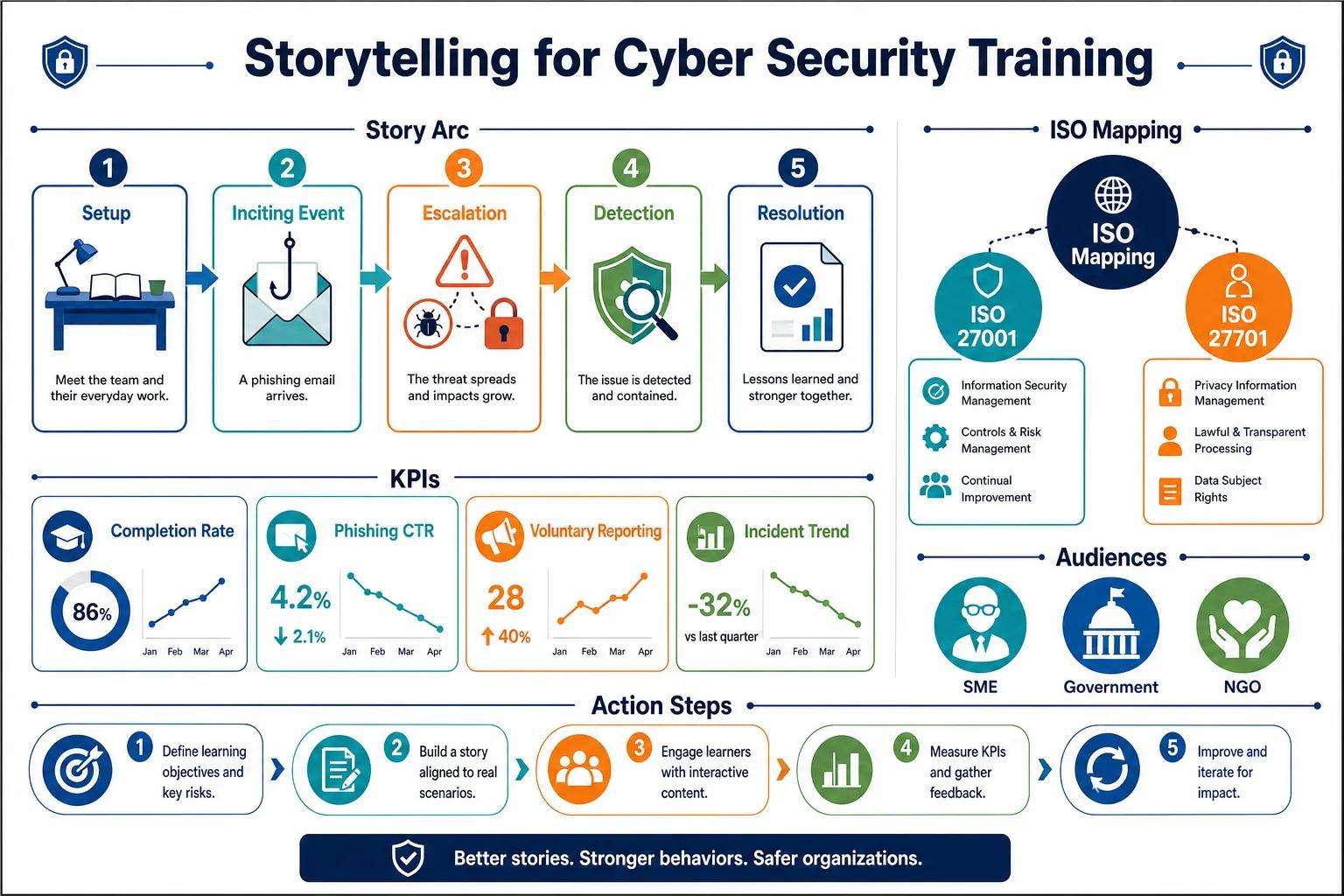
Integrating storytelling into ISO-focused awareness training aligns narrative objectives with the specific learning outcomes auditors expect: evidence of awareness, competence, and management commitment. A stepwise approach works well: identify common incident archetypes and compliance gaps, anonymize for privacy, craft short story modules mapped to ISO clauses, deliver via mixed modalities, and capture evidence such as attendance, assessment results and incident trends. This method ensures story content supports certification objectives while improving staff behaviour. The following list outlines the implementation steps teams can adopt when embedding narratives into ISO programmes.
- Identify incidents: Gather recurring incident types and near-misses as the basis for stories.
- Anonymize and map: Remove identifying details and map each story to relevant ISO clause objectives.
- Design modules: Create short, role-specific stories with clear behavioural prompts and assessment checkpoints.
- Deliver and measure: Use blended delivery and collect audit-ready evidence (completion, scores, incident trends).
These implementation steps demonstrate how narratives satisfy both educational needs and the documentary requirements auditors seek, and they lead directly into the specific ISO training requirements that shape module design.
What Are the ISO 27001 and ISO 27701 Training Requirements Explained?
ISO awareness requirements emphasise that personnel must understand information security and privacy obligations, their roles in risk management, and how to follow policies and procedures, with evidence retained for audits. For ISO 27001, relevant clauses require that top management ensure competence and awareness across the organisation, and for ISO 27701 the emphasis is on privacy information management and related governance duties; both expect documented training activities and records. Storytelling satisfies these requirements when modules clearly map learning objectives to clause language, include attendance and assessment records, and demonstrate ongoing reinforcement. Training evidence that pairs narrative modules with quizzes, incident-response exercises and documented management review creates a richer audit trail than attendance lists alone.
How Does Storytelling Enhance Compliance and Certification Success?
Storytelling enhances compliance and certification success by increasing retention and providing tangible artefacts that show learning outcomes and cultural change. Engaging narratives increase assessment performance and voluntary reporting rates, which can reduce incident frequency over time and produce measurable trends auditors value. Moreover, story-based artifacts—module scripts, anonymized incident narratives, assessment results and follow-up actions—illustrate management commitment and an active awareness programme. Presenting these items during certification assessments helps demonstrate continual improvement and a learning culture rather than a checkbox training approach, which auditors increasingly recognise as a sign of mature information security governance.

What Are the Key Elements of Crafting Compelling Cybersecurity Stories?
Compelling cybersecurity stories combine clear characters, a focused conflict, escalation that reveals decision points, resolution demonstrating correct actions, and a concise lesson with a behavioural prompt. These elements work together to produce narrative transportation and social learning effects while keeping cognitive load manageable for diverse audiences. Effective stories are short, role-specific, and end with a single clear action the learner should take when faced with a similar situation. The table below compares core story elements, their pedagogical role, and typical examples to help designers map narrative components to learning objectives.
This comparison clarifies how each narrative part maps to a training objective, enabling teams to design stories with targeted outcomes. Understanding these components leads to practical character guidelines and arc templates.
Who Are the Characters and What Roles Do They Play in Security Narratives?
Characters are archetypes that map to learner identities and illustrate consequences; typical types include the hero (staff who follow policy), the victim (person or data affected), the attacker (threat actor), the bystander (colleague who can help) and the responder (IT or forensics team). Each archetype serves a pedagogical function: the hero models desired action, the attacker reveals tactics, the victim evokes empathy and consequence, the bystander shows escalation pathways, and the responder demonstrates containment and learning. Short example lines can clarify roles, such as describing a hero who notices a suspicious invoice and escalates it, which sets up discussion of approval workflows. These archetypes make stories relatable across roles and help learners see themselves in scenarios, which improves transfer to real work.
How to Structure Conflict, Resolution, and Lessons Learned in Security Stories?
A practical story arc follows setup → inciting event → escalation → detection → resolution → lesson, with pacing tuned so technical detail supports rather than obscures behavioural lessons. Start with a brief context-setting sentence about role and environment, present a single inciting event that creates a decision point, show escalation to reveal systemic gaps, describe detection and containment steps, and end with a clear lesson and one-sentence behavioural instruction. Embedding an explicit call-to-action—what the learner should do in the next 24 hours—turns a story into a prompt for immediate behaviour change. Balancing human detail with minimal technical jargon ensures stories remain accessible while still connecting to policy and technical controls.
How Can Real-Life Cyber Incident Stories Make Security Training More Relatable?
Real-life, anonymized incident stories grounded in forensic analysis connect training directly to organisational risk and show the real-world consequences of everyday choices, increasing perceived relevance. Unlike hypothetical scenarios, incident-based narratives include root-cause details and remediation steps that feed directly into actionable lessons and simulation design. Careful anonymization preserves confidentiality while keeping the causal sequence intact, enabling learners to understand how chain-of-events lead to breaches. Below is a table listing common anonymized incident types, primary cause, and the training lesson each story should deliver to convert forensic insight into learning outcomes.
This mapping shows how forensic findings translate into concise lessons and prompts for learners. Including such stories makes training feel immediate and applicable, which in turn increases motivation to change behaviours.
What Are Examples of Anonymized Cybersecurity Incidents for Training?
Below are concise anonymized incident summaries suitable for short training modules, each paired with a clear learning takeaway and suggested learner activity. First, a phishing invoice prompts the lesson of verification workflows and a role-play where participants practice vendor validation. Second, credential stuffing on a third-party portal highlights MFA and password reuse with an interactive password audit exercise. Third, a misconfigured cloud share that exposed documents teaches access-review routines and includes a hands-on checklist exercise. These concise mini-cases convert forensic patterns into classroom activities that reinforce the exact behaviours organisations need to adopt.
How Do Incident Response Lessons Translate into Behavioral Change?
Incident response lessons translate into behaviour change by converting forensic insights into repeatable scripts, drills and reminders that embed new routines into daily work. The translation pipeline typically flows from forensic analysis (what happened and why) to an anonymized story, to a training activity (simulation or role-play), to reinforcement (microlearning nudges and periodic simulations), and finally to KPI measurement. Reinforcement mechanisms like short follow-up quizzes and simulated phishing tied to the original story help consolidate learning and make safe behaviours habitual. This pipeline produces measurable behavioural shifts when combined with management support and visible process changes.
How to Tailor Storytelling-Based Security Training for SMEs, Government, and NGOs?
Tailoring storytelling-based security training requires aligning story complexity, delivery format and reinforcement cadence with audience constraints such as budget, regulatory demands and staff roles. SMEs often need concise, low-cost modules that target high-impact behaviours like phishing detection and vendor validation; government and NGOs may require scenario depth, role-based exercises and documentation suitable for audits and stakeholder reporting. Designing modular story libraries—short micro-stories for broad staff, and longer scenario workshops for critical roles—balances reach and depth. The following list summarises audience-specific priorities and practical adjustments training designers should consider.
- SMEs: Prioritise high-frequency risks, use microlearning and low-cost role-plays to achieve quick improvements.
- Government/NGOs: Emphasise scenario depth, cross-stakeholder exercises, and detailed documentation for compliance and oversight.
- All audiences: Use anonymized real incidents, reinforce with simulations, and keep lessons single-action focused.
These targeted priorities help organisations deploy story-based training that fits organisational capacity and regulatory expectations, and they lead to audience-specific module examples and cadence recommendations described next.

What Unique Cybersecurity Challenges Do SMEs Face?
SMEs commonly face resource constraints, limited in-house security expertise, and supplier chain risk, making them vulnerable to opportunistic attacks like phishing and credential abuse. Stories for SMEs should therefore be short, highly relevant, and focused on ageing systems, third-party interactions and straightforward escalation steps that staff can implement without specialist tools. Low-cost delivery such as short videos, email micro-stories, and brief team tabletop exercises deliver high impact. Prioritising story topics by frequency and potential impact ensures small teams spend time on narrative modules that reduce the greatest near-term risk.
What Best Practices Enhance Security Awareness for Government and NGOs?
Government and NGO environments require layered communications, clear stakeholder engagement and audit-quality documentation; storytelling programmes should support these needs with structured scenario workshops, cross-team story development sessions and scenario libraries mapped to regulatory requirements. Use larger, facilitated exercises to rehearse complex incident coordination, and produce documented artefacts—exercise reports, after-action reviews and training records—that demonstrate both learning and oversight. Sustained reinforcement through senior leadership narratives and policy-linked stories helps embed cultural expectations and shows auditors that awareness activity is an ongoing management priority.
The challenge of effectively influencing security behavior within government and public sector organizations is well-documented, underscoring the need for sophisticated and evidence-based training methodologies.
Government Cybersecurity: From Awareness to Behavior Change
With the surge in cyber incidents in recent years, many linked to human error, governments are quite naturally developing security campaigns to improve citizens’ security behaviour. However, it remains not only unclear how successful these campaigns are in changing behaviour, but also what established behaviour change techniques—if any—they employ in order to achieve this goal.
What (if any) behaviour change techniques do government-led cybersecurity awareness campaigns use?, T Van Steen, 2020
How to Measure the Impact of Narrative Security Awareness Training?
Measuring the impact of narrative security awareness training requires a mix of engagement metrics, learning outcomes and operational KPIs that together show whether stories change behaviour and reduce risk. Key indicators include completion and assessment scores, simulated phishing click-through rates, voluntary incident reporting frequency and trend analysis of actual incidents. Measurement methods include pre/post assessments, controlled phishing campaigns, surveys of self-efficacy, and trend analysis from incident and helpdesk data. The table below maps core KPIs to measurement methods and interpretation guidance to help teams create dashboards suitable for management and auditors.
This KPI mapping helps teams interpret results and avoid misleading conclusions, such as misreading an initial rise in reports as failure rather than greater vigilance. Clear interpretation criteria feed into audit evidence and continual improvement cycles.
Which KPIs Indicate Improved Engagement and Behavioral Change?
Top KPIs that indicate engagement and behavioural change include training completion, average assessment scores, simulated phishing click-through rate, and voluntary reporting frequency; each provides a different lens on learning and action. Training completion and scores measure knowledge uptake, while phishing metrics and reporting behaviour indicate whether that knowledge translates into safer actions. Targets should be relative and improvement-focused, for example aiming for a 20–40% reduction in simulated phishing click rates over successive campaigns or steady assessment score increases. Presenting these KPIs with context—cohort, role, and module—helps management see where to allocate resources for further improvement.
How to Use Feedback and Incident Reduction Data to Evaluate Training Effectiveness?
Combine qualitative feedback from surveys and focus groups with quantitative incident and simulation data to form a rounded evaluation framework that drives iteration. Use post-module surveys to capture perceived relevance and confidence, triangulate this with assessment outcomes and simulation performance, and then review incident trends for real-world impact. Schedule regular review cadences—quarterly or semi-annually—to report findings, adjust story content, and plan reinforcement tactics. This feedback loop ensures story libraries stay aligned with emerging threats and organisational priorities while producing the documented evidence auditors and stakeholders require.
For organisations seeking practical assistance with integrating storytelling into ISO awareness programmes and incident-led training, ACATO — a UK-based information security and cybersecurity firm focused on clear communication and tailored awareness training for SMEs, government and NGOs — offers consulting, ISO 27001 and ISO 27701 awareness training, and incident response and IT forensics support. ACATO’s approach maps anonymized forensic insights into story modules and helps organisations collect audit-ready evidence demonstrating awareness and continual improvement. Book a free scoping conversation with ACATO to discuss tailored storytelling modules and how to align them with your certification and risk objectives.