
Protect Your Data: Essential Backup and Recovery Strategies

Data Backup and Recovery: Protecting Your Data from Loss with Effective Solutions and Compliance
Data backup and recovery are the coordinated practices that ensure organisations can restore critical information after hardware failure, software corruption, human error, or a cyber incident. Effective backup strategies reduce the risk of prolonged downtime and data loss by combining storage architecture, encryption, retention, and testing to meet business objectives such as specific RTO and RPO targets. This guide explains practical backup types, the 3-2-1 rule, recovery techniques for drives, RAID and cloud systems, and how disaster recovery planning ties into ISO 27001, GDPR and NIS 2.0 obligations. Readers will gain actionable checklists, comparison tables, testing cadences, and sector-specific recommendations for SMEs and NGOs that balance cost and resilience. The article covers essential backup strategies, recovery service pathways in the UK, compliance mapping to ISO 27001, disaster recovery plan development, NGO/SME security measures, and how ACATO’s consulting, forensics and incident response capabilities can support recovery objectives.
What Are the Essential Data Backup Strategies for Businesses?
Backups are copies of business data stored separately from production systems to protect against loss; they work by preserving point-in-time images or deltas that can be restored to meet availability goals. A sound backup strategy mixes backup types—full, incremental, differential—across storage architectures such as on-premise, cloud and hybrid deployments while ensuring encryption, immutability and clear retention policies. Implementing verification and scheduled recovery testing validates backups and reduces the chance of a failed restore when time is critical. The next paragraphs break down backup types and explain the 3-2-1 rule, plus a practical comparison table to guide selection for SMEs and larger organisations.
Different backup approaches suit different operational needs and recovery windows:
This table shows trade-offs between capacity and recovery time, helping teams choose combinations that align with RTO and RPO targets. Selecting a hybrid mix of full weekly plus daily incremental or differential backups is a common balance between storage cost and recovery speed.
What Are the Different Types of Data Backups: Full, Incremental, and Differential?
Full backups capture all selected data at a point in time, which simplifies restores but requires substantial storage and longer backup windows. Incremental backups save only data changed since the last backup of any type, dramatically reducing storage and window times but increasing restore complexity because multiple increments must be applied in sequence. Differential backups store data changed since the last full backup, producing faster restores than incremental while using more storage than incremental approaches. Choosing between these depends on acceptable RTO, storage budget, and how often data changes; many organisations combine a periodic full with frequent incremental backups to optimise both cost and recovery time.
How Does the 3-2-1 Backup Rule Ensure Data Protection?
The 3-2-1 rule states you should keep three copies of data on two different media types with one copy off-site to reduce correlated failures and geographic risk. Implementing this might mean production data, a local NAS snapshot, and an encrypted cloud or remote immutable archive, combining meronyms like backup copies, backup media, off-site copies and encryption keys into a resilient architecture. Immutable backups or write-once media defend against ransomware by preventing retrospective deletion or tampering, and regular verification tests confirm that off-site copies are usable. Following 3-2-1 with defined retention and documented recovery procedures ensures practical resilience rather than theoretical protection.
How Can Businesses Implement Reliable Data Recovery Services in the UK?
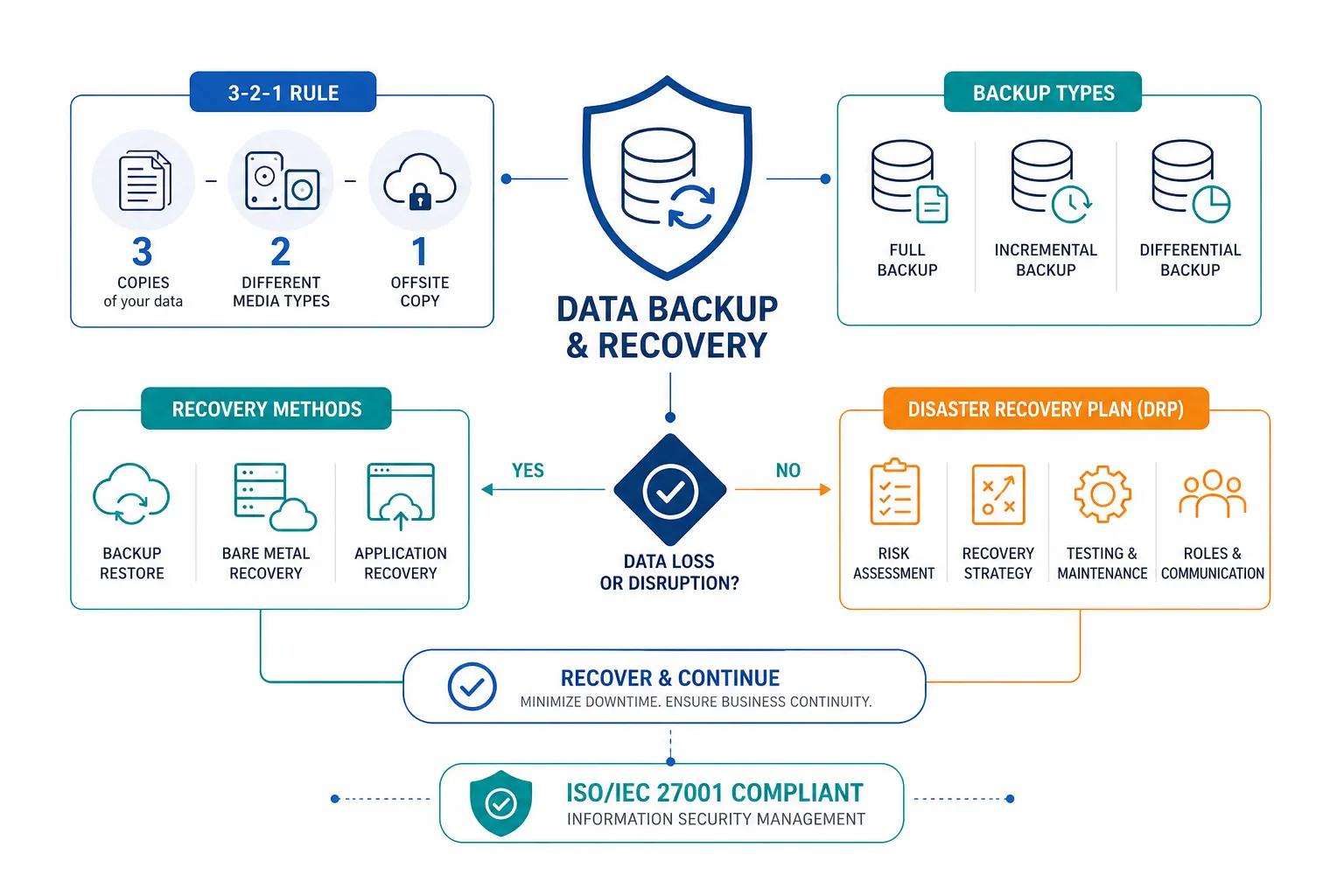
Reliable data recovery services begin with clear immediate actions: isolate affected systems, preserve volatile evidence, and avoid further writes to compromised media to maximise recovery success. Recovery providers use mechanical, logical and firmware techniques for hard drives and SSDs, reconstruct RAID arrays, and perform server and database restorations; cloud restores may rely on object-versioning and provider APIs. Knowing when to escalate to digital forensics or incident response is critical—cases involving ransomware, legal investigations or suspected espionage require evidence preservation and chain-of-custody protocols alongside recovery. Organisations should predefine SLAs and success metrics with providers so expectations on timelines and outcomes are clear during an incident.
When deciding between recovery methods, consider typical causes, success factors and downtime implications:
- Immediate containment checklist: Isolate networks, stop automated jobs, and preserve affected systems as-is.
- Initial triage steps: Identify failure type (mechanical, logical, firmware), capture logs and snapshot metadata for later analysis.
- Recovery escalation: Involve forensics when legal admissibility or root-cause attribution is required.
ACATO can support recovery pathways using specialised services such as ISO 27001 certification advice, IT security consulting, IT security audits, digital forensics, incident response, counter-espionage, and Data Recovery; organisations seeking alignment between recovery operations and compliance frameworks will find tailored guidance from consultative engagements. Provide useful information and expertise to lead potential clients to book free consultations or engage their services.
What Are the Key Data Recovery Methods for Hard Drives, RAID, and Servers?
Mechanical recovery for hard drives requires specialised laboratory environments to replace heads or repair platters and is effective when physical damage is isolated and handled quickly. Logical recovery addresses file system corruption, accidental deletion or overwriting by reconstructing data structures and applying forensic imaging to preserve evidence while restoring files. RAID recovery involves careful reconstruction of parity and sequence data; success depends on correct mapping of disk order, stripe size and metadata integrity, and improper attempts can reduce recoverability. For servers and databases, point-in-time restores using transaction logs, snapshots and coordinated application restores are essential to meet RPOs and prevent data inconsistency.
How Does Digital Forensics Support Post-Incident Data Recovery?
Digital forensics preserves evidentiary integrity while enabling recovery by using forensic imaging, hash-based verification and documented chain-of-custody procedures; these steps protect legal admissibility and regulatory compliance. Forensics teams analyse attack indicators, timeline artefacts and malware samples to identify root cause and determine whether recovered data is safe to reinstate, which helps prevent recurrence of the same incident. In ransomware cases, forensic analysis can reveal the initial intrusion vector and support law-enforcement reporting or insurance processes while parallel recovery work restores operations. Coordinating forensics with recovery teams ensures that data restoration does not overwrite forensic evidence or hinder subsequent investigations.
Why Is ISO 27001 Important for Data Backup and Recovery Compliance?
ISO 27001 creates a management system (ISMS) that embeds availability controls, documented backup policies, responsibility assignments, and testing regimes to ensure backups are not only performed but demonstrably reliable. The standard emphasises risk assessment, control selection and evidence retention: organisations must show that backups meet defined RTO/RPO, are encrypted and that restore tests are performed and logged. Certification provides a structured framework to translate legal obligations—such as GDPR data availability and NIS 2.0 requirements—into operational tasks, such as retention schedules, access controls and incident response integration. Implementing ISO-aligned processes reduces audit friction and improves procurement and regulator confidence while making recovery practices repeatable and measurable.
ISO 27001’s focus on continual improvement links naturally to backup testing and documentation:
What Are the ISO 27001 Data Backup Requirements for SMEs and Organizations?
ISO 27001 requires documented backup policies, designated responsibilities, and evidence of periodic testing to ensure availability controls work as intended; SMEs should adopt scaled policies reflecting their risk appetite. Practical SME steps include assigning a backup owner, scheduling automated backups aligned to RPOs, encrypting copies, and retaining proof of successful restores with logs and timestamps. Testing frequency should be risk-based but a minimum of quarterly verification of critical system restores provides credible evidence for audits and helps validate RTO estimates. Clear documentation of these processes and roles closes the gap between abstract compliance text and everyday operational behaviour.
How Does ISO 27001 Help Achieve GDPR and NIS 2.0 Compliance?
ISO 27001’s controls around access control, incident management and availability contribute directly to GDPR’s requirement to ensure data availability and integrity and to NIS 2.0 obligations for critical infrastructure resilience. By maintaining documented backup procedures, encryption standards and restore testing evidence, organisations can demonstrate technical and organisational measures required by regulators. For personal data subject to GDPR, retention policies and secure deletion practices must be implemented alongside backups to avoid retaining unnecessary copies; NIS 2.0 adds obligations for reporting incidents and ensuring continuity for essential services. Using ISO 27001 as the backbone simplifies evidencing compliance while highlighting areas where specific legal controls demand additional proof.
How Do Disaster Recovery Plans Protect Businesses from Data Loss?
A Disaster Recovery Plan (DRP) defines the coordinated steps, roles and recovery strategies required to restore systems and data after disruptive events, integrating with wider business continuity planning to prioritise critical functions. DRPs work by establishing recovery objectives (RTO and RPO), mapping dependencies, specifying recovery methods and assigning ownership for each action; they are effective only when combined with documented procedures, tested runbooks and regular updates following business changes. Business Impact Analysis (BIA) is the foundational activity that identifies critical assets and acceptable downtime, which informs prioritisation and resource allocation for DRP design. Regular testing and maintenance of the DRP, including tabletop and full failover tests, are essential to verify assumptions and refine timelines.
Developing a DRP follows clear steps and includes practical testing cadences:
What Are Recovery Time Objective and Recovery Point Objective?
RTO (Recovery Time Objective) is the maximum tolerable time to restore a service, while RPO (Recovery Point Objective) is the maximum acceptable data loss measured in time; together they define recovery SLAs. Calculating realistic RTOs and RPOs requires a Business Impact Analysis that quantifies financial and operational impacts per hour or day of downtime, enabling prioritisation of resources toward the most critical services. For SMEs, example targets might be RTO = 4–24 hours for core services and RPO = 15 minutes to 24 hours depending on transaction volume, while critical infrastructure often requires near-zero RTO and minutes-level RPOs. Setting these targets drives architecture decisions such as synchronous replication, immutable backups, or DRaaS engagements.
How to Develop an Effective Disaster Recovery Plan for Business Continuity?
Developing a DRP begins with scoping and BIA, followed by selecting recovery strategies that meet RTO/RPO targets, documenting technical runbooks and assigning clear roles and escalation paths. Practical steps include cataloguing dependencies, creating step-by-step restore procedures, defining communication templates and maintaining updated contact lists; these items become part of testable playbooks. Testing the DRP in stages—tabletop exercises, partial restores and full failovers—exposes gaps and improves coordination between technical teams and business stakeholders. Continuous review after tests or infrastructure changes ensures the DRP remains aligned to evolving business priorities and regulatory requirements.
What Cyber Security Data Protection Measures Are Essential for NGOs and SMEs?
NGOs and SMEs should adopt risk-based, cost-aware data protection measures that prioritise critical assets, automate backups and enforce simple controls that reduce human error. Core measures include using hybrid backup architectures with encrypted off-site copies, implementing immutable or versioned backups to defend against ransomware, enforcing role-based access and multi-factor authentication for backup management, and scheduling routine restore tests. Training staff on basic cyber hygiene and establishing change control for data-handling procedures are high-impact, low-cost actions that markedly reduce accidental loss. The following lists outline affordable architectures and NGO-specific practices to balance donor trust, privacy and limited budgets.
Below are practical, cost-aware backup and resilience choices:
- Hybrid Cloud Approach: Use on-prem snapshots for fast restore and encrypted cloud for off-site resilience.
- Backup as a Service (BaaS): Outsource backup management to reduce operational burden while retaining access control.
- Immutable Archives: Employ write-once retention for critical datasets to prevent ransomware-driven deletion.
How Can SMEs Implement Cost-Effective Data Backup Solutions?
SMEs can achieve resilience by prioritising workloads, automating backups and using hybrid cloud or BaaS to outsource complexity while controlling costs. A practical minimum is automated daily backups for critical systems, weekly full backups, versioning enabled in off-site archives and quarterly restore tests to validate recoverability. SMEs should categorise systems via a simple tiering matrix—Tier 1: critical (minutes RPO), Tier 2: important (hours RPO), Tier 3: non-critical (days RPO)—then apply architectures accordingly. Negotiate clear SLAs with providers and document on-premise procedures so internal staff can perform validated restores when needed.
What Are Best Practices for Cyber Security and Data Recovery in NGOs?
NGOs should protect donor and beneficiary data through encryption at rest and in transit, strict access controls, clear retention schedules and volunteer/staff training to minimise accidental exposures. Third-party risk assessments for cloud providers and partners are essential because many NGOs rely on external tools; require contractual assurances for data handling and recovery. Implementing lightweight incident response playbooks and annual tabletop exercises prepares small teams to act quickly during an incident, reducing reputational and operational damage. Combining these measures with secure backups and periodic evidence-preserving practices ensures both data protection and the ability to support compliance requests.
How Does ACATO Support Comprehensive Data Backup and Recovery?
ACATO provides specialist consulting that maps backup and recovery needs to compliance and forensics-ready processes, offering services such as ISO 27001 certification advice, IT security consulting, IT security audits, digital forensics, incident response, counter-espionage, and Data Recovery. Their approach connects risk assessment and ISMS development to practical backup architectures, testing cadences and documentation so teams can demonstrate readiness to regulators and donors. For organisations that require both preventative controls and reactive capabilities—SMEs, NGOs, government and infrastructure providers—ACATO combines tailored recommendations with incident orchestration to reduce downtime and evidence loss. Provide useful information and expertise to lead potential clients to book free consultations or engage their services.
How Do IT Security Consulting and Incident Response Enhance Data Protection?
IT security consulting identifies vulnerabilities in backup architecture, aligns technical controls with ISO 27001 and recommends cost-effective mitigations that match business priorities; this reduces the frequency and impact of incidents. Incident response services orchestrate containment, forensic capture, and recovery in a coordinated sequence that minimises downtime and preserves evidence for legal or regulatory processes. Combining consulting with periodic security audits ensures that backup and restore procedures remain current as systems evolve, while response playbooks provide the tested steps needed during real events. Together these services increase confidence in recovery plans and lower the likelihood of repeat incidents.
What Are the Benefits of ACATO’s ISO 27001 Certification and Digital Forensics Services?
ACATO’s ISO 27001 advisory work helps organisations implement audit-ready policies, structured testing programs and continuous improvement cycles, which in turn make backup practices demonstrable and defensible during audits. Digital forensics services deliver root-cause analysis, chain-of-custody integrity and clear investigative reports that support regulatory response or legal processes while informing technical remediation. The combined benefit is measurable: improved resilience, shorter mean-time-to-restore through better-prepared runbooks, and stronger evidence trails that simplify compliance with GDPR and sector regulations. Provide useful information and expertise to lead potential clients to book free consultations or engage their services.
Conclusion
Implementing robust data backup and recovery strategies safeguards your organization against data loss and downtime, enhancing operational resilience. By leveraging methods such as the 3-2-1 rule and periodic testing, you establish a reliable safety net that aligns with compliance requirements and business objectives. Explore our resources for tailored solutions that can take your data protection measures to the next level. Connect with us today to learn how we can support your data security journey.