
Software Updates and Patch Management: Keeping Your Systems Secure

Patch Management Best Practices for Enhanced System Security
Patch management is the coordinated process of identifying, testing, deploying, and verifying software updates so known vulnerabilities are closed before attackers can exploit them. Timely software updates reduce the window of exposure, restore secure functionality after disclosed flaws, and preserve system stability and compliance across servers, endpoints, and specialized control systems. This guide explains the patch management lifecycle, practical best practices, risk-based prioritization methods, and how vulnerability management integrates with patching to form a continuous remediation loop. Readers will get actionable checklists for policy development, a lifecycle EAV view to clarify responsibilities, and sector-specific advice for SMEs and critical infrastructure operators facing resource or operational constraints. The article also maps patch activities to ISO 27001 expectations and describes how a consulting partner can help operationalize these controls and prepare evidence for audits.
What Is Patch Management and Why Is It Critical for System Security?
Patch management is the structured practice of applying software updates to address security flaws, bugs, and functional gaps across an organization’s asset estate. It works by closing known vulnerability vectors—often described by CVEs—so that exploit code cannot take advantage of disclosed weaknesses, which reduces breach likelihood and containment costs. Effective patching also maintains reliability and ensures compliance with regulatory and contractual obligations, making it a core activity in any information security management program. Understanding why patching matters first clarifies how updates prevent attacks and why a consistent process is essential for measurable security outcomes.
How Do Software Updates and Patches Protect Against Vulnerabilities?
Software updates remediate vulnerabilities by changing vulnerable code paths, patching memory-corruption bugs, or closing logic flaws that threat actors rely on to gain unauthorized access. For example, when a high-severity CVE is published and a vendor patch is released, applying that patch removes the specific exploit vector and narrows the attack surface that scanners and adversaries can target. Security updates differ from bug or feature updates in that their primary purpose is vulnerability remediation, which often requires faster SLAs and targeted testing. Keeping this remediation cycle tight reduces the exploit window and lowers the chance that an automated scanner or active campaign will find and abuse the flaw.
What Are the Key Benefits of Effective Patch Management?
Effective patch management delivers measurable security, operational, and compliance benefits that translate to lower risk and cost avoidance. It reduces breach probability and incident response scope by eliminating known entry points, improves system uptime through timely bug fixes and performance improvements, and supports audit readiness by creating demonstrable evidence trails for compliance frameworks. These benefits lead to fewer security incidents and more predictable operational behavior, which together reduce total cost of ownership and protect reputation. Recognizing these outcomes helps prioritize conservative SLAs and investment in automation where appropriate.
For organizations seeking expert support to align patching with wider information security programs, ACATO specializes in ISO 27001 certification, cyber security, IT forensics, and data protection and can advise on integrating patch management into your ISMS and audit evidence collection. ACATO assists SMEs, government authorities, NGOs, and infrastructure providers to protect against cyber crime and information security risks and offers free consultations to explain certification steps and associated costs. This early advisory support helps teams scope the patching program correctly before selecting tooling or processes and sets up next steps for policy and evidence capture.
What Are the Best Practices for Patch Management to Enhance Cybersecurity?
Patch management best practice combines governance, inventory, prioritization, safe testing, and measured deployment so updates are both timely and non-disruptive. A strong program begins with a clear policy, authoritative asset visibility (CMDB integration), a risk-based prioritization model, and repeatable test-and-deploy pipelines that include verification and rollback plans. Automation improves scale and consistency, but it must be governed by change control and staged rollouts to reduce operational risk. The next sections present policy components, a lifecycle breakdown, and practical guidance on prioritization and automation.
How Should Organizations Develop and Implement Patch Management Policies?
A patch management policy defines scope, roles, SLAs, and exception handling so stakeholders know who acts and when; it also ties patching into change management and incident response. Essential policy elements include asset scope, classification rules for criticality, patching SLAs by severity (for example, emergency/critical within 24–72 hours depending on exploitability), exception approval processes, and logging/audit requirements. Policy should assign ownership to a named function (e.g., security team or operations) and mandate integration with the CMDB and vulnerability scanner outputs. Embedding these elements in governance ensures patches are not ad-hoc and provides the audit trail auditors seek.
Policy components to include and validate during adoption:
- Scope and asset classification: Define systems in and out of scope and how criticality is measured.
- Roles and responsibilities: Assign clear owners for assessment, testing, and deployment.
- SLAs and escalation: Specify timelines per severity and decision gates for emergency fixes.
These policy elements make enforcement consistent and provide evidence for auditors; the following section explains lifecycle steps that operationalize the policy.
What Are the Steps in the Patch Management Lifecycle?
The patch lifecycle consists of discovery, assessment, test, scheduling, deployment, verification, and reporting; each stage has distinct outputs and KPIs to measure effectiveness. Discovery identifies available patches and affected assets via inventory and vulnerability scanning, assessment scores risk and prioritizes remediation, testing validates compatibility in a non-production environment, scheduling coordinates change windows, deployment executes the update with monitoring, and verification confirms successful remediation and generates evidence for reporting. Implementing KPIs—such as time-to-remediate for critical patches, percentage of assets patched within SLA, and rollback frequency—creates measurable controls and continuous improvement loops. The lifecycle below clarifies responsibilities and expected outcomes.
Patching lifecycle activities, responsibilities, and KPIs are summarized in the table that follows to aid operational planning and assignment of accountability.
Different lifecycle activities map to clear purposes and measurable outcomes for patch teams.
This EAV-style lifecycle table links each activity to an operational purpose and realistic timeframe so teams can allocate tasks and measure adherence to SLAs. The next section explains how to prioritize patches using risk-based approaches.
How to Prioritize Patches Using Risk-Based Approaches?
Risk-based prioritization combines vulnerability severity (for example CVSS), exploit availability, and asset criticality so remediation effort targets greatest business risk first. A typical approach weights CVSS with compensating factors—such as presence of public exploit code, internet exposure, asset value, and regulatory impact—to produce a priority score for scheduling. Practical prioritization rules often place internet-facing systems with public exploits into the highest SLA tier, while low-criticality internal endpoints without exploitation evidence can be batched into routine monthly cycles. This method ensures limited resources address highest-impact items first and reduces overall breach exposure.
What Role Does Automation Play in Efficient Patch Deployment?
Automation reduces manual effort, increases consistency, and speeds remediation across thousands of endpoints, but it requires policy guardrails such as pre-deployment testing, staged rollouts, and integration with change management to avoid mass outages. Automated patch orchestration integrates with vulnerability scanners to convert findings into remediation tasks, schedules deployments during maintenance windows, and runs verification and reporting steps automatically. However, automation must be coupled with monitoring and human oversight—especially for critical servers and OT systems—so that failed patches trigger controlled rollbacks and incident workflows. Choosing automation that integrates with CMDB, EDR, and vulnerability platforms improves traceability and reduces manual reconciliation work.

How Does Patch Management Support ISO 27001 Compliance and IT Security?
Patch management directly supports ISO 27001 requirements by embedding vulnerability remediation into the Information Security Management System (ISMS) and providing documented evidence of control operation. ISO 27001 Annex controls—such as those addressing vulnerability management, change control, and secure development—expect organizations to identify, evaluate, and treat information security risks, including timely application of patches. Mapping patch activities to these controls helps organizations demonstrate operational practice, assign ownership, and present the records auditors need during certification. The next subsection lists specific controls, expectations, and the kind of evidence to collect.
What Are the ISO 27001 Requirements Related to Patch Management?
Relevant ISO 27001 requirements include clauses and Annex controls that require organizations to manage technical vulnerabilities, control changes, and maintain asset inventories for security purposes. Expectations are that vulnerabilities are assessed and remediated in line with organizational risk acceptance, that change procedures document approvals and testing, and that records of patch decisions and deployments are retained for audit. Typical evidence includes patch schedules, test results, exception approvals, vulnerability scan reports, and SLA performance metrics. Aligning patch policies with these requirements converts operational activity into demonstrable ISMS controls for certification.
This mapping shows how concrete patching actions satisfy ISO expectations and which artifacts auditors typically request during assessments. The following subsection explains operational steps to use these mappings to achieve and maintain certification.
How Can Patch Management Help Achieve and Maintain ISO 27001 Certification?
Operationalizing patching within an ISMS means codifying policy, measuring performance against SLAs, and collecting evidence to show continual improvement, which directly supports certification and surveillance audits. Organizations should document roles, maintain a CMDB-linked scan-to-remediate workflow, retain test results and exception records, and use metrics like time-to-remediate and percentage of assets compliant to demonstrate control effectiveness. Regular internal audits and management reviews that include patch program KPIs show continual improvement and readiness for external certification. For teams seeking implementation assistance, an external advisor can help align operational practices with ISMS requirements and prepare the necessary audit artifacts.
ACATO provides ISO 27001 advisory and audit preparation support that helps organizations convert patching operations into certified ISMS controls; their consulting includes assistance with policies, audit evidence preparation, and technical advisory to integrate patch workflows into certification timelines.

What Are the Challenges and Solutions for Patch Management in SMEs and Critical Infrastructure?
Patch management faces distinct challenges depending on organizational scale and operational constraints: SMEs commonly struggle with limited staff and mixed vendor estates, while critical infrastructure and OT/ICS operators must balance safety and availability with security. Solutions range from pragmatic prioritization heuristics and lightweight automation for SMEs to rigorous staged rollouts, segmentation, and vendor coordination for infrastructure owners. Recognizing these sectoral differences helps teams choose the right blend of manual, automated, and managed approaches to keep systems secure without endangering operations.
What Unique Patch Management Issues Do SMEs Face?
SMEs frequently lack dedicated security staff, have incomplete asset inventories, and operate a mix of cloud and legacy systems, which complicates prioritization and testing. Low-cost mitigations include establishing a small but enforceable patch policy, focusing on internet-facing and business-critical assets first, implementing basic automation for endpoints, and outsourcing complex activities to managed services when internal capacity is insufficient. SMEs should keep a lightweight CMDB, schedule monthly maintenance windows for routine patches, and reserve emergency procedures for high-risk vulnerabilities. These pragmatic steps increase security posture without large capital investment and provide a clear pathway to scale practices.
Low-cost SME actions:
- Inventory first: Build a minimal CMDB of critical assets.
- Prioritize externally facing systems: Patch internet-exposed services first.
- Use managed services: Outsource complex or time-consuming tasks when needed.
These measures enable SMEs to make measurable progress while planning longer-term tooling and process investments; the next subsection covers the more stringent demands of critical infrastructure environments.
How Should Critical Infrastructure Providers Manage Software Updates Securely?
Critical infrastructure providers must adopt safety-first patching: maintain segmentation between IT and OT, test patches in representative non-production environments, and stage rollouts with verified rollback procedures to avoid service disruption. Compensating controls such as network segmentation, application whitelisting, and temporary access restrictions reduce exposure while patches are validated, and coordination with vendors and regulators ensures compliance with safety and availability obligations. Strong change management and documented maintenance windows, combined with backup/rollback capabilities and forensic readiness, protect both safety and security objectives. These layered controls are essential because availability and safety sometimes outweigh immediate security patching if not managed carefully.
Different patching approaches fit different organizational needs; the table below summarizes Manual, Automated, and Managed service models to help SMEs and operators choose an appropriate path.
Organizational approaches to patching vary by resource and risk appetite; the comparison below helps select the right model.
This comparison clarifies where automation or managed services deliver greatest value and where manual control remains necessary for safety-critical systems. For organizations that need tailored assistance, ACATO offers consultancy to design hybrid models that combine policy, process, and tooling.
ACATO works with SMEs and critical infrastructure clients to design pragmatic, tailored patching programs that balance safety and security and offers a free consultation to scope requirements and explain certification steps and costs.
How Does Vulnerability Management Integrate with Patch Management for Stronger Security?
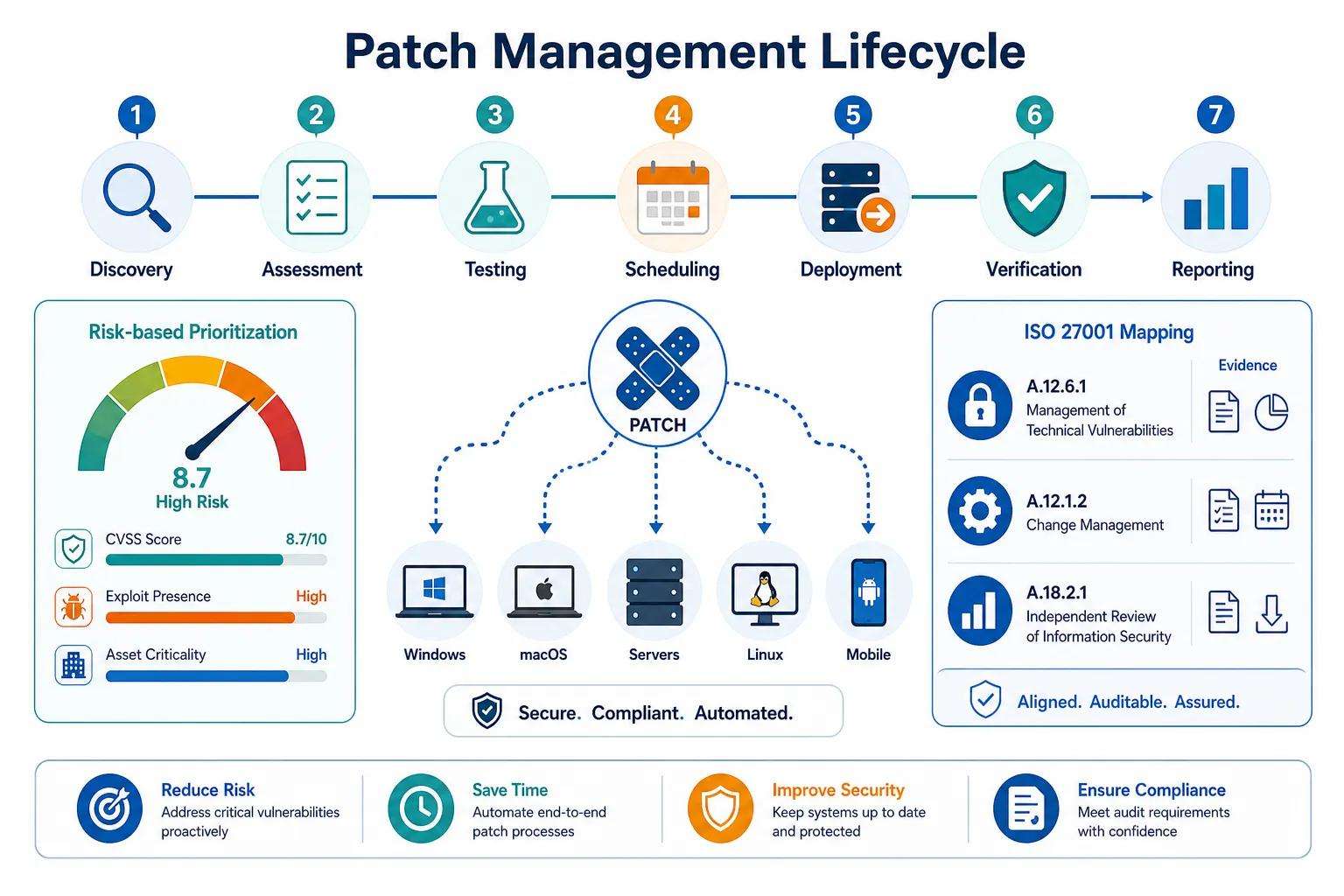
Vulnerability management and patch management form a continuous remediation loop: vulnerability scanning identifies issues, prioritization selects what to fix first, and patching remediates the chosen items while verification closes the loop. Integrating these processes ensures that scan results become actionable remediation tasks, that asset criticality and threat intelligence inform prioritization, and that verification confirms risk reduction. Effectively linking discovery to deployment reduces mean time to remediate and converts raw scanner output into measurable security improvement.
What Is the Relationship Between Vulnerability Assessment and Patch Prioritization?
Vulnerability assessment provides the inputs—severity scores, exploitability, and contextual metadata—that feed prioritization decisions; prioritization overlays asset criticality, business impact, and threat intelligence to select remediation order. A simple prioritization formula might combine CVSS base score, presence of public exploit, and asset exposure to give a composite score for scheduling. Triage teams validate scanner results to reduce false positives and assign remediation owners, which speeds the patch pipeline and prevents wasted effort. This triage-to-patch workflow ensures scarce resources address vulnerabilities with the highest business risk first.
Triage steps to integrate vulnerability and patch management:
- Validate scanner findings: Reduce false positives before committing resources.
- Enrich with context: Add asset criticality and threat intel to prioritization.
- Assign and track remediation: Convert findings to tracked remediation tasks with SLAs.
These steps improve decision quality and reduce time-to-remediate; the next subsection explains tooling integration points that make this process repeatable.
How Can Organizations Use Vulnerability Management Solutions to Inform Patch Strategies?
Vulnerability management solutions should integrate with CMDBs and patch orchestration tools so scan findings automatically generate remediation tickets and trigger automated or semi-automated patch workflows. Key integration points include synchronizing asset tags, using automation triggers to schedule patch deployments, and feeding remediation metrics into executive dashboards for governance. Tool evaluation criteria should prioritize scanner accuracy, asset discovery coverage, ticketing integrations, and reporting capabilities that map to SLAs and audit evidence. When tools are well integrated, organizations can reduce manual reconciliation, improve traceability, and demonstrate control effectiveness to auditors.
How Can ACATO’s IT Security Consulting Services Enhance Your Patch Management Strategy?
ACATO’s IT Security Consulting, ISO 27001 advisory, and cyber security services help organizations turn patch policies into operational programs and audit-ready evidence, combining policy guidance with technical and governance support. Their services include helping teams develop patch management policy, aligning CMDB and vulnerability tooling, preparing documentation required for audits, and advising on hybrid models that mix automation with managed support. The aim is to create measurable SLAs, operational playbooks, and evidence packages that support certification and ongoing risk reduction. Organizations engaging this support typically gain clearer prioritization, faster remediation cycles, and improved audit readiness.
What Support Does ACATO Provide for Patch Management and ISO 27001 Audits?
ACATO assists clients with policy development, ISMS alignment, audit preparation, and technical advisory tailored to the client’s sector and risk profile while keeping the focus on measurable outcomes. Deliverables include policy templates, audit evidence checklists, prioritization frameworks, and recommendations for tooling integration without prescribing single-vendor solutions. For critical infrastructure and SMEs, ACATO helps design staged deployment plans, rollback strategies, and compensating controls that reconcile safety and security needs. This combination of governance and technical advice helps organizations both achieve ISO 27001 certification and operationally sustain secure patching.
How to Book a Free Consultation to Improve Your Software Update Security?
To request ACATO’s free consultation, prepare a brief summary of your environment—key asset types, existing tooling, and primary concerns—and use ACATO’s contact page to submit an inquiry; the initial meeting will focus on scoping certification steps and associated costs. During the consult, ACATO will review current patching practices at a high level, identify immediate low-effort improvements, and propose next steps for audit preparation or technical implementation planning. Bringing vulnerability scan summaries and an asset list to the meeting accelerates scoping and enables a more precise recommendation. This short consult is intended to clarify the path to better patch management and, where relevant, ISO 27001 alignment.