ISO 27001 Standard: Information Security Management System

Understanding ISO 27001: A Guide to ISMS and UK Certification
The ISO 27001 standard defines a systematic Information Security Management System (ISMS) that helps organisations identify, manage and reduce information security risks while proving controls and governance to stakeholders. This guide explains what ISO/IEC 27001:2022 requires, why an ISMS matters for UK businesses and SMEs facing rising cyber risk and regulatory pressure, and how certification works in practical terms. Readers will learn the ISMS core principles, the business benefits and measurable impacts, a clear certification roadmap, realistic cost drivers for UK contexts, and urgent actions for the 2022 revision and the October 31, 2025 transition deadline. The article covers alignment with GDPR and NIS 2.0, provides implementation-focused Annex A guidance, and highlights where specialist consulting accelerates compliance. Throughout, target concepts such as information security management system, ISO 27001 certification process steps, and ISO 27001:2022 changes are explained with operational examples and actionable lists to support immediate next steps.
What Is the ISO 27001 Standard and How Does It Define an Information Security Management System?
ISO/IEC 27001:2022 is an international standard that requires organisations to establish, implement, maintain and continually improve an Information Security Management System (ISMS) based on a risk management approach. The ISMS formalises policies, risk assessment and treatment, documented controls (Annex A), monitoring and continual improvement using the Plan-Do-Check-Act cycle to protect confidentiality, integrity and availability of information. Organisations adopt the ISMS to create measurable controls and evidence for internal governance and third-party assurance. Understanding these elements clarifies how an ISMS becomes the operational backbone of resilient information security and prepares organisations for certification.
Information Security Management Systems: Attributes and Risk Mitigation
Information systems are evolving with rapid pace and it is easier and cheaper for organizations to acquire more systems and digitalize their business. Because of this, Information Security (InfoSec) is increasingly required in organizations. When there are more interconnected systems, databases and applications often accessible online, this leads to more attack vectors and possible security incidents. Incidents can be chained, leading from smaller initial incident into more critical ones, which could be avoided if the first incident did not occur, underlining the need for securing all assets. Regulators are also demanding security under penalty of fines as incentive to secure organizations.
Security researches have continued to propose InfoSec attributes, which are elements of assets that need to be secured. Understanding these attributes helps organizations establish Information Security Management Systems, which are policies and guidelines for mitigating risks.
Information Security Attributes & Securing Organizations, 2020
ACATO is a specialised consulting firm offering ISO 27001 certification support and ISMS consulting tailored to SMEs, government authorities, NGOs and infrastructure providers. For organisations that need a guided start, ACATO provides free consultations and gap analysis to define scope and initial risk priorities. The next sections explain the ISMS principles and protective mechanisms that make certification valuable and actionable for UK organisations.
What Are the Core Principles of ISO 27001 and the CIA Triad?
The core principles of ISO 27001 centre on the CIA triad: confidentiality, integrity and availability, which together define the security outcomes an ISMS must protect. Confidentiality means limiting access to authorised users through access controls and encryption; integrity ensures information remains accurate and untampered via hashing, version control and change management; availability preserves timely access through backup, redundancy and incident response. ISO 27001 operationalises these principles by linking risk assessments to Annex A controls so each identified risk has documented treatment and measurable outcomes. Mapping CIA to specific controls clarifies priorities and allows organisations to select proportionate technical, organisational and physical measures to reduce exposure.
This mapping leads naturally to understanding how the ISMS components combine operationally to protect assets and create evidence for audits.
How Does an ISMS Framework Protect Your Organisation’s Information Assets?
An ISMS protects information assets through interlocking components: governance policies, procedures, risk assessment and treatment plans, control implementation, monitoring, internal audit and management review. Policies set the security objectives and ownership, procedures create repeatable workflows for tasks like access provisioning and incident handling, and risk assessment defines which assets and threats require controls. Controls from Annex A are implemented and monitored with metrics, while internal audits and management reviews ensure continual improvement and alignment with business objectives. This lifecycle reduces likelihood and impact of incidents and produces the documentation auditors and regulators expect, which supports compliance with GDPR and sector requirements.
ISO 27001: ISMS Design for Bandung City Government
ABSTRACT: AbstractThe Department of Communication and Information (Diskominfo) of the Bandung City Government is an agency that has the responsibility of carrying out several parts of the Regional Government in the field of communication and informatics. Based on the composition of the regional service organization Bandung City Diskominfo has five fields and two UPTs which are part of the Bandung City Diskominfo. Bandung City Diskominfo in implementing work programs has IT as a supporter of business processes in government agencies. Based on the results of research conducted that IT management in Bandung City Government Diskominfo found several clauses that were still unfulfilled in this Diskominfo impact on the management of government information security institutions that can affect the performance of Bandung City Government. Therefore, there is a need for standardization that needs to be implemented as a guide that examines the direction in safeguarding information or assets that are
Analysis and design of information security management system based on ISO 27001: 2013 using Annex Control (Case Study: District of Government of Bandung City …, A Fathurohman, 2013
Having defined how an ISMS functions, the next section explains the specific business benefits UK organisations can expect from certification.
What Are the Key Benefits of ISO 27001 Certification for UK Businesses and SMEs?
ISO 27001 certification delivers measurable business advantages by reducing risk exposure, demonstrating regulatory alignment, and improving commercial trust with customers and supply chains. Certification clarifies roles and responsibilities, lowers incident frequency through systematic controls, and produces evidence that supports tendering and contractual requirements. For SMEs, the ISMS is a structured way to prioritise limited security budgets toward the highest-impact controls and to present verifiable assurance to partners and insurers. These business outcomes translate into reduced breach costs, stronger procurement positioning, and often improved cyber insurance terms.
ISO 27001 provides several practical benefits for organisations:
- Risk Reduction and Operational Resilience: A structured risk approach reduces likelihood and impact of breaches.
- Regulatory and Contractual Compliance: Documented controls and evidence support GDPR, NIS 2.0 and contractual clauses.
- Commercial Advantage and Trust: Certification is a clear signal to customers and partners of mature security practices.
These benefits drive strategic decisions about scope and investment, and the following table summarises typical impacts and measurable outcomes.
Different business benefits map to specific commercial outcomes and metrics.
This table shows how ISO 27001 converts security activity into tangible metrics such as incident frequency, procurement success and insurance positioning. The next subsections explain how ISO 27001 supports regulatory compliance and commercial trust in practice.
How Does ISO 27001 Enhance Risk Management and Regulatory Compliance?
ISO 27001 enhances risk management by requiring a documented risk assessment methodology, risk treatment plans and evidence of implementation and monitoring, which regulators and auditors can evaluate. The standard’s risk-based approach means organisations identify information assets, quantify threat likelihood and impact, and prioritise controls from Annex A based on residual risk. For GDPR and NIS 2.0 mapping, ISO 27001 provides the structure to show how privacy and critical services risks are assessed and managed, producing the records and DPI-related controls that demonstrate due diligence. This makes it easier to respond to regulatory inquiries and to provide evidence during inspections or contractual reviews.
This connection between risk treatment and compliance underpins why certified ISMSs are credible in tenders and regulatory contexts, which we explore next in client trust and competitive advantage.
In What Ways Can ISO 27001 Certification Improve Competitive Advantage and Trust?
ISO 27001 certification signals to customers, partners and regulators that an organisation has a formal, audited approach to protecting information, which lifts trust and enables participation in secure supply chains. Certification supports bids and tenders by offering a single, recognised assurance that satisfies many buyer requirements, reducing negotiation friction. It also improves vendor credibility in sectors where contractual security clauses are strict or where government and NGO partners require certified providers. Internally, certification strengthens security culture and accountability, which reduces human error-related incidents and reinforces corporate reputation.
These commercial advantages flow into measurable procurement wins and reduced contractual friction, which informs decisions about scope and investment in certification services. The following section outlines the certification lifecycle and practical steps UK organisations should expect.
How Does the ISO 27001 Certification Process Work in the UK?

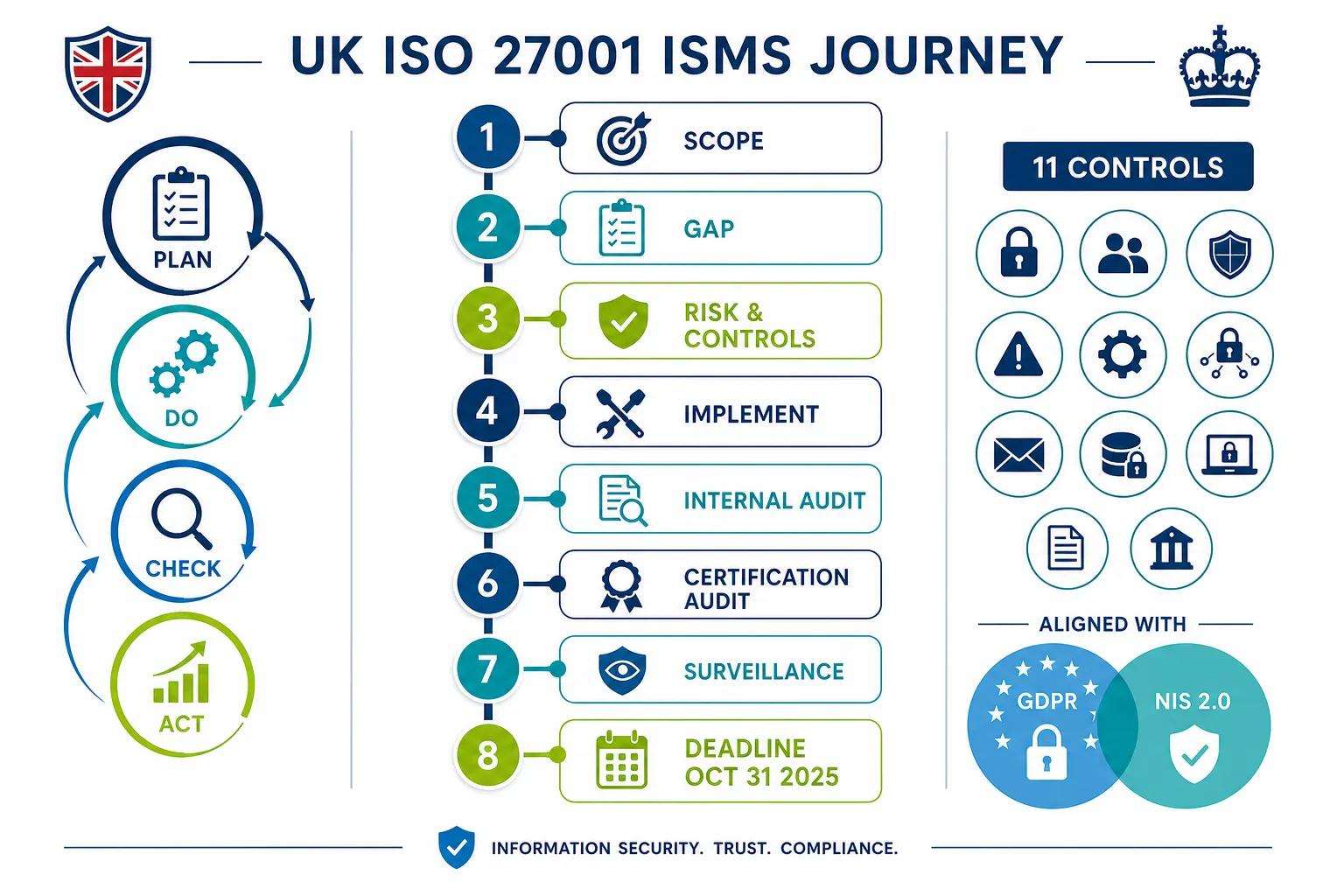
The ISO 27001 certification lifecycle follows a predictable sequence: scoping and project initiation, gap analysis, risk assessment and control implementation, internal audit and management review, followed by an external certification audit and ongoing surveillance. Each stage produces deliverables—scope statements, gap reports, risk registers, ISMS documentation, internal audit reports—that create evidence for certification bodies and accreditation expectations. Typical timeframes vary by scope and resource availability, but most SME projects complete initial certification within 6–12 months with focused effort. Understanding these stages helps organisations plan budgets and timelines effectively.
The following table compares each certification stage with typical deliverables, expected timeframe and where consulting support adds value.
This comparison clarifies where external expertise reduces time-to-certification and internal rework. The next subsection lists step-by-step stages as a concise roadmap.
What Are the Step-by-Step Stages of ISO 27001 Certification?
A clear step-by-step roadmap helps teams manage dependencies and milestones during ISO 27001 projects. The practical sequence usually includes scoping, gap analysis, risk assessment and treatment, control implementation and documentation, internal audit and corrective actions, management review, and independent certification audit. Each step produces specific evidence—scopes, risk registers, procedures and audit reports—that feed into the next phase and support continuous improvement. Quick tips to accelerate progress include focusing scope on high-value assets, using templated documentation, and scheduling internal audits before external assessment to reduce nonconformities.
Key steps condensed for quick reference:
- Define scope and governance: Identify assets and stakeholders.
- Conduct a gap analysis: Compare current state to ISO requirements.
- Assess and treat risks: Prioritise controls and implement changes.
These steps lead directly into the question of practical consultancy support and how firms like ACATO can help reduce time and risk.
How Can ACATO’s Consulting Services Support Your ISO 27001 Journey?
ACATO provides targeted support across the certification lifecycle, including free initial consultations and gap analysis to set realistic scope and priorities. Practical services include ISMS documentation templates and drafting, risk assessment facilitation, internal audit checklist development, awareness training for staff and audit support during certification. By supplying ready-to-adapt documentation, trainer-led awareness sessions and experienced internal audit resources, ACATO helps organisations reduce consultancy hours and avoid common nonconformities that delay certification. Booking a free consultation with ACATO is a practical first step to map a tailored roadmap, estimate effort and set realistic timelines for UK, EU, Poland, USA and Canada operations.
This practical support is particularly valuable when teams lack internal resources for technical documentation or audit readiness, which also affects cost considerations discussed next.
What Are the Costs and Factors Influencing ISO 27001 Certification in the UK?
Costs for ISO 27001 certification depend on company size, scope complexity, existing maturity, consultancy hours and external audit fees, among other drivers. Core cost components include internal staff effort for implementation, consultancy fees for gap analysis and documentation, certification body audit fees, and ongoing surveillance and maintenance costs. Scope and the number of locations or systems in scope are primary drivers; a narrow, cloud-focused scope costs materially less than a multi-site, heavily integrated operational scope. Transparent estimation and phased approaches reduce upfront expense and enable predictable budgeting.
The table below breaks down typical cost components and representative ranges for UK scenarios.
This breakdown highlights that while consultancy can add cost, it also reduces internal overhead and audit risk. The next subsection gives illustrative SME cost ranges and scenarios.
What Typical Cost Ranges Should SMEs Expect for ISO 27001 Certification?
SME cost scenarios vary by scope and approach: a narrow, single-site SME using primarily cloud services with modest documentation needs can expect lower total costs than a medium enterprise with multiple sites and complex integrations. Typical cost bands for initial certification (illustrative, UK context) include lower-range scenarios where internal capability is strong and consultancy minimal, mid-range with moderate consultancy and remote audits, and higher-range where full documentation services and onsite audit support are required. Ongoing annual surveillance and maintenance add recurring costs that should be budgeted from year two onward.
When estimating costs, organisations should consider trade-offs between internal effort and external consultancy to determine the most efficient route to certification.
How Do Consultancy Fees and Documentation Services Affect Overall Pricing?
Consultancy and documentation services accelerate certification and reduce audit nonconformities, often offsetting fees through time saved and lower rework rates. Typical consultancy deliverables include gap reports, ISMS policy sets, risk registers, control implementation guides, internal audit checklists and awareness training; each deliverable reduces internal labour and shortens audit preparation time. Remote consultancy options reduce travel-related costs, while on-site engagement may be needed for complex scoping or stakeholder workshops. Transparent pricing and a free initial consultation help organisations choose the right mix of services to meet budget and timeline requirements.
What Are the Latest ISO 27001:2022 Updates and How Do They Impact Your ISMS Transition?
ISO 27001:2022 introduced a reorganised Annex A and a set of new or refocused controls to reflect modern threats such as cloud services, threat intelligence and data handling techniques; organisations must transition by the formal deadline to remain aligned with accredited certification. The 2022 update emphasises outcome-focused controls and requires organisations to re-evaluate their control selection, update documentation, and ensure existing evidence maps to the revised control set. Transition planning should start immediately to review control applicability, update risk treatment plans and schedule internal audits against the new requirements. Early action reduces the risk of nonconformities during surveillance or re-certification audits.
What Are the 11 New Controls Introduced in ISO 27001:2022?
ISO 27001:2022 introduced new or refocused control areas to address contemporary information security needs; these priority controls have practical implications for SMEs and larger organisations. The eleven priority areas include threat intelligence, cloud service security, data masking and anonymisation, web filtering and content security, secure coding and development practices, configuration management, ICT readiness for business continuity, protective monitoring and logging, identity and access management enhancements, asset lifecycle and media handling, and supplier security controls.
Each area requires proportionate implementation: for example, cloud service security often needs contract and configuration controls, while threat intelligence feeds inform detection and response priorities.
Prioritising these areas based on your risk assessment helps focus limited resources on controls with the highest residual risk reduction, which is essential before the transition deadline.
Why Is the October 31, 2025 Deadline Critical for Certification Transition?

The October 31, 2025 deadline is the formal transition date after which accredited certificates are expected to conform to the 2022 control set and organisations that have not transitioned risk gaps during surveillance and re-certification audits. Failure to transition in time can lead to audit nonconformities, delayed re-issuance of certificates or the need for additional corrective action plans that increase cost and operational disruption. Immediate steps include scheduling a control-gap review, updating ISMS documentation to reflect 2022 controls, and booking internal audits against the revised control set to identify gaps early. Acting now preserves certification continuity and avoids compressed, costly remediation just before the deadline.
How Does ISO 27001 Align with GDPR and NIS 2.0 Regulations?
ISO 27001 supports GDPR and NIS 2.0 compliance by providing the management system scaffolding—risk assessment, incident response, documented controls and evidence—that both regulatory regimes expect, though neither is a complete substitute for the other’s legal requirements. GDPR focuses on lawful bases, data subject rights and specific privacy obligations, while ISO 27001 provides a systematic approach to identifying and managing risks to personal data as information assets. NIS 2.0 addresses obligations for operators of essential services and digital service providers, emphasising resilience, incident reporting and supply-chain security—areas where a mature ISMS and Annex A controls provide strong foundation but may require targeted extensions for sector-specific obligations.
The following subsection clarifies direct differences and overlaps with GDPR to help legal and security teams map controls and responsibilities.
What Are the Key Differences and Overlaps Between ISO 27001 and GDPR?
ISO 27001 and GDPR overlap in risk-based approaches, incident response, access controls and data protection measures, but they differ in legal scope: GDPR mandates legal bases for processing, data subject rights and supervisory authority obligations that an ISMS alone does not create. ISO 27001 helps operationalise technical and organisational measures (encryption, access control, logging) and provides documented evidence of due diligence that supports GDPR compliance. However, GDPR requires specific procedural elements—for example, lawful processing documentation, DPIAs and data subject rights processes—that must be integrated into the ISMS.
Mapping these elements ensures the ISMS both secures data and provides necessary GDPR records.
How Can ISO 27001 Help Organisations Meet NIS 2.0 Compliance?
ISO 27001 provides the processes (risk assessment, incident management, supplier evaluation, business continuity) that align closely with NIS 2.0 requirements for resilience and reporting, although additional sector-specific reporting and governance items may be required. The ISMS supports timely incident detection, response and documentation which are central to NIS 2.0 obligations, and supplier/security of the supply chain controls help manage downstream risks. To fully meet NIS 2.0, organisations should map regulatory reporting thresholds and timelines into incident response procedures and ensure written evidence of system resilience and supplier due diligence is integrated into the ISMS. This combined approach reduces duplication and provides a unified governance model.
For organisations seeking expert help to plan a transition or estimate certification costs, ACATO offers ISO 27001 certification and consulting services including gap analysis, ISMS documentation, internal audit checklist development, awareness training and audit support. ACATO provides transparent pricing practices during a free initial consultation to help estimate cost drivers and propose a tailored roadmap. Book a free consultation to obtain a realistic action plan that aligns scope, budget and timetable with UK regulatory and accreditation expectations.