
Protect Against Cyber Espionage with Strong Threat Detection
Strengthening Organisational Defenses Against Cyber Espionage
Cyber espionage is the deliberate, covert theft or surveillance of sensitive information by external actors or insiders for political, economic, or strategic advantage. This article explains why cyber espionage matters for organisations, how attackers operate, and which countermeasures materially reduce risk through prevention, detection, and response. You will learn how threat actors select targets, which tactics (phishing, supply-chain compromise, malware-free credential theft, and APT campaigns) to prioritise, and how governance frameworks such as an information security management system (ISMS) aligned to ISO/IEC 27001 reduce exposure. Practical guidance covers technical controls (SIEM, EDR, NDR, AI-driven monitoring), identity and access strategies like MFA and Zero Trust, and operational measures including incident response and digital forensics. Finally, the article outlines regulatory drivers and how certification and audit readiness improve resilience, with concise references to how ACATO’s ISO, incident response, and monitoring services can support SME, government, NGO, and infrastructure stakeholders seeking to strengthen espionage defences.
What Is Cyber Espionage and Who Are the Threat Actors?
Cyber espionage is the targeted use of digital techniques to access, exfiltrate, or surveil confidential information without authorisation. Attackers exploit technical vulnerabilities, lax controls, or trusted insiders to obtain intellectual property, strategic planning data, or credentials that enable broader campaigns. The immediate value is asymmetric: a single breach can yield long-term competitive, political, or operational advantage for the adversary while the victim sustains reputational and financial harm. Understanding the actor profile helps prioritise mitigations because motivation, sophistication, and resources shape the tools and persistence of campaigns. Recognising these distinctions informs risk assessments and control selection for an effective ISMS.
How Do State-Sponsored and Insider Threats Operate in Cyber Espionage?
State-sponsored groups typically plan long-term campaigns that emphasise reconnaissance, credential harvesting, stealthy persistence, and staged exfiltration to avoid detection. They often leverage supply-chain compromises or custom tooling and invest in lateral-movement capabilities to access high-value systems over months or years. Insiders—whether malicious or negligent—offer direct access vectors through privileged credentials, shadow accounts, or removable media, speeding compromise and complicating attribution. Indicators include unusual access patterns, data staging on non-standard hosts, and privilege escalation logs; these patterns suggest the need for monitoring, least-privilege policies, and focused insider-threat controls. Understanding these mechanics leads naturally to targeting detection capabilities tuned for long dwell times and subtle exfiltration.
What Are the Common Targets and Impacts of Cyber Espionage?
Attackers most often seek intellectual property, product designs, R&D data, credentials, and strategic planning documents that deliver competitive advantage or geopolitical leverage. Critical infrastructure, government decision-making systems, and NGOs holding sensitive program information are also high-value targets due to their operational sensitivity and potential for political impact. The business and operational consequences include loss of competitive advantage, regulatory penalties, operational disruption, and damaged stakeholder trust that can persist long after technical recovery. Sector-specific risk assessments help organisations prioritise protections where the value of the targeted data is highest and where regulatory obligations amplify exposure. Mapping target sets to control priorities directly informs an effective defence strategy.
Which Tactics Should Organizations Recognize?

Effective defence begins by recognising the principal tactics adversaries use to gain and maintain access. Phishing and spear-phishing remain the most frequent initial access vectors and are chosen for their blend of human manipulation and low technical cost. Supply-chain attacks exploit trust in third-party software, services, or vendors to insert malicious components upstream of victims. Malware-free techniques—such as credential stuffing, session hijacking, and living-off-the-land lateral movement—rely on legitimate tools and stolen credentials to evade signature-based detection. Advanced Persistent Threats (APTs) combine multiple tactics over extended periods to perform targeted reconnaissance, pivot through environments, and exfiltrate data with minimal detection. Recognising these patterns helps organisations deploy layered controls that focus on early detection and rapid containment.
How Do Phishing, Supply Chain Attacks, and Malware-Free Techniques Work?
Phishing uses crafted messages to trick recipients into revealing credentials or executing actions that enable account takeover, often serving as the first step in broader campaigns. Supply-chain attacks compromise vendors, libraries, or update channels to deliver malicious code to many downstream victims, bypassing per-victim hardening. Malware-free techniques exploit legitimate administrative tools, stolen tokens, or misconfigured services to move laterally and access data without leaving traditional malware signatures. Detection signals include anomalous authentication times, unusual process creation by standard binaries, and unexpected outbound connections to data-staging hosts; these signals guide immediate mitigations such as forced credential resets, revocation of tokens, and supplier isolation. Mapping detection to response actions supports faster containment and reduced exfiltration.
- Common detection signals for these tactics include unusual login locations, anomalous process launches, and unexpected data aggregation.
- Immediate mitigations focus on credential rotation, blocking suspicious IPs, and isolating affected hosts.
- Longer-term measures include supplier security reviews, stronger authentication, and simulated phishing awareness campaigns.
These tactical countermeasures connect directly to broader monitoring and identity controls that are discussed in subsequent sections.
What Role Do Advanced Persistent Threats Play in Espionage?
APTs represent attacker groups that combine technical sophistication with long-term operational discipline to maintain stealthy access and repeatedly harvest high-value data. Their lifecycle typically includes targeted reconnaissance, initial access (often via spear-phishing or supply-chain vectors), privilege escalation, lateral movement, data staging, and covert exfiltration. APTs emphasise persistence through backdoors, web shells, or legitimate accounts and use encryption or steganography to mask exfiltration channels. Indicators of compromise include long-lived anomalous accounts, periodic beaconing to uncommon infrastructure, and small, consistent data transfers that avoid threshold alerts. Detecting APTs requires telemetry aggregation, behavioural analytics, and a response capability that preserves forensic evidence while containing adversary actions.
A notable real-world example of a highly sophisticated and targeted cyber espionage campaign is the ‘Darkhotel’ operation.
Cyber Espionage Tactics: Darkhotel Malware Campaign
The stress placed by these statistics—both on the victims of identity theft and those who fear it—is substantial. It is not helped by reports in late 2014 of highly targeted attacks on consumers such as theDarkhotel“espionage campaign” reported by Kaspersky Labs [3] in which a sophisticated ring of cyber-criminals target individuals who are wealthy enough (and presumably influential enough) to stay at high-end luxury hotels. When these individuals access the hotel’s Wi-Fi network, they are asked to update a piece of software which induces most such individuals to download a malicious piece of code onto their devices. Once on the unsuspecting victim’s device,Darkhotelruns in the background, downloading, installing, and deleting at will, advanced software such as keystroke loggers, Trojans, and various malware designed for data and information theft.
Types of malware and malware distribution strategies, VS Subrahmanian, 2015
How Can ISO/IEC 27001 and Information Security Management Systems Prevent Cyber Espionage?
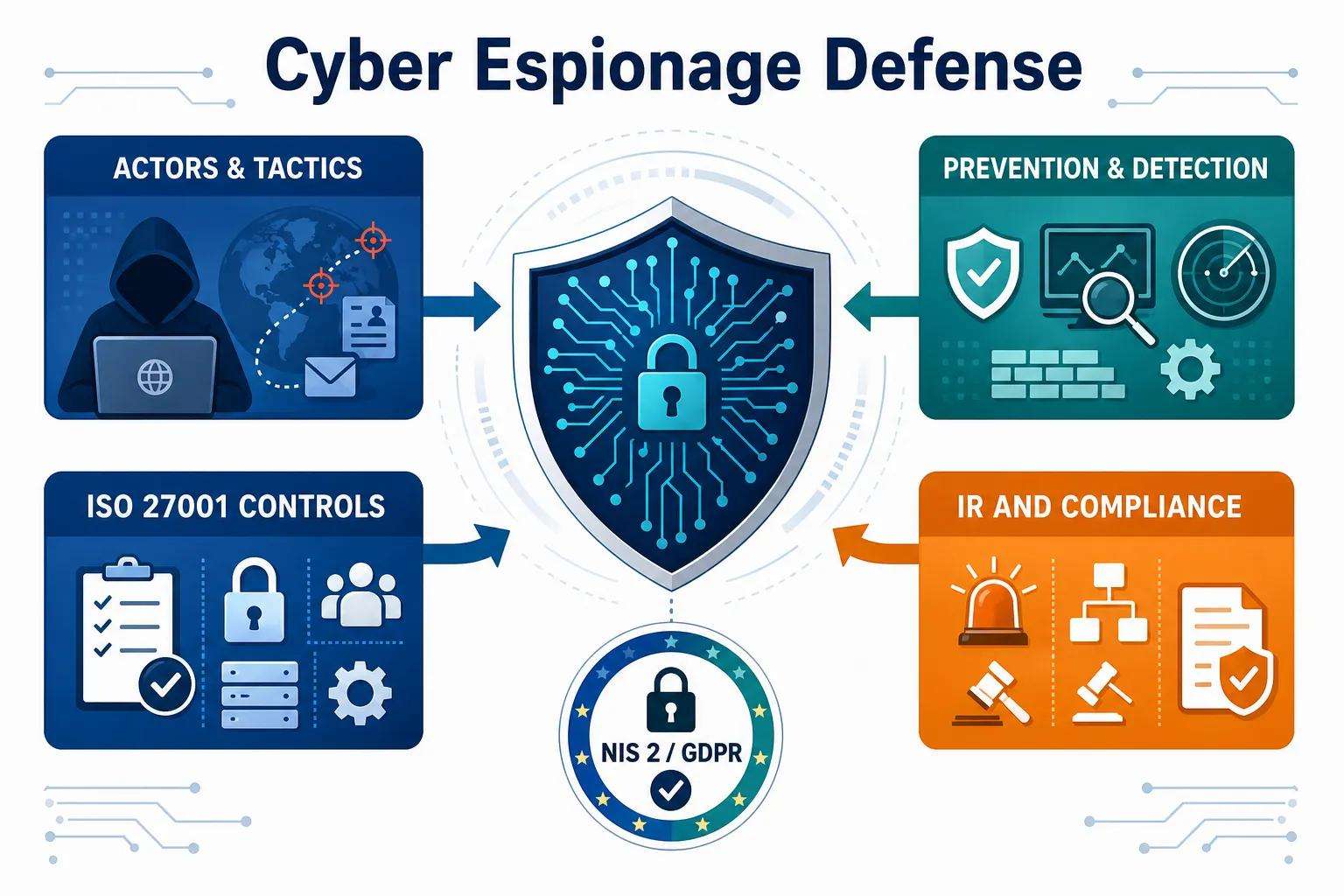
An ISMS based on ISO/IEC 27001 provides a structured, risk-focused framework that aligns policy, people, process, and technology to reduce opportunities for espionage. The ISMS requires formal risk assessments, control selection, continual monitoring, and management review processes that close governance gaps attackers exploit. Key control families—access control, supplier relationships, cryptography, monitoring and logging, and incident management—directly limit initial access, reduce the attack surface, and improve detection and recovery. Implementing ISO/IEC 27001 also supports contractual and reputational assurances to customers and partners, demonstrating that the organisation manages espionage risk as part of an auditable system. The structure of the ISMS ensures controls are prioritised by business impact and tested through continuous improvement cycles.

What Are the Key Controls and Benefits of Implementing ISO/IEC 27001 for Espionage Protection?
Below is a mapping of core ISO/IEC 27001 control families to practical implementation actions and their direct value in mitigating espionage.
The table summarises how controls reduce attack surface and improve resilience.
Implementing these controls yields measurable benefits such as reduced breach surface, improved audit readiness, and faster incident containment. Effective ISMS programmes link controls to risk owners, enabling prioritised investment where espionage risk is highest.
How Does ACATO Support Organizations in ISO/IEC 27001 Certification and Compliance?
ACATO provides ISO/IEC 27001 consulting and certification support services that follow the typical phases of gap analysis, implementation assistance, and audit preparation tailored to organisational context. Their approach emphasises aligning security controls with business objectives for SMEs, government authorities, NGOs, and infrastructure providers, with a focus on practical, evidence-based implementation rather than checkbox compliance. ACATO’s services include preparing documentation, advising on supplier control strategies, and supporting management reviews to demonstrate continual improvement during certification audits. Organisations seeking professional help are encouraged to book a free consultation to discuss tailored ISO/IEC 27001 pathways that balance risk reduction with operational practicality.

What Proactive Cybersecurity Measures Detect and Mitigate Espionage Threats?
Proactive defences combine telemetry collection, identity hardening, network controls, and data-centric protections to detect early indicators and block adversary movement. Monitoring platforms like SIEM aggregate logs and correlate alerts, EDR provides endpoint-level detection and response, and NDR adds network-centric visibility for lateral movement and exfiltration patterns. Identity controls—MFA, privileged access management, and lifecycle governance—prevent unauthorised use of credentials and limit the blast radius of credential theft. Network segmentation, DLP, and encryption reduce the value of any stolen data and slow adversaries so detection systems can act. Together, these measures form a layered defence that increases the cost and complexity for espionage actors while improving organisational resilience.
How Do Threat Detection Tools Like SIEM, EDR, and AI-Driven Monitoring Work?
Below is a concise comparison of key tool types, their primary features, and the detection/response value they provide for espionage scenarios.
Detecting stealthy campaigns requires combining multiple telemetry sources.
Evaluating these tools should include metrics such as mean time to detect (MTTD) and mean time to contain (MTTC) to ensure investments yield operational improvements. Integration across SIEM, EDR, and NDR enhances context and speeds forensic triage.
What Are Effective Access Control Strategies Including MFA and Zero Trust Architecture?
Zero Trust architecture and rigorous access control practices minimise trust assumptions and restrict what attackers can access even when initial compromise occurs. Key principles include verifying every access request, applying least privilege, micro-segmentation of networks, and continuous authentication based on context. Multi-factor authentication (MFA) should be mandated for all remote and privileged accesses, using phishing-resistant methods where possible, and privileged access management should enforce just-in-time elevation and session monitoring. Operational steps include inventorying accounts and assets, defining access policies, implementing enforcement mechanisms, and periodically reviewing entitlements. These measures materially reduce the success rate of credential-based espionage and limit potential damage from insider threats.
- Start with an account and asset inventory to identify high-risk privileges.
- Implement MFA and privileged access controls for admin and remote users.
- Use micro-segmentation and least privilege to reduce lateral movement opportunities.
These access strategies feed directly into detection tooling and incident response playbooks described next.
How Should Organizations Respond to Cyber Espionage Incidents Effectively?
A structured incident response (IR) capability tailored to espionage scenarios ensures evidence preservation, rapid containment, and proportionate recovery actions. IR follows defined phases—prepare, identify, contain, eradicate, recover, and lessons learned—with roles, communication plans, and legal coordination pre-established to reduce decision latency. For espionage, preserving forensic evidence is critical for attribution, regulatory reporting, and legal action; this requires chain-of-custody processes and minimal disturbance of volatile data. Coordinated engagement between security teams, legal counsel, and external forensic specialists ensures that operational recovery does not compromise investigations. Regular tabletop exercises help validate playbooks and clarify escalation paths for complex espionage incidents.
What Is the Role of Digital Forensics in Investigating Espionage Breaches?
Digital forensics aims to preserve, collect, and analyse evidence to determine what happened, who accessed what, and how data left the environment, while maintaining the integrity of that evidence for possible legal or regulatory proceedings. Typical forensic activities include disk imaging, memory captures, timeline reconstruction, and network packet analysis to trace adversary actions and identify indicators of compromise. For espionage incidents, attributing activity often requires correlating multiple evidence sources and understanding attacker tooling and techniques. External forensic expertise can provide impartial analysis, advanced tooling, and procedural rigor; organisations should engage specialists when intrusion complexity or legal risk exceeds internal capabilities. Forensics findings should feed back into IR processes to improve detection and harden controls.
How Does Incident Response Planning Minimize Damage and Support Recovery?
A robust incident response plan minimises damage by enabling rapid, coordinated actions to contain adversaries and restore trusted operations while supporting evidence preservation. Key components include defined roles and responsibilities, escalation criteria, communication protocols for stakeholders and regulators, and playbooks for specific scenarios like credential compromise or supply-chain intrusion. Tabletop exercises and red-team simulations validate assumptions, reveal gaps in coordination, and build institutional muscle memory for high-pressure decisions. Metrics such as MTTR and time-to-containment quantify effectiveness and drive continual improvement in processes and tooling. Well-rehearsed IR capabilities significantly shorten dwell times and limit the long-term strategic value adversaries can extract from espionage campaigns.
Why Is Compliance and Certification Critical in Cyber Espionage Defense?
Compliance frameworks and certification programmes formalise security practices, creating auditable evidence that controls are implemented and maintained to reduce espionage risk. Regulations like NIS 2 and GDPR impose obligations for incident reporting, risk management, and supply-chain security that directly shape how organisations prioritise espionage mitigations. Certification such as ISO/IEC 27001 demonstrates to partners and regulators that an organisation operates a systematic ISMS with documented controls, which can translate to contractual trust and reduced scrutiny during procurement. Meeting these obligations reduces legal and reputational exposure while aligning internal processes with defence-in-depth measures that disrupt espionage vectors. Certification and compliance are therefore practical risk-management levers rather than mere paperwork.
How Do NIS 2 and GDPR Regulations Influence Espionage Protection Strategies?
The table below maps regulation to core obligations and the practical effect those requirements have on managing espionage risk.
These regulatory drivers compel organisations to formalise evidence collection, reporting workflows, and third-party controls that directly reduce espionage exposure and improve cross-stakeholder trust. Compliance thus becomes integral to operational security rather than a separate legal exercise.
What Are the Advantages of ACATO’s Certification Support and Audit Preparation Services?
ACATO’s certification support focuses on gap analysis, practical implementation guidance, and audit preparation tailored to the client’s sector and scale, helping SMEs, government authorities, NGOs, and infrastructure providers demonstrate control alignment to standards. Their approach emphasises prioritised remediation plans that deliver time-to-value and audit readiness while integrating supplier-security and incident-management improvements that specifically mitigate espionage risk. By combining expertise in ISO certifications with complementary services such as incident response, digital forensics, and cyber attack monitoring, ACATO helps organisations present coherent evidence to auditors and stakeholders. Organisations interested in tailored certification support can book a free consultation to explore a pragmatic route to compliance and improved espionage defences.
For organisations that need help implementing monitoring, response, or certification programmes, ACATO’s integrated services offer a practical pathway to strengthen defences while preserving operational priorities. Book a free consultation to evaluate which combination of ISO certification support, cyber attack monitoring, and incident response services best fits your organisation’s espionage risk profile.