
GDPR Compliance: Understanding Your Obligations

GDPR Compliance: Understanding Your Obligations and Key Requirements
GDPR compliance is the legal and operational process organisations must follow to protect personal data, reduce regulatory risk, and respect data subject rights across processing activities. This guide explains the essential obligations under GDPR, practical steps to implement controls, and how to manage compliance in UK-specific post-Brexit contexts such as the UK Data Protection Act 2018 and transfer mechanisms. Many businesses struggle with translating legal requirements into day-to-day processes like DPIAs, RoPA maintenance, consent management, and vendor oversight; this article bridges that gap with step-by-step guidance, templates, and checklists. You will learn the core GDPR principles, how to respond to rights requests, the primary compliance tasks (DPOs, DPIAs, breach response, cross-border transfers), and emerging 2025 trends including AI interactions. Each section includes practical controls, numbered procedures, and EAV tables to help operationalise obligations; the final sections explain how to get expert help and where an integrated ISO 27001 + GDPR approach adds resilience. Read on to convert obligations into a pragmatic compliance programme that protects people and preserves business continuity.
What Are the Core GDPR Principles You Must Follow?
The core GDPR principles set the foundation for lawful processing and drive design choices in systems and policies. These principles require organisations to be lawful, transparent and fair; limit personal data to specified purposes; minimise data collection; keep records accurate; restrict storage to what is necessary; protect integrity and confidentiality with security controls; and be able to demonstrate accountability. Implementing these principles reduces legal exposure and improves trust with customers and regulators, so every programme should map controls to each principle explicitly. The next subsections explain each principle with practical examples and controls you can adopt immediately.
The seven core principles and practical next steps are:
- Lawfulness, fairness and transparency: Use documented lawful bases and clear privacy notices.
- Purpose limitation: Record processing purposes and forbid undeclared secondary uses.
- Data minimisation: Collect only fields required for the purpose and adopt field-level controls.
- Accuracy: Implement verification and correction workflows to maintain data quality.
- Storage limitation: Apply retention schedules and automated deletion where possible.
- Integrity and confidentiality: Use encryption, access control and monitoring aligned to ISO 27001.
- Accountability: Maintain RoPA, policies, and audit trails to demonstrate compliance.
These concise principles frame how to design processes and controls, and the following table maps each principle to practical actions you can implement.
Different GDPR principles translate into specific controls and processes that teams must operationalise.
This table helps teams convert abstract principles into concrete technical or organisational controls; next we examine lawfulness, fairness and transparency in more detail.
What Does Lawfulness, Fairness, and Transparency Mean in GDPR?
Lawfulness, fairness and transparency require that organisations identify a legitimate legal basis for each processing activity, explain processing openly, and act reasonably with respect to individuals. The lawful bases include consent, contract performance, legal obligation, vital interests, public task and legitimate interests; selecting the correct basis depends on context and must be documented in RoPA. Transparency means privacy notices and bespoke communications that cover purpose, retention, recipients and rights; fairness involves avoiding deceptive practices that would surprise or disadvantage data subjects. Implement a decision checklist to map processing to a lawful basis and ensure privacy notices are accessible; this foundation then informs consent management and legitimate interests assessments.
Clear examples improve operational decisions: choosing consent for direct marketing, contract for service delivery, or legitimate interests for low-intrusion analytics with balancing tests. The following subsection explains how purpose limitation and minimisation further reduce compliance risk.
How Do Purpose Limitation and Data Minimization Protect Personal Data?
Purpose limitation and data minimisation constrain data use to what is necessary and expected, directly reducing reidentification and breach impact. Document processing purposes in a RoPA and apply automated controls to prevent secondary use without a documented legal review; for example, tag datasets with purpose metadata that developers and analysts can query. Minimisation techniques include removing legacy fields, applying selective collection at forms, and using pseudonymisation to separate identifiers from payloads. These practices lower the scope of DPIAs and reduce retention overheads, which simplifies incident response and subject access workflows.
When you implement minimisation, teams should pair it with retention schedules and monitoring to ensure fields are not reintroduced; the next subsection covers accuracy, storage limits and integrity measures that complement these controls.
Why Are Accuracy, Storage Limitation, and Integrity Essential for Compliance?

Accuracy, storage limitation and integrity protect subjects from harm and support lawful processing by keeping datasets reliable and secure. Accuracy duties require correction processes and validation checks at point of entry and during syncs with third-party sources; maintain clear ownership for each data domain so issues can be fixed promptly. Storage limitation demands retention policies, archival procedures and deletion scripts that are reviewed for legal holds; document retention justifications in RoPA. Integrity and confidentiality are achieved through technical controls—encryption at rest/in transit, role-based access, logging and incident monitoring—ideally aligned with an ISMS like ISO 27001 to ensure mature security practices.
Combining these controls reduces regulatory risk and demonstrates accountability; the next subsection explains accountability and consent lifecycle management in operational terms.
How Does Accountability and Consent Management Impact Your GDPR Obligations?
Accountability under GDPR means you must be able to show how you meet obligations through documentation, governance and training; consent management is a specific lifecycle that must be recorded and honoured. Maintain a RoPA that links processing activities to DPIAs, legal bases and retention; implement training programmes so staff understand data handling responsibilities and escalation paths. Consent practices should capture granular choices, store timestamps and contexts, and provide easy withdrawal mechanisms that trigger processing changes across systems. Audit trails, policy registers and periodic reviews are practical accountability artefacts that make regulatory interactions more straightforward.
Accountability measures also feed into DPIAs and breach response planning, which we explore next when covering data subject rights and operational obligations.
The creation and maintenance of Registers of Processing Activities (ROPA) are fundamental to demonstrating GDPR compliance and accountability.
GDPR Accountability: Enhancing with Common Semantic Model for ROPA
1. The creation and maintenance of Registers of Processing Activities (ROPA) are essential to meeting the General Data Protection Regulation (GDPR) and thus to demonstrate compliance based on the GDPR concept of accountability. To establish its effectiveness in meeting this obligation, we evaluate an ROPA semantic model, the Common Semantic Model–ROPA (CSM–ROPA). Semantic models and tools represent one solution to the compliance challenges faced by organisations: the heterogeneity of relevant data sources, and the lack of tool interoperability and agreed common standards. By surveying current practice and the literature we identify the requirements for GDPR accountability tools: digital exchange of data, automated accountability verification and privacy-aware data governance. A case study was conducted to analyse the expressivity and effectiveness of CSM–ROPA when used as an interoperable, machine-readable mediation layer to express the concepts in a comprehensive regulator-provided accountability framework used for GDPR compliance. We demonstrate that CSM–ROPA can express 98% of ROPA accountability terms and fully express nine of the ten European regulators’ ROPA templates. We identify three terms for addition to CSM–ROPA, and we identify areas where CSM–ROPA relies on partial matches that indicate model limitations. These improvements to CSM–ROPA will provide comprehensive coverage of the regulator-supplied model. We show that tools based on CSM–ROPA can fully meet the requirements of compliance best practice when compared with either manual accountability approaches or a leading privacy software solution.
2. The GDPR requires organisations to create and maintain a comprehensive record of their personal data processing activities known as a Register of Processing Activities (ROPA).Footnote1Aside from being a legal obligation on organisations, an ROPA is an internal control tool and is a crucial document to demonstrate that an organisation is meeting the accountab
Support for enhanced GDPR accountability with the common semantic model for ROPA (CSM-ROPA), P Ryan, 2022
What Are the Data Subject Rights Under GDPR and How Can You Respect Them?
Data subject rights give individuals control over their personal data and require operational processes to respond within strict timelines. Rights include access, rectification, erasure, restriction of processing, portability, objection and protections for automated decision-making; controllers must verify identity, locate data across systems, and provide responses typically within one month unless extensions or exemptions apply. Establish a request handling workflow with triage, verification, search, redaction and response steps, and log each request in a central register to support accountability. The subsequent subsections break down common rights, provide stepwise procedures, and include a table summarising who is affected and how to comply.
Below is a compact list of the main rights to help teams prioritise operational workflows.
- Right of access — individuals can request copies of their personal data and processing details.
- Right to rectification — correct inaccurate or incomplete personal data.
- Right to erasure — request deletion where lawful bases permit, subject to exceptions.
- Right to restrict processing — temporarily suspend use pending dispute resolution.
- Right to data portability — receive personal data in a structured, commonly used format.
- Right to object — oppose processing, particularly for direct marketing and profiling.
- Rights related to automated decision-making — require safeguards and the ability to contest decisions.
This list frames the operational tasks controllers face; the following table maps rights to practical steps for compliance.
Organisations must operationalise rights handling through documented workflows and technical integrations.
Use this table to prepare standard operating procedures and system integrations that automate common tasks; next we detail workflows for access, rectification and erasure.
How Can Individuals Exercise Their Right to Access, Rectification, and Erasure?
Access, rectification and erasure typically follow a three-stage workflow: verify identity, locate and extract data, and respond or action the request within regulatory timelines. Verification can use known identifiers and two-factor checks to prevent unauthorised disclosure; once authenticated, use RoPA and system indexes to find all records, then prepare redacted extracts and an explanatory note on processing activities. For rectification, apply updates at the authoritative source and notify third-party processors to maintain consistency; for erasure, check legal retention obligations, apply deletion or anonymisation, and document any refusal with legal justification. Logging each step allows auditability and demonstrates compliance during regulatory reviews.
These processes should be automated where possible to reduce response times and error rates; the following subsection addresses portability, restriction and objection handling mechanics.
What Are the Rights to Restrict Processing, Data Portability, and Object?
Restriction, portability and objection introduce operational flags and data formatting requirements that teams must handle consistently across systems. Restriction places a processing flag on records to suspend activities without deleting data; implement a central flagging mechanism that triggers downstream processors to respect the restriction. Portability requires exporting data in a structured, interoperable format like CSV or JSON and providing secure transfer mechanisms; ensure schemas map to source fields and include metadata describing processing contexts. Objection handling often requires a legitimate interests balancing test; document reasoning, apply stops for direct marketing requests, and maintain records of decisions to show compliance.
Design system-level flags and export services to make these rights manageable at scale; the final subsection in this H2 covers automated decision-making protections and DPIA triggers for profiling.
How Does GDPR Address Automated Decision-Making and Profiling Rights?
GDPR restricts solely automated decisions with significant legal or similarly significant effects and grants subjects the right to obtain human intervention, express their views, and challenge outcomes. When algorithms or AI models influence decisions (credit scoring, recruitment screening), organisations must provide meaningful information about logic, significance and envisaged consequences, and consider human oversight. DPIAs are usually triggered for high-risk profiling; include explainability measures, error monitoring and appeals pathways in the mitigation plan. Operational controls include model documentation, data provenance logs, fairness testing and routine audits that feed into governance frameworks.
Addressing automated decisions is increasingly critical with AI adoption, which leads naturally into mandatory compliance requirements such as DPOs, DPIAs and breach planning covered next.
What Are the Key Compliance Requirements and How Do You Implement Them?
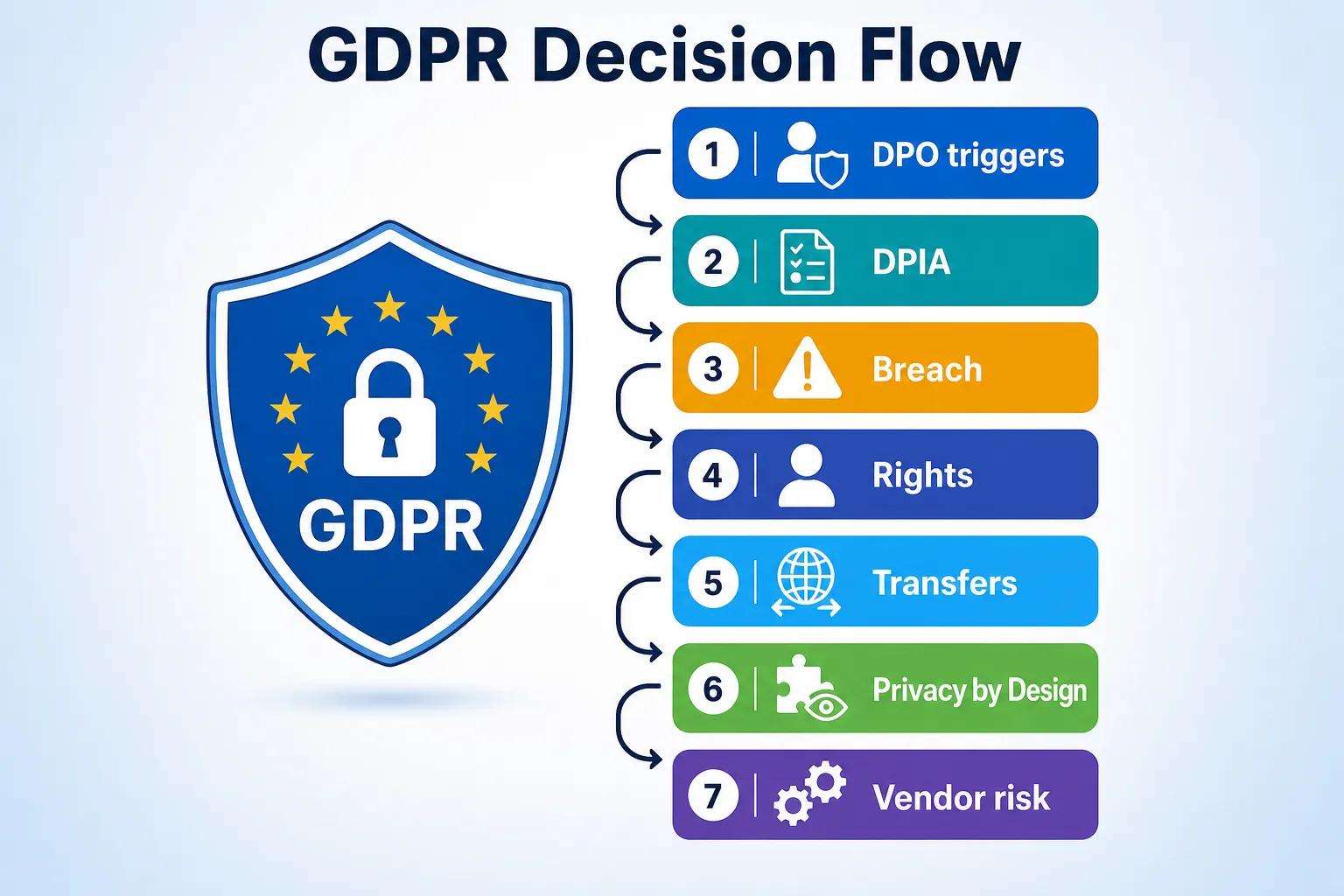
Key GDPR compliance requirements include appointing a DPO where applicable, maintaining a RoPA, conducting DPIAs for high-risk processing, preparing breach notification procedures, applying privacy by design/default, and managing cross-border transfers and vendors. Implementing these obligations requires policy work, technical controls and governance artefacts mapped to a schedule of responsibilities and evidence. The rest of this section provides checklists and how-to steps for each requirement, with templates and prioritised actions you can adopt quickly to reduce exposure.
Start by mapping which requirements apply to your organisation and trigger conditions for mandatory actions:
- DPO appointment triggers and role expectations.
- DPIA triggers and a stepwise DPIA process.
- Breach response timelines and notification templates.
- Privacy by design controls for projects.
- Cross-border transfer mechanisms and vendor clauses.
Use the table below to compare requirements, when they are triggered, and concrete implementation steps to operationalise them.
This table gives a single view of required actions; the next subsections explain DPO triggers, DPIA methodology, breach procedures and privacy-by-design controls in more detail.
(Implementation support note) If you need practical help turning these checklists into project plans, ACATO offers advisory services including DPIA support, DPO assistance and ISO 27001 integration to align security and privacy. ACATO provides Data Privacy advice, Data protection analysis and Data protection training delivered by certified experts, and a Free Consultation to explain steps and likely costs so you can prioritise remediation. This next subsection explains DPO considerations in full.
When and Why Must You Appoint a Data Protection Officer?
A Data Protection Officer is required when your core activities involve large-scale monitoring or processing of special category data, or where you’re a public authority; even when not mandatory, appointing a DPO or outsourced DPO-style role improves oversight. DPO responsibilities include monitoring compliance, advising on DPIAs, training staff, liaising with regulators, and maintaining records of processing activities. Decide whether to recruit internally or retain external expertise based on independence needs and available skills, and document the appointment, reporting line and contact details in governance records. A designated DPO accelerates incident response and provides a single point of contact for regulators and subjects, which reduces enforcement risk.
A clear DPO remit also helps with accountability evidence and streamlines DPIA and breach workflows; the next subsection walks through conducting a DPIA.
How Do You Conduct a Data Protection Impact Assessment?
A DPIA systematically evaluates privacy risks for high-risk processing and identifies mitigations to reduce residual risk to acceptable levels. Begin with a screening step to determine if a DPIA is required, then follow structured phases: description of processing; necessity and proportionality assessment; risk identification and scoring; mitigation selection and acceptance; documentation and sign-off; and ongoing review. Use a template to capture risk likelihood and impact, map technical and organisational controls, and set review dates; consult your DPO or the regulator when residual risk remains high. Record DPIA outcomes in RoPA and use them to inform vendor contracts, technical design and communications with data subjects.
A robust DPIA template saves time on repeated assessments and links naturally to breach planning, which we describe next.
The process of conducting a Data Protection Impact Assessment (DPIA) can be complex, especially when dealing with new technologies and documenting outcomes consistently.
GDPR DPIA: Semantic Specification for Data Protection Impact Assessments
ABSTRACT: AbstractThe GDPR requires assessing and conducting a Data Protection Impact Assessment (DPIA) for processing of personal data that may result in high risk and impact to the data subjects. Documenting this process requires information about processing activities, entities and their roles, risks, mitigations and resulting impacts, and consultations. Impact assessments are complex activities where stakeholders face difficulties to identify relevant risks and mitigations, especially for emerging technologies and specific considerations in their use-cases, and to document outcomes in a consistent and reusable manner. We address this challenge by utilising linked-data to represent DPIA related information so that it can be better managed and shared in an interoperable manner. For this, we consulted the guidance documents produced by EU Data Protection Authorities (DPA) regarding DPIA and by ENISA regarding risk management. The outcome of our efforts is an extension to the Data Privacy Vocabu
A semantic specification for data protection impact assessments (DPIA), HJ Pandit, 2022
What Are the Procedures for Data Breach Notification and Incident Response?
Breach response requires a fast, repeatable playbook: detect, contain, assess, notify and learn. Detection and containment include isolating affected systems and preserving forensic evidence while preventing further loss; assessment evaluates the nature of data, scope, and likelihood of harm to individuals. If the breach is likely to result in risk to rights and freedoms, notify the regulator (ICO in the UK) within 72 hours with the required information and notify affected data subjects without undue delay when high risk is present. After resolution, perform a root-cause review, update controls and communicate lessons learned across teams to reduce recurrence.
Create a breach runbook with roles, decision trees and notification templates to accelerate execution; the following list outlines core incident steps.
- Identify and contain the incident to prevent further damage.
- Convene the response team and assign roles (technical lead, legal, comms, DPO).
- Perform initial impact assessment and evidence preservation.
- Notify regulator and subjects where obligations require, using standard templates.
- Conduct post-incident review and remedial actions.
These steps form the backbone of an effective incident response programme; next we discuss privacy by design and default for proactive compliance.
How Do Privacy by Design and Default Enhance GDPR Compliance?
Privacy by design and default embed data protection into systems and business processes from conception, reducing the need for retrofits and lowering risk. Practical measures include threat modelling, minimisation-oriented data schemas, default settings that favour privacy, and deployment checklists ensuring pseudonymisation and encryption where appropriate. Integrate privacy gates into project lifecycles—requirements, design, testing and deployment—and require DPIA sign-off for significant features. Document design decisions, trade-offs and residual risk so accountability is demonstrable during audits and regulatory inquiries.
Embedding these practices shortens DPIA cycles and simplifies rights handling because systems were built with fewer data fields and clearer provenance; the next subsection explains transfer and vendor rules central to cross-border compliance.
What Are the Rules for and Vendor Management?

Cross-border transfers require either an adequacy decision, Standard Contractual Clauses (SCCs), or other appropriate safeguards plus a Transfer Impact Assessment where necessary; transfers must be documented and monitored.
Vendor management demands due diligence, data processing agreements with required clauses, evidence of technical controls, and on-site or remote audits for critical suppliers. Implement a vendor risk register, map data flows to determine transfer points, and apply SCCs or equivalent safeguards when adequacy is not present. Maintain contractual obligations that require processors to assist with rights requests and breach notifications to preserve compliance across the supply chain.
A simple decision flow helps teams choose the right transfer mechanism and document the rationale for each cross-border link, which supports auditability and regulatory scrutiny.
How Does the UK Data Protection Act 2018 Relate to GDPR Compliance?
The UK Data Protection Act 2018 tailors and supplements GDPR rules in the UK context after Brexit, so UK organisations must align both regimes to remain compliant.
The UK regime mirrors many GDPR principles while introducing specific provisions for law enforcement processing, national security and certain public functions; organisations should map UK DPA provisions against EU GDPR obligations to identify divergence. Post-Brexit transfer mechanisms require checking for UK adequacy or using SCCs/TIAs for outbound transfers; the Information Commissioner’s Office (ICO) provides UK-specific guidance and templates.
The following subsections give a concise comparison and practical transfer strategies for UK businesses.
This section helps UK controllers reconcile international obligations with domestic law and prepare for regulatory interactions with the ICO.
What Are the Key Differences and Similarities Between UK DPA 2018 and GDPR?
UK DPA 2018 largely implements GDPR principles but includes bespoke elements for law enforcement data, national security and certain public sector exemptions; substantive rights and principles remain aligned. Similarities include rights of data subjects, obligations for controllers/processors, DPIA and breach notification frameworks, and the accountability principle. Differences arise in some derogations for public functions and in the application of enforcement mechanisms; UK guidance from ICO may also differ in emphasis or timelines. Practically, UK organisations should adopt a single compliance baseline mapped to both frameworks, track ICO updates, and document where domestic law creates additional obligations.
Understanding these alignments simplifies international compliance and informs decisions on transfers and dispute resolution; next we outline how to manage post-Brexit data transfers.
How Should UK Businesses Manage Post-Brexit Data Transfer Mechanisms?
UK businesses must confirm whether recipient jurisdictions are subject to an adequacy decision, use SCCs adapted for UK/EU contexts, or conduct Transfer Impact Assessments when appropriate. Steps include mapping outbound transfers, identifying legal basis, selecting contractual mechanisms (SCCs), assessing recipient legal frameworks for potential access by third-country authorities, and implementing technical measures such as encryption and pseudonymisation. Keep documented evidence of the decision process and retain TIAs and contractual templates in RoPA. Follow ICO guidance and update transfer mechanisms as adequacy decisions or model clauses evolve to maintain lawful transfers.
Documenting these choices is essential for regulatory defensibility and supports vendor oversight, which connects to broader compliance maturity activities discussed later.
How Does the Data (Use and Access) Act 2025 Affect GDPR Compliance?
The Data (Use and Access) Act 2025 (DUAA) is an act of the Parliament of the United Kingdom concerned with data protection. The act makes changes to the operation of the UK’s General Data Protection Regulation (“UK GDPR”) and the Data Protection Act 2018. The act passed into law on 19 June 2025. The provisions of the act are being implemented “slowly”, in stages: the initial implementation of certain aspects of the new law took effect on 19 and 20 August 2025. (en.wikipedia.org)
The DUAA introduces changes to data protection laws in the UK, including provisions related to data processing and access. Organisations should review the specific provisions of the DUAA to understand how it may impact their data processing activities and compliance obligations.
What Are the Emerging Trends and Future Developments in GDPR Compliance?
GDPR compliance continues to evolve with technological change and regulatory focus, and 2025 trends emphasise AI governance, targeted SME simplifications, evolving transfer rules and sustained enforcement activity. Regulators are increasingly scrutinising automated decision-making, algorithmic transparency and high-risk AI systems, making DPIAs and explainability central to ongoing compliance. For SMEs, proposals aim to streamline record-keeping and scale requirements proportionately, but businesses should prepare lightweight RoPA and proportionate DPIAs now. Enforcement remains active, with fines and corrective orders driven by systemic failures and poor vendor management rather than isolated technical lapses.
How Will AI and Machine Learning Impact GDPR Compliance in 2025?
AI and machine learning increase the likelihood of DPIA triggers because models often involve large-scale profiling, automated decision-making, and processing of special categories or sensitive inference. Organisations should implement transparency measures—model cards, data provenance logs, fairness testing and human review gates—to reduce legal and ethical risk. The EU AI Act and related guidance intersect with GDPR, creating additional obligations for high-risk AI systems; implement combined risk assessments that address data protection and AI safety together. Practical mitigations include robust data minimisation, versioned model registries, and monitoring to detect drift or bias, which materially reduce regulatory exposure.
These AI governance actions align with privacy by design and inform incident response and rights handling when automated decisions are involved.
What Simplifications Are Proposed for SMEs Under GDPR in 2025?
Regulators are exploring proportionate approaches for SMEs that reduce administrative burden while preserving core protections, such as simplified RoPA formats and tiered DPIA requirements. Proposed simplifications encourage lightweight record templates, clear thresholds for DPIA necessity, and pragmatic documentation standards that scale with processing risk rather than company size. SMEs should prepare by adopting proportionate controls: basic RoPA, template DPIAs, standard vendor clauses and routine training to embed privacy awareness. Taking these small steps now positions smaller organisations to benefit from any formal simplifications while maintaining strong data protection practices.
Proactive preparation reduces the effort needed when formal SME reliefs arrive and improves resilience against audits and enforcement.
How Are GDPR Enforcement and Fines Evolving in 2025?
Enforcement continues to target systemic failures: inadequate security, poor vendor oversight, non-transparent profiling, and failure to honour rights. Recent trends show regulators prioritising cases with cross-border impact or demonstrable consumer harm, and fines often accompany remediation orders and public reprimands. To reduce fine risk, maintain comprehensive RoPA, evidence of DPIAs and mitigations, timely breach reporting, and vendor audits. Insurance and contractual indemnities can also be part of a risk management strategy, but regulators focus on prevention and documented governance as primary mitigations.
Adopting an integrated ISMS and documented accountability practices substantially lowers enforcement exposure, which leads naturally into how specialist advisory support can help operationalise these steps.

How Can ACATO Support Your GDPR Compliance Journey?
ACATO provides practical, expert support to implement GDPR obligations, combining data protection advice, analysis, training and ISO 27001 integration to deliver an integrated Management System that strengthens both privacy and information security. ACATO’s certified experts help organisations perform DPIAs, maintain RoPA, define DPO roles (including outsourced options), and design breach response playbooks. Their Data protection training equips staff with role-specific responsibilities, while Data protection analysis assesses gaps and prioritises remediation. A Free Consultation is available to outline steps, estimate costs and timelines, and recommend a pragmatic engagement path that aligns privacy and security objectives.
This services overview shows how advisory support converts regulatory requirements into project plans and technical changes, and the next subsections list services and explain the consultation offering in detail.
What GDPR Compliance Services Does ACATO Offer?
ACATO’s core services relevant to GDPR include Data Privacy advisory support, Data protection analysis (gap assessments and remediation plans), Data protection training for staff and leadership, and integration of ISO 27001 with GDPR to harmonise security and privacy controls. Advisory work covers DPIA facilitation, DPO support (including outsourcing advice), RoPA creation and vendor contract review to embed appropriate processor clauses. Training programmes are tailored for SMEs, public bodies and critical infrastructure operators to ensure role-based competence. These services are designed to be modular so organisations can prioritise urgent gaps and scale support as governance matures.
Engaging these services is most effective after an initial assessment that identifies quick wins and high-risk areas; ACATO’s Free Consultation helps set those priorities.
How Can You Benefit from ACATO’s Free Consultation and Certified Experts?
ACATO’s Free Consultation provides an initial gap analysis, a high-level roadmap and an outline of expected steps and costs to reach compliance or certification goals. During the consultation, certified experts review your current posture, identify immediate risks (e.g., lack of RoPA, missing DPIAs, weak breach plans), and recommend practical next actions such as targeted training, DPIA workshops or ISO 27001 alignment. Working with certified professionals brings efficiency and authoritative guidance that reduces the time to remediate and supports credible evidence for regulators. To proceed, request the Free Consultation to obtain a tailored plan that aligns legal obligations with technical and organisational controls.
Start with a short diagnostic to prioritise actions and gain clarity on resource needs; the Free Consultation is intended to convert legal complexity into an executable plan with measurable milestones.
ACATO’s advisory and integration services complement internal efforts and help ensure that privacy-by-design, DPIA processes and incident response are professionally aligned with recognised information security practices. For an immediate next step, consider the Free Consultation to map your highest-risk processing and create a focused remediation roadmap.