
Enhance AWS Security with Expert Cloud Security Consulting

Cloud Security Consulting: Expert Strategies for Securing Your Cloud Infrastructure
Cloud security consulting is the practice of assessing, designing, and strengthening cloud infrastructure to reduce risk, meet regulatory obligations, and ensure resilient operations across AWS, Azure, and multi-cloud deployments. This article explains why external cloud security expertise matters, how an assessment-driven methodology secures cloud workloads, and which technical controls and compliance practices deliver measurable protection and audit evidence. Readers will learn concrete assessment steps, platform-specific hardening advice, data protection best practices mapped to ISO 27001 and GDPR, and incident response and forensics considerations tailored for cloud environments. The guidance is practical for SMEs, public sector teams, and infrastructure providers facing skill shortages or evolving threats, and it integrates actionable checklists and tables to support operational planning. Where relevant, the role of consulting firms that provide ISO 27001, cybersecurity and IT forensics services is noted to illustrate typical delivery models and how to access a free consultation for roadmap planning.
Why Is Cloud Security Consulting Essential for Modern Businesses?
Cloud security consulting helps organisations identify cloud-specific risks, align controls to compliance requirements, and prioritise remediations in line with business impact. Specialists translate regulatory pressure from GDPR and NIS 2 into technical and procedural controls, reducing the likelihood of breaches and fines while improving detection and response capabilities. External consultants also address internal skill shortages by delivering targeted assessments, architecture design and remediation roadmaps that are cost-effective compared with hiring full-time expertise. Current threat trends show cloud workloads are high-value targets due to concentrated data and complex configurations, which makes a structured consulting engagement a pragmatic risk-reduction investment.
ACATO provides information security, cybersecurity and IT forensics services that extend to cloud environments, assisting organisations with ISO 27001 alignment and incident response planning; interested teams can book a free consultation to explore an assessment-first approach. This naturally leads into the specific challenges organisations face in cloud settings and how consulting engagements prioritise those issues for rapid impact.
What Are the Key Cloud Security Challenges Organizations Face?
Misconfiguration and human error remain the single largest source of cloud incidents, from open object storage to permissive security groups that expose services. Identity and access management weaknesses — overly broad IAM policies, shared credentials, and lack of role separation — increase attack surface and enable lateral movement after compromise. Visibility gaps arise when logging and telemetry are fragmented across accounts, subscriptions or regions, making detection and incident reconstruction slow and uncertain. Tackling these issues begins with inventorying cloud assets and establishing a centralised logging, monitoring and least-privilege access model to reduce attack vectors and speed investigations.
How Do Compliance Standards Like ISO 27001 and GDPR Impact Cloud Security?
ISO 27001 functions as an information security management framework that organises cloud controls into governance, risk management and technical safeguards; mapping ISO clauses to cloud practices ensures policies, supplier reviews and evidence collection are systematically addressed. GDPR imposes obligations on processors and controllers for lawful processing, data minimisation, and cross-border transfers, which affects cloud storage choices, encryption and data residency arrangements. NIS 2 adds sectoral requirements for operators of essential services, often increasing the need for demonstrable incident response capability and resilience testing in cloud architectures. Understanding how each standard translates into concrete cloud controls — access control, encryption, logging and supplier due diligence — is essential before designing remediation and certification roadmaps.
How Does ACATO Approach Cloud Security Consulting Services?
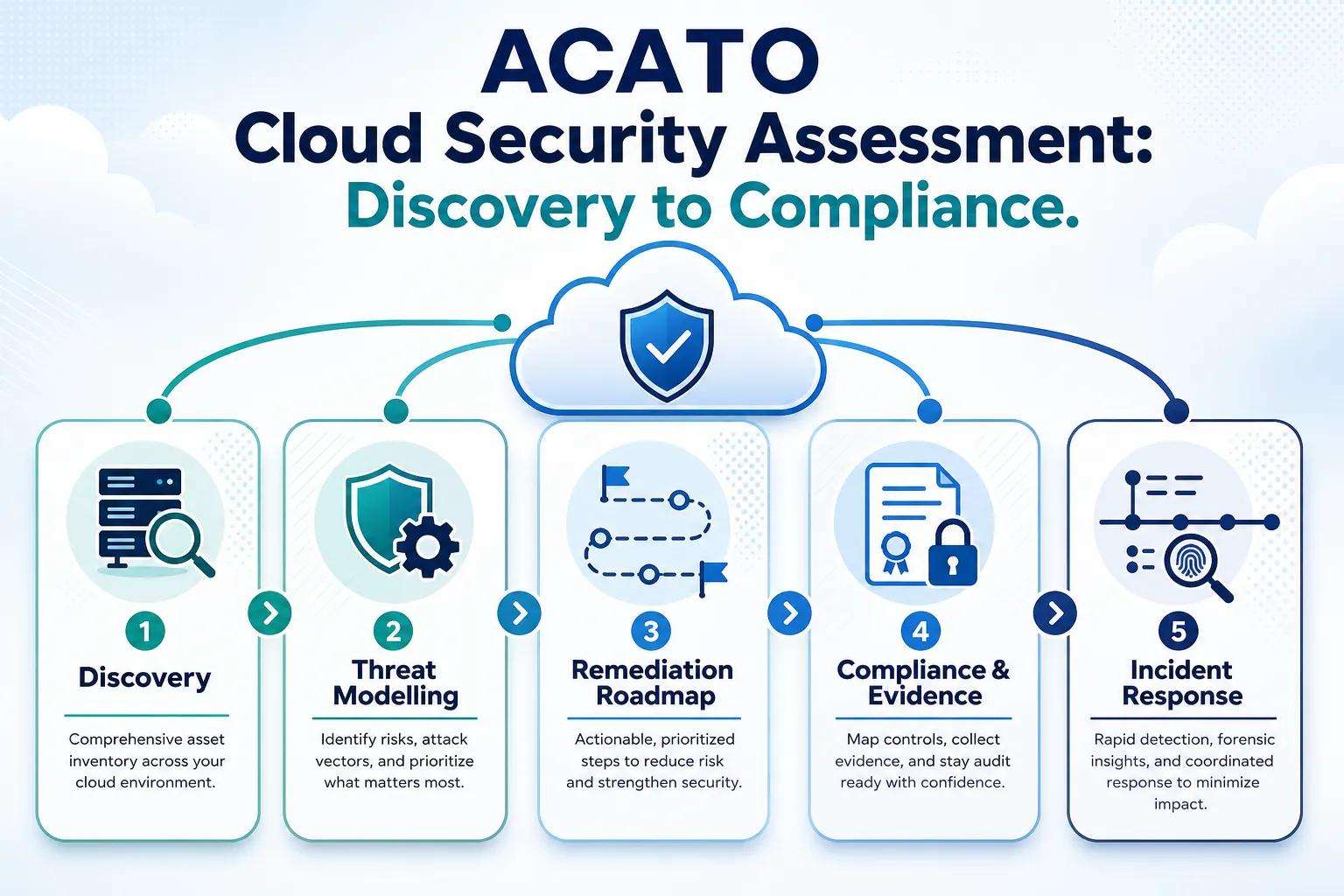
ACATO adopts an assessment-first methodology that prioritises risk and compliance gaps, designs pragmatic controls mapped to ISO 27001, and supports implementation through technical guidance and governance changes. The process foregrounds discovery, risk scoring and a prioritised remediation plan that balances business impact with likelihood, then follows through with implementation support and monitoring recommendations. Deliverables commonly include an asset inventory, risk register, remediation roadmap, and evidence packages suitable for certification or regulator review. This structured approach helps organisations transition from discovery to measurable security improvements while aligning cloud controls with broader ISMS processes.
What Is the Methodology Behind ACATO’s Cloud Security Assessments?
The assessment methodology begins with discovery and asset inventorying to capture cloud accounts, services and data flows, then uses automated CSPM scans and manual architecture reviews to identify misconfigurations and vulnerabilities. Findings are combined with threat and vulnerability analysis to produce a risk-scored register and a prioritised remediation roadmap that highlights quick wins and longer-term projects. Typical tools referenced include CSPM, targeted penetration testing and log analysis to validate detection capability; deliverables emphasise actionable tasks, ownership, and estimated timelines for remediation. The final phase includes handover and monitoring guidance so teams can embed improvements into their ISMS and continuous compliance cycles.
How Does ACATO Integrate ISO 27001 Principles into Cloud Security?
ACATO translates ISO 27001 clauses into cloud-specific policies and controls, for example defining ISMS scope to include cloud assets, tailoring access control policies to IAM constructs, and documenting supplier/cloud contract review processes. Evidence collection is framed around configuration baselines, centralised logs and change records that auditors expect, helping organisations demonstrate control effectiveness during certification. The integration also emphasizes a continuous improvement loop: implementing controls, measuring their operation, and feeding results back into the ISMS for iterative enhancement. This alignment reduces certification friction and ensures that cloud security is not an isolated technical activity but part of organisational risk management.

What Core Cloud Security Solutions Does ACATO Offer?
Cloud security solutions focus on platform hardening, posture management, detection and response, and data protection controls that are deployable across AWS, Azure and multi-cloud estates.
Typical services include architecture reviews and platform-specific hardening, CSPM-driven posture management, SIEM integration for centralised detection, and technical controls for encryption and key management. The EAV comparison below outlines how platform attributes map to common control categories to help decision-makers choose the right focus areas for their environment.
How Does AWS Security Consulting Enhance Cloud Protection?
AWS security consulting focuses on principle-of-least-privilege IAM configuration, enabling comprehensive logging via CloudTrail and centralising threat detection using GuardDuty and related services. Practical hardening includes creating narrowly scoped roles, separating duties between administrative and operational functions, and using resource-level policies to limit access paths. Storage hardening covers S3 bucket policies, mandatory encryption at rest and lifecycle controls to limit data exposure over time. Implementing consolidated logging and alerting ensures incidents are detected across accounts and that forensic trails are preserved for investigations and compliance evidence.
What Are the Benefits of Azure Security Consulting Services?
Azure-focused consulting leverages Defender for Cloud for posture assessment and Sentinel for scalable SIEM capabilities to unify detection across subscriptions and services. Governance is enforced through Azure Policy and Blueprints, enabling repeatable, auditable deployments that align with compliance baselines. Identity protection benefits from Managed Identities and Conditional Access to remove shared credentials and introduce adaptive controls based on risk signals. Together these controls improve detection fidelity, reduce drift from mandated configurations, and provide clearer audit trails for certification and regulatory reporting.
How Can Organizations Conduct Effective Cloud Security Assessments?
An effective cloud security assessment follows a structured framework: inventory assets, perform threat modelling, run automated CSPM scans, conduct manual penetration and architecture reviews, and produce a prioritised remediation roadmap tied to business impact. Prioritisation should map each finding to business-critical services and regulatory obligations so resources focus on the highest-impact fixes first. Outputs include a risk register, recommended controls, remediation timelines and monitoring recommendations to validate implementation. The checklist below distils these steps into actionable tasks that teams can apply immediately.
Follow this checklist to organise an assessment and track progress toward a measurable improvement in security posture.
- Inventory Assets: Catalogue accounts, services and data flows to define assessment scope.
- Threat Model: Identify entry points, privileges and attacker objectives for critical workloads.
- Automated Scanning: Run CSPM and dependency checks to catch configuration drift and vulnerabilities.
- Manual Testing: Perform architecture reviews and targeted penetration tests for business-critical assets.
- Prioritised Remediation: Map fixes to business impact and compliance needs with ownership and timelines.
These steps form a repeatable assessment cycle that feeds into continuous monitoring and control verification, which in turn supports compliance and incident readiness.
What Are Common Risks and Threats in Cloud Environments?
Common cloud risks include misconfigurations that expose services, compromised credentials that allow privilege escalation, and supply chain vulnerabilities introduced by third-party integrations. Insider risks and overly permissive identities accelerate attack progress when combined with limited monitoring, while insufficient patching of container images or serverless functions can leave exploitable vulnerabilities. Detection controls like centralised logging, anomaly detection in SIEM and runtime protection for workloads reduce dwell time and limit damage, helping teams contain incidents before they escalate into regulatory-reportable breaches.
How Does Threat Modeling Improve Cloud Security Posture?
Threat modelling methods adapted for cloud — such as STRIDE or PASTA applied to an architecture diagram — reveal where privileges, data flows and exposed endpoints create the highest risk. Translating identified threats into mitigations yields prioritized actions: harden IAM, encrypt data paths, implement network segmentation and add detection for specific attack vectors. Outputs include an attack surface map, prioritized mitigations and detection requirements that feed directly into sprintable remediation tasks. Regular threat modelling ensures that design decisions consider likely attacker goals and that security controls align to business impact.
Further research emphasizes the evolving nature of cloud threat modeling, highlighting the need for formal methodologies and automation to keep pace with complex cloud architectures.
Cloud Threat Modeling: Challenges, Methodologies & Automation
Cloud computing has significantly changed the operational models of companies. This adoption has consequently caused impact on security, resulting in a wider attack surface. Due to the diverse deployment models of the cloud computing architecture, securing the environment has become a challenging task. This paper provides a narrative review of threat modeling approaches in cloud computing. It seeks to identify research challenges and gaps that new research potentially needs to address. It reviews 10 recent related studies and identifies two main types of approaches. Findings show that the next-generation threat modeling needs to introduce more formal methodologies, including a quality assessment of the threat modeling process and its output. Furthermore, automation-enabled methods are vital for advancing the threat modeling process and enabling live integration with cyber threat intelligence for developing threat identification, management, and mitigation.
Threat modeling in cloud computing-a literature review, M Kharma, 2022
What Are Best Practices for Cloud Data Protection and Compliance?
Data protection in the cloud hinges on classification, encryption at rest and in transit, robust key management and strict access control tied to least privilege. Implementing consistent logging and retention policies creates the audit evidence needed for ISO 27001 or GDPR compliance, while data lifecycle controls minimise exposure by automating archiving and deletion. For multi-cloud environments, centralised key management and platform-agnostic DLP and CSPM tools enforce uniform policies and reduce operational friction. The table below compares compliance frameworks against cloud controls to guide implementation for SMEs and regulated organisations.
How Does ACATO Support Cloud Compliance with ISO 27001 and NIS 2?
ACATO offers gap analysis, control implementation advice and evidence-gathering support to prepare organisations for ISO 27001 certification and to align with NIS 2 expectations. Typical deliverables include a mapped gap analysis, recommended control set, templates for cloud policies and a package of audit-ready evidence such as configuration baselines and log retention records. Engagements are framed to achieve demonstrable certification readiness and to integrate compliance into day-to-day operations through ISMS updates. Organisations benefit from practical timelines and focused remediation activities that turn high-level requirements into technical and procedural tasks.
What Strategies Ensure Data Protection Across Multi-Cloud Platforms?
A strong multi-cloud data protection strategy centralises key management, standardises IAM and logging patterns, and deploys vendor-agnostic CSPM and DLP tools to ensure consistent policy enforcement. Centralised KMS or federation of key control reduces fragmentation and simplifies access revocation, while a unified logging pipeline aggregates telemetry for correlation and faster investigation. Automation via IaC scanning and policy-as-code ensures baseline configurations are applied consistently across clouds. Starting with classification and a minimal set of common controls yields rapid risk reduction and a manageable roadmap for platform-specific refinements.
Academic research further explores advanced techniques for securing data in complex multi-cloud environments, focusing on innovative approaches to privacy and reliability.
Enhancing Data Privacy & Security in Hybrid Multi-Cloud Environments
ABSTRACT: In this study, we present and realize a solution for contributing to the provision of data security and data privacy in a hybrid configuration based Multi Cloud environment. This method combines prevention of independent cloud security attacks and server failures through a Byzantine fault tolerance protocol, a data encoding and decoding mechanism using the Dusky architecture to improve reliability and confidentiality; and Shamir’s secret sharing scheme to guarantee data trustworthiness and privacy during storage at the cost of a minor performance implication. They compared the security and privacy of their hybrid approach with well-known protocols such as SAML with proxy encryption and Kerberos, showing the benefits in terms of memory footprint, encryption/decryption time and totaltimetoauthenticate. The experimental results show that our hybrid scheme provides considerable improvements with regard to encryption/decryption time, memory consumption and average precision.
Enhancing Data Privacy And Security In Multi Cloud Environments, ME Hossain, 2022
How Does Incident Response and Forensics Strengthen Cloud Security?
Incident response and forensics reduce the impact of cloud breaches by enabling fast containment, accurate scope determination and evidence collection needed for compliance or legal processes. Preparedness requires defined playbooks, assigned roles and telemetry that supports quick triage: logs, snapshots and network flows must be collected and preserved to reconstruct events. Forensic techniques adapted to cloud environments — snapshot capture, centralized log aggregation and timeline analysis — allow teams to establish root cause and affected assets. Integrating IR plans with the ISMS and compliance obligations ensures that post-incident reporting is timely and that lessons learned drive control improvements.
What Is the Process for Cloud Incident Response Planning?
A cloud incident response plan defines roles, escalation paths and classification criteria, then details containment, eradication and recovery actions tailored to cloud services and automation capabilities. The plan identifies critical telemetry sources — activity logs, CloudTrail/Activity Logs, network flows and storage snapshots — and prescribes how to preserve and analyse them without disrupting evidence integrity. Sample timelines assign minutes to initial containment and hours to scope assessment, with follow-up activities for remediation and ISMS update. Regular tabletop exercises and runbooks keep the team practised and reduce decision latency during real incidents.
How Does IT Forensics Help in Cloud Security Breach Investigations?
IT forensics in cloud contexts focuses on preserving volatile evidence, capturing snapshots of affected VMs or containers, and correlating centralized logs to build a chronological timeline of attacker activity. Artifacts such as CloudTrail events, Azure Activity Logs, access token usage and object storage audit records are critical to mapping intrusion paths and identifying compromised credentials. Forensic processes also consider chain-of-custody and integrity of collected data to support legal or regulatory follow-up and to provide defensible evidence for audits. Clear forensic playbooks help organisations determine root cause and scope, enabling more targeted remediation and improved future detection.
For teams ready to translate assessment findings into a remediation roadmap or certification plan, ACATO offers a free consultation to discuss ISO 27001 alignment, incident readiness and practical implementation steps for AWS, Azure or multi-cloud environments. This conversational planning session can help prioritise quick wins and long-term improvements while preserving organisational resources.
- Book a consultation: Discuss assessment scope and key objectives.
- Agree deliverables: Define the risk register, remediation roadmap and evidence package.
- Start remediation: Execute short-term fixes while planning medium-term architecture changes.
These steps help organisations convert findings into measurable security posture improvements and ensure that cloud security efforts align with compliance and business objectives.