
Create Effective Digital Evidence Reports with Our Template

Computer Forensic Report Template: Comprehensive Guide to Analyzing Digital Evidence
A computer forensic report is a structured document that records the acquisition, analysis, and interpretation of digital evidence to support investigations and legal proceedings. A robust template matters because it enforces reproducibility, preserves chain of custody, and translates technical artifacts into actionable conclusions for non-technical stakeholders and courts. This guide teaches how to build and use a digital forensic report template, how to analyse digital evidence step-by-step, and how to structure findings so they remain legally defensible and understandable. Readers will learn the essential report components, practical acquisition and preservation techniques, best practices for drafting methodology and findings, and how to tailor reports for executives, lawyers, and technical audiences. The article also covers preparing reports for expert witness testimony and demonstrates how templates adapt to incident types such as cloud, mobile, malware, and data breaches. Throughout, keywords such as digital evidence report, computer forensic report template, chain of custody digital evidence, and forensic methodology section are integrated to aid discoverability and practical use.
What Are the Essential Components of a Digital Forensic Report?
A digital forensic report lists and organises the fundamental sections needed to present evidence clearly, reproducibly, and impartially. These components establish scope, document methods and tools, present verified findings with hashes and timestamps, and conclude with recommendations and appendices for raw exhibits. Using a standard structure ensures each artifact is traceable from acquisition to interpretation and helps legal teams evaluate admissibility and weight of evidence. The sections below reflect canonical elements that forensic teams should include in every digital forensic report to maintain credibility and legal defensibility, and they set the stage for step-by-step analysis guidance.
The importance of standardizing these components for efficient reporting and legal integrity is further emphasized by research in the field.
Standardizing Digital Evidence Reporting for Forensic Tools
Due to the lack of standards in reporting digital evidence items, investigators are facing difficulties in efficiently presenting their findings. This paper proposes a standard for digital evidence to be used in reports that are generated using computer forensic software tools. The authors focused on developing a standard digital evidence items by surveying various digital forensic tools while keeping in mind the legal integrity of digital evidence items. Additionally, an online questionnaire was used to gain the opinion of knowledgeable and experienced stakeholders in the digital forensics domain. Based on the findings, the authors propose a standard for digital evidence items that includes data about the case, the evidence source, evidence item, and the chain of custody. Research results enabled the authors in creating a defined XML schema for digital evidence items.
Defining a standard for reporting digital evidence items in computer forensic tools, I Baggili, 2010
For organisations that prefer professional preparation, ACATO provides forensic report drafting and incident response support, including expert witness-ready reporting and international service coverage. ACATO’s specialists can author executive summaries and full forensic reports suitable for legal use and assist in immediate evidence preservation after incidents. Those needing expert report-writing services or a free consultation on incident handling and ISO-related controls can consider engaging trained forensic consultants to avoid common documentation pitfalls.
This EAV mapping helps analysts present raw artifacts and their significance succinctly in Findings and Appendices, improving reproducibility and reviewer comprehension.
How to Write an Effective Executive Summary in Forensic Reports
An effective executive summary is a concise, non-technical distillation of the report that states objectives, key findings, and recommended actions for decision-makers. Begin with the investigation scope and the primary question addressed, then summarise the most significant verified findings, including the impact and suggested remediation steps. Avoid technical jargon; present high-level confidence levels and any limitations that affect interpretation. The executive summary should allow senior stakeholders and legal counsel to grasp the investigation outcome quickly without parsing technical appendices.
- Scope & Objective: State the investigation purpose and systems involved.
- Key Findings: Summarise the most critical artifacts and their relevance.
- Recommendations: Provide prioritized remediation and preservation steps.
This approach ensures that the executive summary guides immediate decisions and transitions naturally into detailed methodology and findings that support those recommendations.
What Should Be Included in the Methodology and Findings Sections?
The methodology and findings sections document exactly how evidence was acquired, handled, analysed, and interpreted so that another competent examiner can reproduce the work. Methodology should record acquisition methods (live vs. dead), tools and versions, imaging hashes, and verification steps, while findings should list artifacts with timestamps, hashes, and analyst interpretation. Use tables in Findings to present artifact, source, timestamp, hash, and a short interpretation for each item. Transparency about constraints and assumptions—such as unavailable logs or encrypted volumes—preserves impartiality and helps readers evaluate evidentiary weight.
Methodology checklist:
- Acquisition method and justification.
- Tools and versions with verification hashes.
- Chain-of-custody entries for each transfer.
Clear methodology leads into a findings table and then to conclusions, ensuring each interpretation is traceable to specific artifacts and methods used in the analysis.

How to Analyze and Document Digital Evidence Step-by-Step?
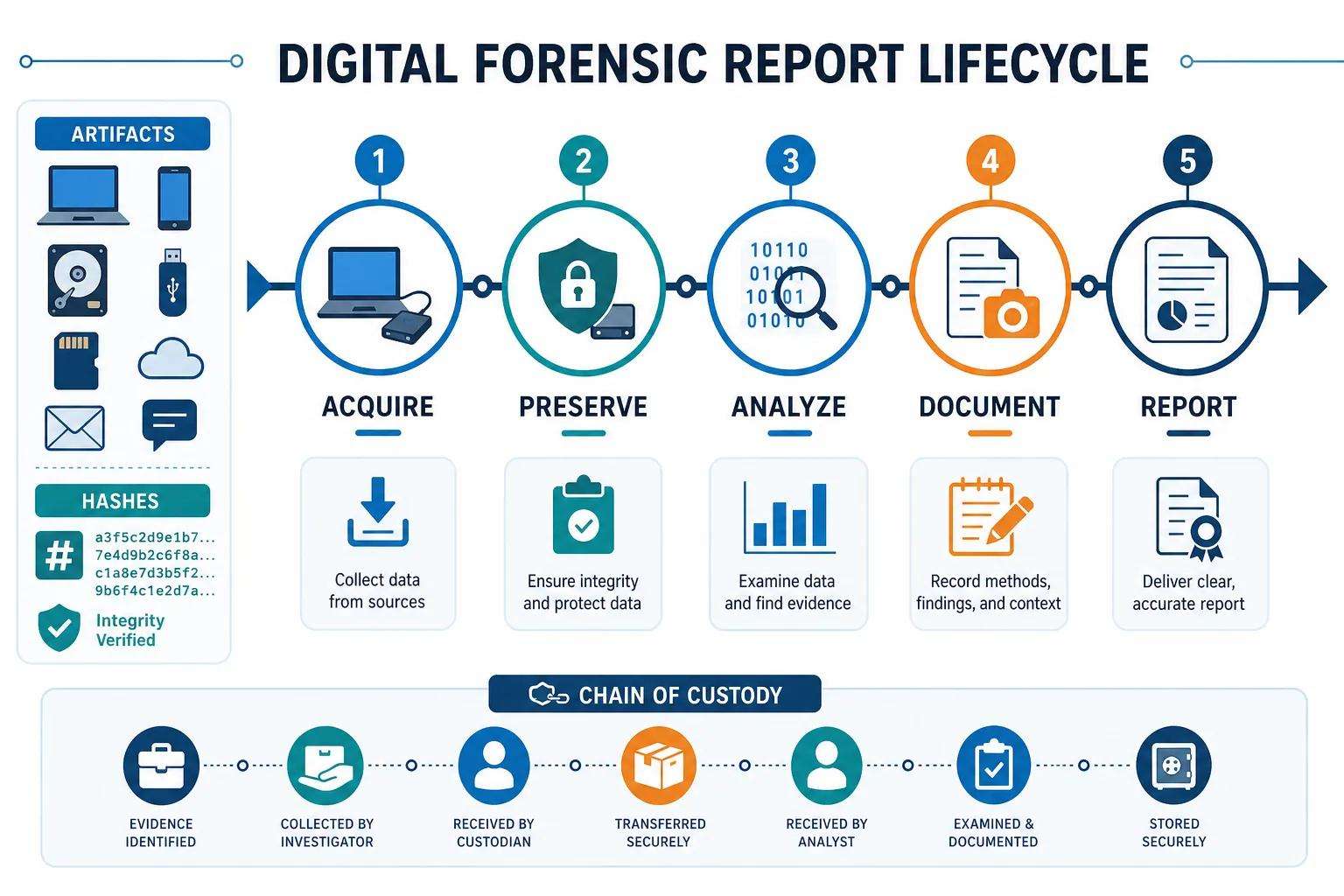
A practical analysis workflow follows discrete phases—acquire, preserve, analyse, document, and report—each designed to protect evidence integrity and create reproducible outcomes. Begin with triage and risk assessment to prioritise volatile evidence, then perform forensically sound acquisition using write-blocking and hashing, followed by timeline construction, correlation of artifacts across sources, and peer review before drafting findings. Documentation at every step, including tool outputs and verification hashes, ensures the final report can withstand scrutiny and supports expert testimony. Following this disciplined progression reduces the risk of contamination, omission, or misinterpretation of digital evidence.
The stepwise process below outlines core phases and their primary activities so analysts can translate actions into reportable methodology and defend results in court.
- Acquire: Collect volatile and non-volatile data with documented methods.
- Preserve: Secure originals and calculate hashes to verify integrity.
- Analyse: Build timelines, recover deleted data, and correlate artifacts.
- Document: Record commands, tool outputs, and chain-of-custody entries.
- Report: Draft executive summary, methodology, findings, and appendices.
Careful documentation during acquisition enables reliable analysis and leads directly into reproducible findings and defensible reporting.
What Are Best Practices for Digital Evidence Collection and Preservation?
Best practices for evidence collection combine technical controls with procedural rigor to maintain admissibility and integrity. Use hardware write-blockers for disk imaging, capture volatile memory before powering down when appropriate, and export cloud data using vendor-supported APIs while logging authentication and export parameters. Always calculate and record cryptographic hashes immediately after acquisition, and store originals in secured, access-controlled evidence storage with documented chain-of-custody. Chain-of-custody forms should record every transfer, including timestamps, personnel, and purpose, to preserve a clear provenance trace.
Preservation checklist:
- Use forensically sound tools and record versions.
- Hash media at acquisition and after transfer.
- Secure originals and document every custody change.
Adhering to these controls prevents common legal challenges related to evidence tampering or unexplained gaps in custody, which supports later interpretation and testimony.
How to Interpret and Present Digital Evidence in Reports?
Translating technical artifacts into clear, defensible interpretations requires separating raw facts from analyst opinion and expressing confidence levels. Present raw artifacts in appendices and use findings to map each artifact to case relevance with concise interpretation statements. Visual tools—timelines, annotated screenshots, and correlation diagrams—help non-technical readers and judges understand sequences of events and relationships among artifacts. Always state limitations, such as incomplete logs or ambiguous timestamps, to avoid overstating conclusions while preserving transparency about what the evidence does and does not support.
- Factual listing: Present artifacts, hashes, and timestamps without interpretation.
- Analyst interpretation: Link artifacts to hypotheses, with confidence ratings.
- Visual summaries: Provide timelines and annotated figures for clarity.
Clear presentation supports decision-making and sets up findings for use in legal proceedings or remediation planning.
What Are the Best Practices for Writing a Computer Forensic Report?
Producing defensible and readable forensic reports relies on clarity, reproducibility, and transparency about methods and limitations. Use consistent formatting, clear section labels, and appendices for raw data to keep the main body accessible to executives and legal readers while preserving technical depth for expert reviewers. Disclose tools and versions, include hashes for verification, and avoid advocacy by stating facts and reasoned interpretations. Consistent template usage improves reviewer efficiency and reduces the risk of omitting critical documentation that could undermine admissibility.
Report drafting best practices:
- Maintain reproducibility with detailed methodology and tool disclosure.
- Use appendices for raw artifacts and maintain a clear chain-of-custody log.
- Declare limitations and potential sources of uncertainty.
These editorial principles ensure reports remain useful across stakeholders and resilient under scrutiny, which naturally leads to legal admissibility considerations discussed next.
How to Ensure Legal Admissibility and Maintain Chain of Custody?
Yes — following a documented chain-of-custody and preserving original media are essential for legal admissibility. Maintain a standardised chain-of-custody form recording each transfer, person, time, and reason, and ensure originals are stored securely with restricted access. Capture cryptographic hashes at acquisition and verify them at each transfer; document tool names and versions used for imaging and analysis. Avoid altering original media and disclose any deviations from standard procedures with rationale to preserve transparency and reduce challenges during admissibility hearings.
Indeed, the legal admissibility of digital evidence hinges on its authenticity, accuracy, and completeness, with inadequate procedures often leading to inadmissibility.
Digital Evidence Admissibility: Authenticity, Integrity & Chain of Custody
For digital evidence to appear at court and be legally admissible, the evidence must be authentic, accurate, complete, and convincing to the jury. Presenting digital forensic evidence at court has proved to be challenging, due to factors such as inadequate chain of custody, not maintaining legal procedures and inadequate evidential integrity. Following legal procedures in evidence gathering at a digital crime scene is critical for admissibility and prosecution. However, inadequate evidence gathering and maintaining accuracy, authenticity, completeness has prevented many cases to be inadmissible at court. This paper aims to discuss digital forensics investigations jurisprudence and the issues of authentic, accurate, complete, and convincing evidence leading to inadmissibility at court.
Digital forensics investigation jurisprudence: issues of admissibility of digital evidence, A Yeboah-Ofori, 2020
Chain-of-custody checklist:
- Record every custody change with timestamp and signature.
- Preserve originals and use hashed copies for analysis.
- Explain deviations and preserve documentation for court.
Using this checklist reduces admissibility risk and allows reports to serve as the foundation for expert testimony or court exhibits.
Developing robust frameworks and standards for the chain of custody is crucial for ensuring digital evidence is accepted as valid in court.
Digital Evidence Chain of Custody Framework & Standards
Chain of custody of digital evidence in digital forensic field are today essential part of digital investigation process. In order the evidence to be accepted by the court as valid, chain of custody for digital evidence must be kept, or it must be known who exactly, when, where, why and how came into contact with evidence in each stage of the digital investigations process. This paper deals with digital evidence and chain of custody of digital evidence. Authors define taxonomy and use an ontological approach to manage chain of custody of digital evidence. The aim of this paper was to develop ontology to provide a new approach to study and better understand chain of custody of digital evidence . Additionally, developed ontology can be used as a method to further develop a set of standard and procedures for secure management with digital evidence.
Digital evidence cabinets: A proposed framework for handling digital chain of custody, Y Prayudi, 2014
ACATO provides Expert Witness services and prepares forensic reports for court disputes worldwide; their capabilities include producing expert-ready reports that align with legal admissibility standards. For organisations facing litigation, engaging expert witness services can streamline report preparation and courtroom support while ensuring impartial, methodical documentation.
What Tools and Technologies Enhance Forensic Reporting Accuracy?
Accurate forensic reporting is supported by tools for imaging, hashing, timeline analysis, log parsing, and cloud/API extraction; automation and validated utilities reduce human error while preserving audit trails. Use established forensic imaging tools for disk capture, specialized parsers for logs and mail artifacts, timeline correlation platforms to visualise event sequences, and validated cloud exporters to obtain provider-side records. Where appropriate, AI-assisted triage can highlight high-risk artifacts for analyst review, but analysts must validate automated outputs and document verification steps. Disclose tools and versions in methodology to preserve reproducibility and confidence in reported results.
- Imaging & hashing utilities: Ensure verifiable acquisitions.
- Timeline & correlation platforms: Aid in reconstructing sequences.
- Cloud and mobile exporters: Capture remote and device-specific artifacts reliably.
Documenting tool use supports reproducibility and helps readers evaluate the reliability of findings.
How to Use a Forensic Investigation Report Template Effectively?
A forensic template is effective when adapted to incident scope and audience while preserving core reproducibility elements. Select sections according to stakeholder needs—detailed methodology and raw artifacts for legal experts, concise executive summaries for management—and keep appendices organised with labelled exhibits, hashes, and extraction logs. Templates should specify expected content length for each section, include example sentence starters for clarity, and require mandatory items such as acquisition hashes and chain-of-custody logs. Maintaining reproducibility when adapting templates means not omitting verification artifacts even when summarising for non-technical readers.
Using this template guidance ensures each audience receives the right level of detail while preserving the forensic rigor needed for reproducibility and legal review.

What Sections Should a Forensic Report Template Include?
Canonical template sections include Executive Summary, Scope, Methodology, Findings, Conclusion & Recommendations, and Appendices for exhibits and raw data. Each section serves distinct audiences: executives require concise summaries, legal teams need method disclosure and exhibits, and technical reviewers need granular logs and tool outputs. Provide example sentence starters and required artefact listings for each section to standardise output across analysts and cases. Recommended word counts per section help balance readability with completeness and support efficient peer review.
- Executive Summary: 150-250 words for non-technical stakeholders.
- Methodology & Findings: 500-1,200 words combined for technical and legal scrutiny.
- Appendices: Complete raw exhibits, hash lists, and chain-of-custody records.
Standardising these sections reduces variance between reports and helps organisations maintain defensible documentation practices.
How to Customize Templates for Different Incident Types and Audiences?
Customize templates by adjusting technical depth, prioritising evidence types relevant to the incident, and selecting appropriate appendices for reviewers. For ransomware, emphasise encrypted volumes, ransom notes, and lateral movement artifacts; for insider threat cases, prioritise access logs, file transfers, and privileged activity; for cloud incidents, document provider-side exports, API logs, and IAM changes. Tailor language to audiences: use plain language and impact statements for executives, procedural and tool details for legal teams, and raw artifact indices for technical reviewers. Include clause language for cross-jurisdictional considerations and specify how to handle provider subpoenas or data retention policies.
Audience mapping:
- Executive: high-level impact and remediation.
- Legal: method disclosure and exhibit labelling.
- Technical: raw artifacts and commands used.
Customising templates this way preserves relevance while ensuring critical reproducibility elements are never omitted.
How Does Expert Witness Testimony Relate to Forensic Report Writing?
A forensic report often forms the evidentiary backbone of expert witness testimony by documenting the methods and conclusions that the expert will present in court. Reports intended for testimony must emphasise transparency, declare limitations, and include a clear expert opinion section stating the basis and scope of conclusions. Structuring reports so that findings and exhibits are directly cross-referenced to testimony exhibits reduces confusion during cross-examination and helps courts follow the factual and analytical trail. Preparing reports with courtroom presentation in mind ensures the expert can defend methodology, demonstrate reproducibility, and explain technical matters in accessible terms.
What Role Do Expert Witnesses Play in Court Disputes?
Expert witnesses provide impartial, reasoned opinions based on documented methods and evidence to assist courts in understanding technical matters beyond lay knowledge. They must disclose methodologies, toolsets, and limitations, and ensure their testimony aligns with the written report and exhibits. Anonymised case examples often show that clear documentation and transparent methodology reduce successful challenges during cross-examination. Experts should avoid advocacy and focus on explaining the significance and limitations of technical findings so the court can weigh the evidence fairly.
- Impartiality: Experts present objective analysis, not advocacy.
- Disclosure: Full method and tool disclosure is required.
- Support: Reports must support testimony with traceable artifacts.
This role underscores why reports must be meticulously documented and structured for court readiness.

How to Structure Reports for Effective Expert Testimony?
Structure reports to include a distinct expert opinion section, well-labelled exhibits, and a technical appendix that isolates raw data for expert review while keeping an executive summary for judges and clients. Include exhibit lists with labels matching courtroom demonstratives and ensure chain-of-custody records are collated and easy to reference. Provide clear templates for expert statements that identify the factual basis, methods used, and the expert’s conclusions with confidence levels. Preparing court-ready appendices and demonstratives facilitates effective testimony and helps the court understand complex technical relationships.
Exhibit preparation:
- Label exhibits consistently with report references.
- Assemble a technical appendix for experts and an executive summary for the bench.
- Prepare demonstratives (timelines, annotated screenshots) that mirror report figures.
This structure supports coherent testimony and strengthens the evidentiary value of the forensic report.
ACATO offers Expert Witness services that prepare reports for court disputes around the world and can assist in converting investigative reports into expert statements suitable for legal proceedings. Engaging such services can streamline courtroom preparation and reduce evidentiary challenges by ensuring reports meet international forensic and legal expectations.
At the end of the investigative and reporting process, organisations seeking professional support for forensic report drafting, incident response, or expert witness engagement can request a free consultation to discuss requirements, preserve evidence immediately after incidents, and obtain expert-ready reports tailored for legal or regulatory use. ACATO’s forensic and ISO advisory capabilities are available internationally to help organisations produce legally defensible, transparent, and reproducible forensic reporting.