
HIPAA Compliance: Protecting Patient Health Information

HIPAA Compliance Requirements: How to Protect Patient Health Information Effectively
HIPAA (the Health Insurance Portability and Accountability Act) defines legal obligations for protecting patient health information and sets the baseline for privacy, security, and breach notification across healthcare operations. This guide explains what constitutes protected health information (PHI), the difference between the Privacy Rule and Security Rule, and the practical controls organizations must implement to meet HIPAA compliance. Healthcare leaders face regulatory, financial, and reputational risks when PHI is mishandled, so this article delivers actionable steps — from risk assessments to encryption and vendor management — to reduce those risks. You will find concise checklists, EAV-style tables mapping safeguards to controls, and practical vendor contract guidance that supports operational decisions. The content covers core rules, technical baselines (encryption, access controls, logging), incident response steps, and continuous monitoring approaches that align HIPAA with broader frameworks such as ISO/IEC 27001 and the NIST Cybersecurity Framework. Read on for clear implementation actions, contract-focused templates, and places where an expert consultation can accelerate remediation and evidence collection.
What Are the Key HIPAA Compliance Requirements for Healthcare Providers?
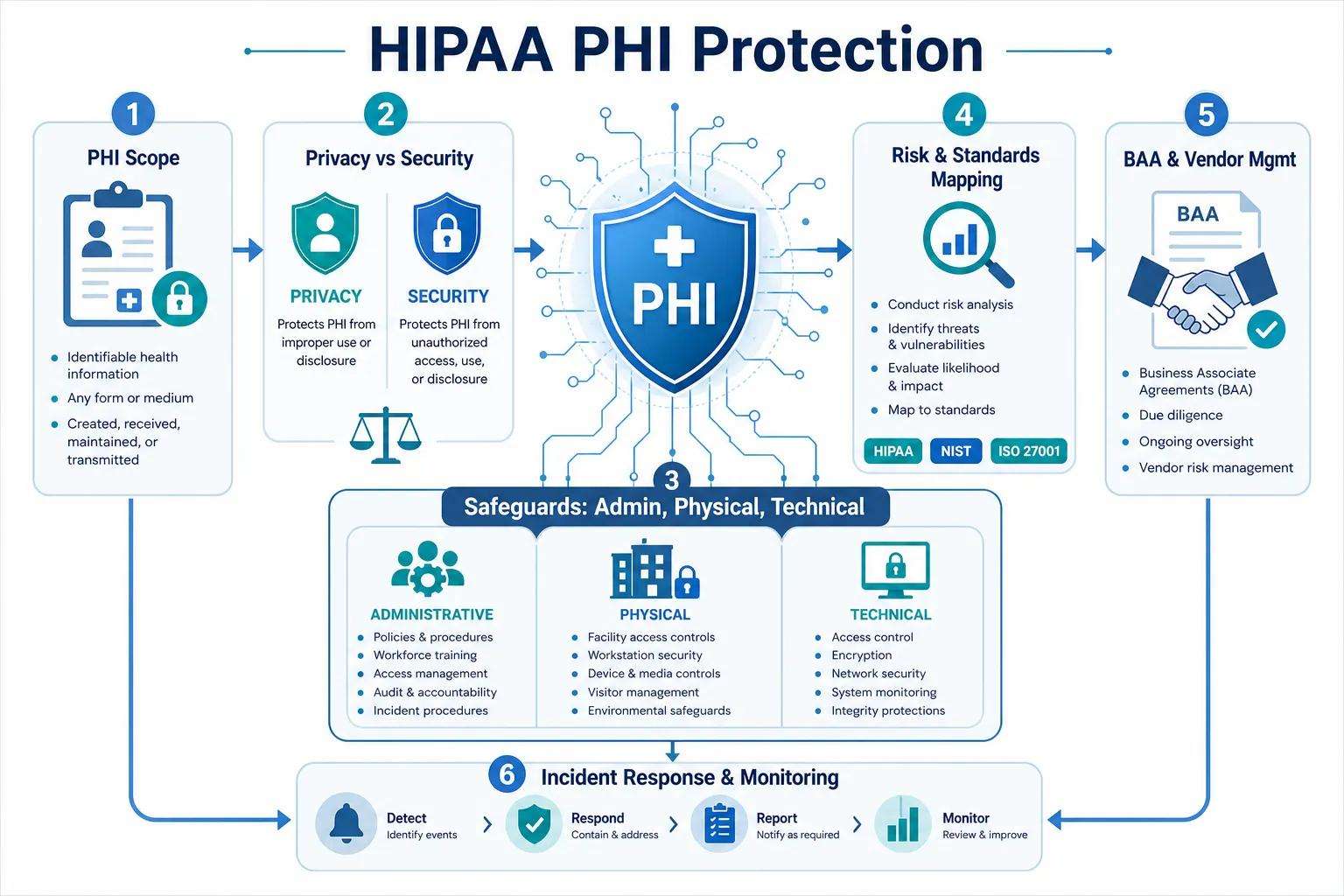
HIPAA’s core obligations for covered entities include three interlocking rules: the Privacy Rule (governing use and disclosure of PHI), the Security Rule (requiring administrative, physical, and technical safeguards), and the Breach Notification Rule (mandating timelines and reporting). These rules work together to ensure patient data confidentiality, integrity, and availability through documented policies, workforce training, technical controls, and incident procedures. Healthcare providers must maintain written policies such as a Notice of Privacy Practices, perform periodic risk assessments, implement audit logging, and provide workforce HIPAA training to evidence compliance. The following concise list highlights the primary compliance elements that are commonly inspected or audited.
- Privacy and permitted uses: Limit PHI disclosures to permitted purposes and document consents.
- Security safeguards: Apply administrative, physical, and technical controls proportionate to risk.
- Breach notification: Detect, assess, and notify affected individuals and regulators within required timelines.
These core requirements lead directly into detailed definitions of what PHI includes and how the Privacy and Security Rules differ in scope and effect.
Which Patient Health Information Must Be Protected Under HIPAA?
Protected Health Information (PHI) is any individually identifiable health information created or received by a covered entity that relates to past, present or future physical or mental health or payment for healthcare services. PHI typically includes identifiers such as name, date of birth, address, medical record numbers, treatment notes, imaging, and billing information when linked to an individual. De-identified data, where identifiers are removed following regulatory standards, falls outside PHI scope, while limited data sets permit restricted uses under data-use agreements. Understanding these boundaries helps organizations classify records for access controls, retention policies, and permissible disclosures.
PHI classification enables targeted safeguards such as stricter controls on treatment notes and flexible handling of de-identified analytics datasets. Identifying which datasets require the highest protection informs risk assessments and monitoring priorities, which we discuss next.
How Do the HIPAA Privacy and Security Rules Differ?
The Privacy Rule governs the permissible uses and disclosures of PHI and sets patient rights around access and amendments, while the Security Rule focuses on specific categories of safeguards — administrative, physical, and technical — to protect electronic PHI (ePHI). In practice, the Privacy Rule answers “who may see or share PHI” and the Security Rule answers “how PHI must be protected in systems and facilities.” Both rules require documented policies and workforce training, but the Security Rule also demands measurable technical controls such as encryption, access management, and audit logging. Recognizing this distinction helps organizations design controls that both limit disclosure and harden systems against unauthorized access.
This conceptual separation frames the practical control mapping that secures PHI across people, processes, and technology, which is described in the next section.
This EAV table summarizes the three primary HIPAA rules and the typical documentation examiners expect to see. Understanding these core obligations prepares organizations to map policies to controls and evidence.
How Can Healthcare Organizations Ensure Patient Health Information Security?
Securing PHI requires a risk-driven program: conduct a comprehensive HIPAA-aligned risk assessment, implement layered safeguards, enforce policies and training, and maintain continuous monitoring and incident response capability. Start with asset inventory and threat analysis to prioritize controls such as encryption-at-rest and encryption-in-transit, multifactor authentication (MFA), role-based access controls, and audit logging to capture access to PHI. Operational measures including physical facility controls, device management, and workforce training complement technical controls and create demonstrable evidence for compliance reviews.
- Perform a risk assessment: Identify ePHI assets, threats, and control gaps and produce a remediation roadmap.
- Develop policies and procedures: Document access controls, acceptable use, and incident response processes aligned to HIPAA.
- Implement technical controls: Deploy encryption, MFA, ACLs, and audit logging with tamper-evident retention.
- Train and test the workforce: Use role-based training and simulations to validate policy adherence.
- Monitor and review: Conduct regular access reviews, log analysis, and update controls based on incidents.
This checklist leads into a more detailed mapping of safeguard categories to practical tools and controls for implementation.
This EAV-style table links safeguard categories to actionable controls and example tools to help teams implement measurable evidence of compliance. The next section explains essential safeguards in more depth.
For organizations that need hands-on support, the information hub at acato.co.uk offers a free consultation that covers a HIPAA risk assessment, gap analysis, and a remediation roadmap tailored to your environment. This consultation is designed to prioritize the highest-risk ePHI assets, recommend configuration baselines for encryption and logging, and outline a practical evidence collection plan to demonstrate compliance. Choosing an expert review early shortens the remediation timeline and provides a clear set of deliverables for leadership and auditors. The following subsection details essential safeguard categories to implement as part of that roadmap.
What Are the Essential HIPAA Security Rule Safeguards?
The Security Rule organizes safeguards into three categories: administrative, physical, and technical. Administrative safeguards include policies, workforce training, risk assessments, and contingency planning that create the governance foundation for protecting PHI. Physical safeguards control facility and device access to prevent unauthorized physical access to records and systems, while technical safeguards such as encryption, access controls, and audit trails protect ePHI in systems and networks. Each category requires documentation and regular review to provide evidence of ongoing compliance to auditors and leadership.
These safeguard categories are interdependent: administrative policies mandate technical implementations, and physical protections reduce insider and environmental risks, which leads to concrete implementation guidance in the next subsection.
How to Implement Physical and Technical Controls for Data Protection?
Implementing physical and technical controls begins with risk-driven baselines: apply encryption-at-rest for databases and file stores, enforce encryption-in-transit for web and API traffic, and require MFA for remote and privileged access. Device management should include full-disk encryption, mobile device management, and secure wipe capabilities for lost or repurposed hardware. For verification, retain immutable audit logs that record PHI access, perform periodic access reviews, and document configuration baselines and change-control records. Combined, these controls reduce the attack surface and produce the evidence required during audits or incident investigations.
After implementing controls, organizations should schedule continuous monitoring, periodic control validation, and simulated exercises to ensure resilience and compliance, which the next main section addresses through standards mapping and risk assessment methodologies.
What Are the Healthcare Data Protection Standards Under HIPAA?
HIPAA sets outcomes and safeguard categories rather than prescriptive technical standards, so organizations interpret requirements by mapping controls to recognized frameworks and industry best practices. Aligning HIPAA controls with ISO/IEC 27001, NIST CSF, or other technical standards helps healthcare organizations create auditable control sets and measurement frameworks. Using standards alignment enables coherent evidence collection, change control, and governance reporting that auditors and executive stakeholders can evaluate uniformly.
Effective standards mapping requires a documented control matrix tying each HIPAA safeguard to a specific policy, technical control, and evidence artifact. This mapping approach supports audit readiness, which is commonly requested by regulators and contractual partners.
How Do Risk Assessments Support HIPAA Compliance?
A HIPAA-aligned risk assessment identifies ePHI assets, existing controls, threats and vulnerabilities, and the likelihood and impact of potential incidents, producing a risk register and remediation roadmap. Typical components include asset inventories, data-flow diagrams, threat modeling, and control evaluations that feed into prioritized remediation tasks. Deliverables should include a documented methodology, risk treatment plan, and timelines for mitigation actions that map back to HIPAA requirements. Periodic reassessment is essential, especially after major system changes, vendor onboarding, or detected incidents.
Producing a risk assessment creates the practical evidence auditors expect and informs resource prioritization for both technical controls and policy changes, which is crucial given common operational challenges described next.
What Are Common Challenges in Maintaining Healthcare Data Security?
Common obstacles include constrained budgets for security improvements, legacy systems that lack native encryption or modern access controls, workforce behavior that introduces human risk, and third-party vendor exposures through Business Associates. Mitigations include a prioritized remediation plan from the risk assessment, phased upgrades for legacy systems with compensating controls, continuous role-based training, and rigorous vendor risk management. Treating vendor relationships as part of the security perimeter reduces unexpected exposures and integrates third-party controls into the organization’s evidence base.
Addressing these challenges requires contract-level controls with vendors, which the following section explores with respect to Business Associate responsibilities and BAAs.
How Does Business Associate HIPAA Compliance Impact Patient Data Protection?
Business Associates (BAs) perform functions involving PHI on behalf of covered entities and therefore inherit substantive responsibilities to protect PHI under HIPAA. A well-managed Business Associate program requires clear BAAs that define permitted uses, security obligations, breach notification timelines, and audit or attestation rights. Vendor lifecycle management — from due diligence and contracting to ongoing monitoring and termination clauses — is essential; failure in BA controls often leads to the largest exposures due to outsourced data flows and cloud services. Ensuring BA compliance strengthens the overall PHI protection posture and provides contractual remedies when controls fail.
Below is a contract-to-action mapping that clarifies common BAA clauses and the corresponding vendor-management steps necessary to operationalize them.
What Responsibilities Do Business Associates Have Under HIPAA?
Business Associates must implement appropriate safeguards for PHI, promptly report breaches, limit uses consistent with the BAA, and allow appropriate access for audits or investigations. Examples of Business Associates include cloud providers hosting ePHI, billing processors, and analytics vendors that handle identifiable patient data. Contractual obligations often include specific technical measures (encryption, access controls), incident notification timelines, and requirements for subcontractor flow-down obligations. These responsibilities create direct, auditable tasks that BA vendors must perform to reduce risk for the covered entity.
Understanding BA responsibilities frames how to draft, negotiate, and monitor BAAs, which the next subsection addresses with a practical checklist.
How to Manage Business Associate Agreements for Compliance?
Managing BAAs effectively begins before contracting with a rigorous due-diligence checklist: require evidence of security posture, documented controls, and written incident response plans. Essential BAA components include permitted uses and disclosures, security safeguard expectations, breach notification processes, data return/destruction clauses, and audit or attestation rights. Post-contract, maintain an ongoing vendor monitoring schedule with periodic attestations, penetration-testing results where appropriate, and verification of subcontractor controls. Escalation procedures, remediation timelines, and termination clauses should be clearly defined to enable rapid action if a BA fails to meet its obligations.
For organizations that prefer practical assistance, the information hub represented by acato.co.uk provides a focused BAA review service and vendor risk management support; this offering includes clause-level guidance and recommendations for contractual language and monitoring cadence. Engaging a specialist can accelerate contract remediation and reduce negotiation cycles.
HIPAA Security Rules: Challenges and Implementation in Healthcare
This paper discusses the challenges associated with privacy in health care in the electronic information age based on the Health Insurance Portability and Accountability Act (HIPAA) and the Security Rules. We examine the storing and transmission of sensitive patient data in the modern health care system and discuss current security practices that health care providers institute to comply with HIPAA Security Rule regulations. Based on our research results, we address current outstanding issues that act as impediments to the successful implementation of security measures and conclude the discussion and offer possible avenues of future research.
Challenges associated with privacy in health care industry: implementation of HIPAA and the security rules, YB Choi, 2006
This table links BA responsibilities to contractual clauses and the practical vendor-management actions that fulfill them. Properly managed BAAs close a major gap in the PHI protection lifecycle.
What Are the Consequences of Non-Compliance with HIPAA?

Non-compliance with HIPAA can result in a spectrum of consequences including civil monetary penalties, corrective action plans imposed by regulators, and criminal liability in severe cases; additionally, organizations suffer operational disruption and long-term reputational harm that undermines patient trust. Beyond fines, non-compliant entities may face required system remediation, mandated audits, and contractual liabilities with payers or partners. These consequences underscore the need for documented controls, timely breach response, and proactive remediation planning to reduce both immediate and downstream impacts.
- Regulatory penalties and corrective actions: Regulators may impose fines and require corrective programs.
- Operational disruption: Investigations and remediation consume resources and may halt services.
- Reputational damage: Loss of patient trust and financial relationships can have lasting impacts.
These consequences make a well-rehearsed incident response plan an essential component of HIPAA readiness, which the following subsection details.
How Do HIPAA Violations Affect Healthcare Organizations?
HIPAA violations typically result in regulatory scrutiny, potential fines, and mandated corrective actions that require operational changes and oversight. Operational impacts include diverted IT and clinical resources for forensic investigations, remediation work, and extended audits, all of which increase costs and reduce service capacity. The reputational impact can lead to patient attrition, partner contract losses, and heightened scrutiny from payers and regulators. These combined effects mean that even a single incident can cascade into prolonged financial and operational consequences for providers.
Preventing these outcomes requires robust detection, containment, and communication processes, which is the focus of the next subsection on immediate breach steps.
What Steps Should Be Taken After a Data Breach?
An effective post-breach sequence begins with immediate containment and a preliminary assessment to determine the scope and impact on PHI, followed by internal notification to the breach response team and external notifications as required by the Breach Notification Rule. Forensic investigation and preservation of logs are necessary to understand root cause and provide evidence for regulators, while remediation actions should be documented in a corrective action plan. Organizations should also evaluate notification obligations to affected individuals and authorities, communicate transparently to reduce reputational harm, and update policies and training to prevent recurrence.
If a breach occurs, engaging incident response specialists and legal counsel early improves forensic outcomes and regulatory communications; the information hub at acato.co.uk offers emergency consultation and breach-preparedness reviews to help organizations assemble immediate response plans and remediation roadmaps. Prompt expert involvement often shortens investigation timelines and strengthens regulatory submissions.
This table provides a concise incident response checklist and the typical evidence items required by regulators during and after a breach investigation.
How Can Healthcare Providers Stay Updated on HIPAA Compliance Changes?
Staying current with HIPAA involves monitoring official regulator guidance, participating in industry groups, and embedding a cadence of training and audits to reflect regulatory updates and emerging threats. Sources to follow include regulator announcements, industry associations, and standards organizations that publish guidance on control expectations and best practices. Integrating update monitoring into governance routines ensures policies, training, and technical baselines evolve with changes in threat landscapes and regulatory interpretations.
Implementing a repeatable cycle of training, review, and audit helps translate regulatory changes into operational tasks and measurable evidence.

What Are Effective Training Strategies for HIPAA Compliance?
Effective training combines an annual baseline for all staff with role-based refreshers tailored to clinicians, administrative users, and IT personnel, using scenario-driven modules to teach practical decision-making. Simulated exercises — such as phishing simulations and tabletop breach response drills — improve behavioral outcomes and readiness. Track training effectiveness with metrics like completion rates, assessment scores, and incident reduction trends to prove training impact to auditors. A combination of microlearning, simulations, and role-specific content produces measurable improvements in compliance behavior.
Well-designed training programs feed into continuous monitoring and audit processes, keeping staff aligned with evolving policy changes that the next subsection covers.
How to Monitor and Audit HIPAA Compliance Continuously?
Continuous monitoring requires automated logging of PHI access, scheduled access reviews, and periodic policy audits to ensure controls operate as intended and evidence is retained for inspections. Implement SIEM or log-management solutions to alert on anomalous PHI access and automate retention of immutable audit records. Establish a documented audit cadence — for example, quarterly access reviews and annual policy reviews — and retain attestation records and corrective action logs. Combining automated detection with routine human review creates a sustainable compliance posture that regulators can validate.
- Reliable update sources include regulator guidance, standards bodies, and industry groups that provide interpretive guidance and best practices.
- Training strategies should be measured and role-based to ensure staff demonstrate required behaviors and decision-making.
- Continuous monitoring combines automated logging with scheduled human review to produce audit-ready evidence.
These practices create a living HIPAA program that adapts to regulatory and threat changes while improving organizational resilience and patient data protection.
This final table summarizes practical monitoring activities and their expected evidence items for sustained HIPAA compliance.