
Master Role-Based Access Control for Information Security

Implementing Access Control: A Comprehensive Guide to Protecting Your Information Assets
Access control is the set of processes and technologies that determine who can access which information assets and under what conditions, protecting confidentiality, integrity, and availability across systems and data stores. This guide explains how access control works at a conceptual and practical level, links common models such as RBAC and ABAC to deployment patterns, and shows how effective access governance reduces breach risk while supporting regulatory obligations like ISO 27001 and GDPR. Many organisations face over-permissioned users, unmanaged privileged accounts, and inconsistent enforcement; this article offers a phased roadmap for assessment, policy design, technology selection, and audit readiness to close those gaps. You will find comparative guidance on models, a step-by-step implementation plan, practical technology advice for IAM, MFA, and PAM, operational best practices for least privilege and reviews, and clear mappings from access controls to Annex A.9 and other regulatory requirements. Throughout, semantic relationships between identity, authentication, authorization, and audit trails are emphasised so readers can apply principles to SMEs, government bodies, NGOs, and infrastructure providers seeking both resilience and certification.
Implementing Access Control: A Strategic Framework for Security
Access control is the coordinated set of policies, identities, authentication, and authorization mechanisms that restrict access to resources to only authorised subjects. It works by verifying identity (authentication), evaluating entitlements and policy (authorization), enforcing decisions at enforcement points (gates, applications, APIs), and recording access events for monitoring and audit. The primary benefits are reduced insider and external threat exposure, demonstrable compliance with legal and contractual obligations, and operational control over who can view or change sensitive assets. Effective access control directly reduces the blast radius of credential compromise and supports incident detection via audit trails that feed security monitoring and forensics. Understanding these fundamentals prepares organisations to select suitable control models and technologies, which the next subsections explore in technical and governance terms.
How Does Access Control Protect Your Information Assets?
Access control protects assets by combining identity verification, policies, and enforcement to ensure only appropriate actions occur, and by creating logs that enable detection and response. Authentication methods such as passwords, certificates, and multi-factor authentication establish identity, while authorization mechanisms map that identity to allowed actions using roles, attributes, or discretionary rights. Enforcement occurs at application gateways, API managers, operating systems, and cloud identity layers, where policy decisions block or allow access and generate audit records. Logged events and access reviews then enable ongoing monitoring and evidence for audits, making access control both preventative and detective in a layered security approach.
What Are the Key Principles of Access Control?
Key principles include least privilege (only grant the minimum access needed), separation of duties (reduce fraud and error by splitting critical tasks), role minimisation (keep role counts small and meaningful), and need-to-know (restrict sensitive data to those with a legitimate purpose). Operationalising these principles requires artefacts such as a role matrix, approval workflows, change control, and documented policy that tie business functions to permissions. Practical tips include using temporary elevated access for high-risk tasks, automated provisioning and deprovisioning to reduce orphaned accounts, and defined approval authorities to prevent privilege creep. Applying these principles across people, processes, and technology forms the foundation for robust access governance and audit readiness.
What Are the Main Types and Models of Access Control?
Access control models frame how authorization decisions are made; choosing the right model affects complexity, scalability, and suitability for different operational contexts. Common models include role-based access control (RBAC), attribute-based access control (ABAC), discretionary access control (DAC), and mandatory access control (MAC). Each model maps identity and contextual information to permissions differently, influencing manageability, policy expressiveness, and enforcement points. The following concise list summarises the models for quick comparison and selection guidance.
- RBAC assigns permissions to roles and users to roles, making it efficient for organisations with stable job functions.
ABAC evaluates attributes (user, resource, environment) against policies and is suited for dynamic, fine-grained controls.
- DAC lets resource owners assign access, which is simple but can be inconsistent in large organisations.
- MAC enforces centrally defined labels and clearance levels for high-assurance environments where strict control is required.
The table below compares these models to help match capabilities to organisational needs and constraints.
Different access control models suit different organisational needs; this table summarises key characteristics and practical limitations to guide selection.
This comparison highlights that RBAC often fits SMEs and government departments with clearly defined roles, ABAC supports dynamic cloud identity scenarios, DAC is for small owner-led resources, and MAC suits regulatory or classified contexts with strict separation requirements.

How Does Role-Based Access Control Work and When Should You Use It?
RBAC groups permissions into roles that map to job functions and assigns users to those roles, reducing direct permission assignments and simplifying reviews. Role design follows discovery (identify tasks), grouping (create roles aligned to business functions), and lifecycle management (change, retire, review roles) with naming conventions and separation rules to control privilege. RBAC is particularly effective where role definitions are stable and HR systems can source identity attributes for provisioning, enabling automated onboarding and offboarding. Pitfalls include role explosion (too many roles) and role drift (permissions diverge from intended duties), which are mitigated through regular role rationalisation, role-based testing, and integration with access review workflows.
What Are Attribute-Based Access Control, Discretionary, and Mandatory Access Control?
ABAC bases decisions on attributes—user identity, resource labels, action types, and environmental context—allowing flexible, contextual policies such as time-based or location-aware access. DAC delegates control to resource owners, enabling fast collaboration but often lacking central oversight in larger organisations. MAC enforces centrally administered labels and clearance checks for access, providing strict compartmentalisation suited to high-assurance environments. Each approach presents trade-offs between expressiveness, administrative overhead, and auditability: ABAC offers fine control at the cost of policy complexity, DAC offers simplicity with governance risk, and MAC offers strong enforcement with operational rigidity.
How Do You Implement Access Control Effectively? A Step-by-Step Guide
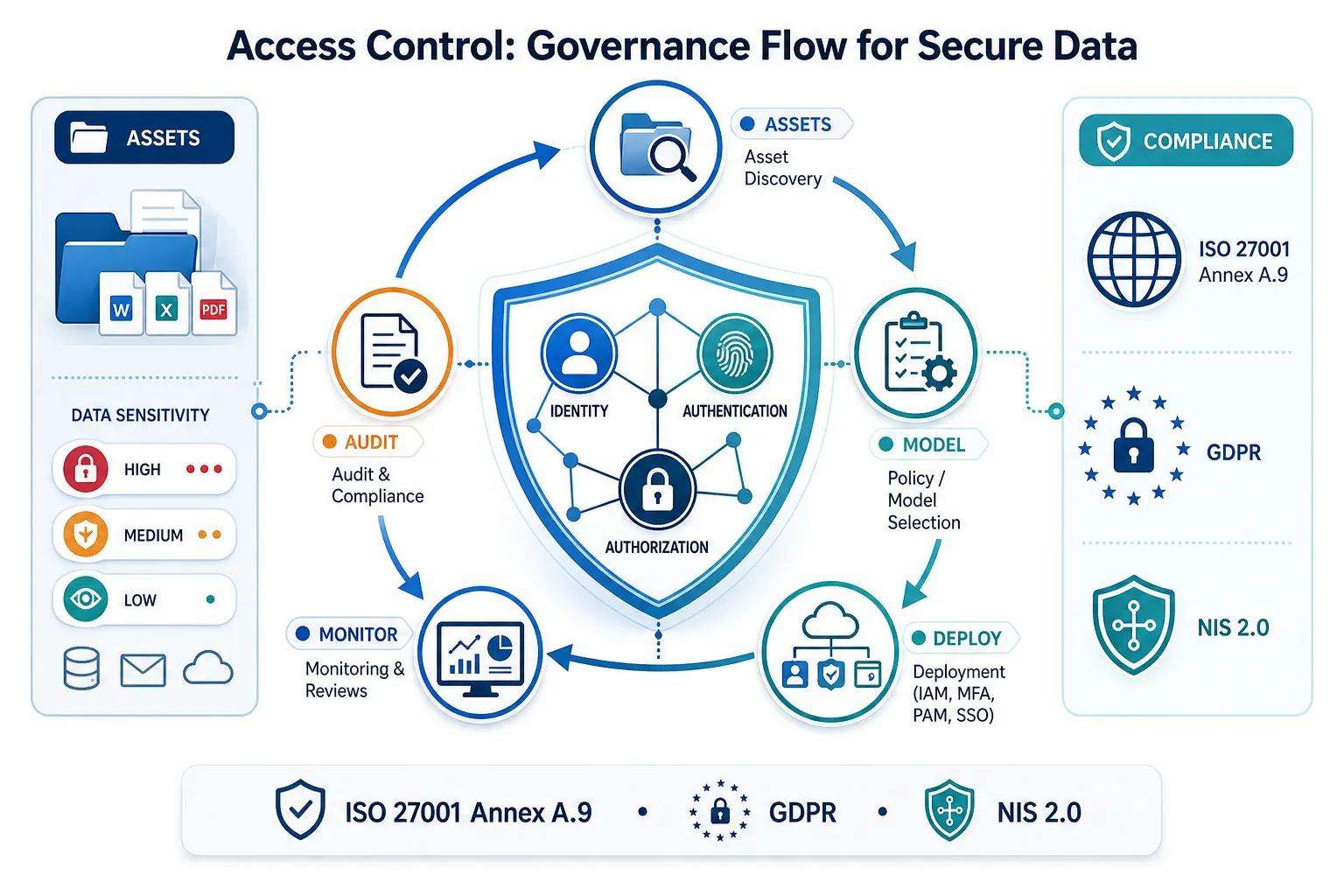
A phased implementation roadmap reduces risk and delivers measurable progress: assess assets and risks, design policy and model, deploy technology and integrate, then monitor and improve continuously. This lifecycle maps to deliverables such as an asset register, access control policy, role matrix, technology configuration baselines, and scheduled access reviews. Success depends on clear responsibilities, stakeholder engagement (HR, IT, legal, business owners), and measurable goals like reduced privileged accounts and completion of quarterly reviews. The numbered steps below provide an actionable high-level sequence that readers can adapt to their organisational scale and maturity.
- Assess Assets and Risks: Create an asset inventory, classify data sensitivity, and map current access paths.
- Design Policy and Model: Select RBAC/ABAC/MAC as appropriate, document access control policy and approval workflows.
- Deploy Technology and Integrate: Implement IAM, MFA, PAM, and SSO, and integrate with HR and cloud identity sources.
- Monitor, Review and Improve: Schedule regular access reviews, analyse logs for anomalies, and refine policies based on incidents and audits.
These steps provide a practical path from discovery to continuous improvement; the next table maps specific controls and tools to measurable outcomes organisations should track during implementation.
What Are the Key Phases in Access Control Implementation?
Implementation phases include discovery and risk assessment, policy and model design, pilot deployments and phased rollouts, and steady-state governance with monitoring and periodic reviews. Discovery produces artefacts such as an asset register, sensitivity classifications, and a risk register that inform model selection and policy scoping. Pilot deployments validate role definitions, integration with identity sources, and end-user workflows before organisation-wide rollout, reducing disruption and surfacing edge cases. Governance establishes review cadences, exception handling, and measurable KPIs; tying these to audit artefacts ensures the access control programme remains both effective and demonstrable during certification audits.

How Do You Deploy Technologies Like IAM, MFA, and PAM?
Technology selection should prioritise integration capability with existing HR and cloud identity providers, support for standards (SAML, OAuth, SCIM), and suitable administrative delegation models. IAM provides lifecycle automation and single sign-on to reduce password sprawl, while MFA significantly lowers account takeover risk through additional factors like hardware tokens or authenticator apps. PAM secures privileged accounts via credential vaulting, session recording, and just-in-time elevation to limit standing privileges. Deployment tips include starting with enterprise SSO+MFA for broad coverage, piloting PAM on the highest-risk systems, and instrumenting robust logging to feed SIEM and audit processes.
After completing technical rollouts and governance setup, many organisations choose to bring in external expertise to validate controls, prepare audit evidence, and accelerate certification. ACATO is a consulting firm specialising in information security, cyber security, and IT forensics and can help with assessments and certification readiness. ACATO assists SMEs, government authorities, NGOs, and infrastructure providers to align controls with ISO requirements and regulatory expectations, and can explain implementation steps and certification costs in a free consultation to clarify the path to compliance.
This section highlights the importance of Identity and Access Management (IAM) as a foundational technology for securing digital identities and controlling access within organizations.
Identity and Access Management (IAM): Framework for Secure Digital Identity Control
Identity and Access Management proposes a web service that assists in controlling the entire work through secured ways. This research study has been started to highlight the importance of IAM by discussing its roles, characteristics, advantages and disadvantages. It is a framework comprising processes, policies, and the latest technologies, allowing the organization to monitor digital identities and control exclusive access to follow information based on user data.
IAM identity Access Management—importance in maintaining security systems within organizations, C Singh, 2023
What Are the Best Practices for Access Control to Enhance Data Security?
Best practices combine technical controls with governance, automation, and people processes to maintain a resilient access posture over time. Core recommendations are to enforce least privilege, implement centralised identity governance, mandate MFA for high-risk access, and deploy PAM for privileged accounts. Complementary operational steps include scheduled access reviews, automated provisioning/deprovisioning from authoritative HR sources, targeted user training to reduce social engineering, and logging coupled to alerting thresholds. The following list organises essential practices to operationalise access control consistently across environments.
- Enforce least privilege: Grant users only the permissions required for tasks and use temporary elevation where needed.
- Centralise identity governance: Use IAM and access governance tools to provide a single source of truth and streamline audits.
- Mandate MFA: Require multi-factor authentication for privileged and remote access to reduce credential theft risk.
- Automate provisioning: Integrate IAM with HR systems to ensure timely onboarding and deprovisioning and reduce orphaned access.
Adopting these practices reduces attack surface and improves audit readiness; the next subsection explains least privilege mechanics and measurement, while the following subsection covers sustainment activities such as reviews and training.
How Does the Principle of Least Privilege Improve Security?
Least privilege limits the set of actions and resources a user or process may access to the minimum necessary, thereby reducing the potential impact of credential compromise or insider misuse. Implementation techniques include role scoping, just-in-time access that grants temporary elevation, and breaking up broad roles into narrowly scoped ones for sensitive functions. Measuring success relies on metrics such as number of privileged accounts, percentage reduction in high-risk permissions after role remediation, and time-to-revoke access on termination. In practice, least privilege combined with PAM and access reviews significantly reduces lateral movement and simplifies forensic investigations when incidents occur.
Why Are Regular Reviews, User Training, and Centralized Management Critical?
Regular reviews and centralised management keep permissions aligned to current business needs and reveal drift from intended roles, while user training reduces risky behaviours that enable account compromise. Recommended cadences include quarterly reviews for privileged accounts and semi-annual reviews for standard roles; exceptions should require documented business justifications and time-bound approvals. Centralised identity governance provides visibility across cloud and on-premise systems, enabling faster remediation and consistent policy enforcement. Together, these practices create a sustainable access programme that supports audit evidence, reduces human error, and improves overall security posture.
How Does Access Control Support Compliance with ISO 27001 and Other Regulations?
Access control is a core component of compliance frameworks; ISO 27001’s Annex A.9 specifically addresses access control objectives and controls, while GDPR, NIS 2.0, and the Data Protection Act emphasise lawful processing, data minimisation, and accountability. Mapping technical measures to regulatory requirements simplifies audit readiness by showing concrete evidence such as access control policies, role matrices, configured MFA, logs, and access review records. The table below ties typical regulatory requirements to Annex references and practical evidence organisations can present to auditors.
The following mapping demonstrates how access control measures directly meet certification and regulatory obligations and what artefacts auditors expect.
What Are ISO 27001 Access Control Requirements and Annex A.9 Controls?
ISO 27001 Annex A.9 mandates access control objectives such as ensuring access rights are appropriately granted, managed, and reviewed, and that user access is revoked when no longer required. Typical implementations include documented access control policy, role-based permission assignments, MFA for sensitive access, and periodic access reviews with recorded approvals. Auditors expect artefacts like a role matrix, access review reports, authentication configuration screenshots, and logs that show enforcement and any exceptions with approvals. Demonstrating a repeatable process for provisioning, change control, and review shows both operational control and readiness for certification.
How Does Access Control Help Meet GDPR, NIS 2.0, and Data Protection Act 2018 Obligations?
Access control supports GDPR by limiting access to personal data on a need-to-know basis, enabling data minimisation and supporting the accountability principle through documented policies and evidence. For NIS 2.0 and infrastructure providers, robust access management, privileged account controls, and logging feed into regulatory expectations around operational resilience and supply chain risk. Under the Data Protection Act 2018, demonstrable technical and organisational measures—such as restricted access, DPIAs reflecting access patterns, and contractual controls—help organisations meet legal obligations and reduce regulatory exposure. Access controls therefore serve both operational security and legal compliance functions when implemented and evidenced correctly.

How Can ACATO Support Your Access Control Implementation and Certification?
ACATO provides specialised consulting across information security, cyber security, and IT forensics to help organisations design, implement, and demonstrate effective access control as part of an ISMS and certification journey. Services that align to access control needs include ISMS and ISO 27001 consulting, certification support and audits, security assessments, awareness training, and incident response that integrates access governance with detection and remediation. Provide useful information and expertise to lead potential clients to book free consultations or engage their services. ACATO combines expert guidance for ISO certifications with a holistic approach that ties access control to broader cyber services, helping organisations improve resilience and achieve audit-ready evidence.
What Consulting and Audit Services Does ACATO Offer for Access Control?
ACATO’s service offerings relevant to access control typically include initial assessments to create an asset and risk register, policy design and role matrix development, technology selection advice for IAM/MFA/PAM, implementation support during rollouts, and audit readiness support for ISO 27001 certification. Engagements usually follow a flow of assessment → policy and design → implementation support → audit and certification assistance, with deliverables such as access control policies, documented role matrices, evidence packs, and training materials. These services aim to reduce the time to demonstrate compliance, improve control effectiveness, and provide practical steps to remediate gaps discovered during assessments.
How Have Clients Benefited from ACATO’s Access Control Expertise?
Clients that have engaged ACATO for access control and ISO readiness report improvements in audit outcomes, measurable reductions in excessive permissions, and faster incident response thanks to better logging and privileged account management. Outcomes include clearer role definitions, documented and repeatable provisioning processes, and demonstrable artefacts required by auditors—leading to more efficient certification paths and stronger regulatory positioning. By integrating policy, technical controls, and training, ACATO helps organisations achieve both compliance goals and operational resilience in a way that aligns security investments to measurable business benefits.