
Top Access Control Strategies: Secure Your Space with Ease
Implementing Robust Physical Security for Modern Businesses
Physical security measures protect facilities, people, and information by combining deterrence, detection, delay, and response into a coherent defense strategy. This article explains what core physical security systems do, how they mitigate risks to commercial premises, and why integrating physical controls with information security standards such as ISO 27001 improves resilience. Readers will gain practical selection criteria for access control and video surveillance, clear mappings from ISO 27001 Annex A to tangible controls, and operational steps for incident response and compliance with NIS 2.0 and GDPR. The guide covers perimeter protections, intrusion detection, environmental safeguards, and policy and training programs that support consistent implementation. Practical lists, comparison tables, and checklists are included to enable rapid risk assessment and to prioritize investment decisions for SMEs, data centers, and corporate sites. Throughout the article, semantic considerations for cyber-physical risks and evidence preservation for forensic follow-up are highlighted to support audit-readiness and regulator expectations.
What Are the Essential for Businesses?
Essential physical security systems are the core building blocks that deter, detect, and enable response to threats against premises, assets, and people. These systems work by creating layered controls: perimeter measures slow intruders, access control regulates entry to secure areas, surveillance provides detection and evidence, and alarms prompt rapid response. The resulting benefit is a measurable reduction in successful breaches and improved investigatory capability when incidents occur. Understanding the strengths and integration points of each system helps organizations design an affordable, risk-based protection plan tailored to their threat profile and operational needs.
This list summarizes the primary systems with a concise definition and the main benefit for featured-snippet clarity:
- Perimeter security: fences, gates, and vehicle barriers that delay unauthorized access and channel movement.
- Access control: credential systems that restrict entry to authorized personnel and log movements.
- Video surveillance (CCTV): cameras and recording systems that deter crime and provide forensic evidence.
- Intrusion detection systems: sensors and alarms that detect unauthorized entry and trigger response.
- Environmental safeguards: fire suppression, HVAC protection, and UPS measures that preserve equipment and data.
- Visitor management: processes and logging that control temporary access and support audits.
These systems work best when layered and integrated, which leads into practical comparisons of their roles and interoperability.
Introductory table comparing core physical security systems and their practical attributes:
Different systems serve complementary roles; this table highlights purpose, strengths, limitations, and typical integration points to guide selection.
This comparison clarifies where investments deliver most risk reduction and which integration points should be prioritized during design and procurement.
Which Types of Physical Security Measures Protect Commercial Premises?
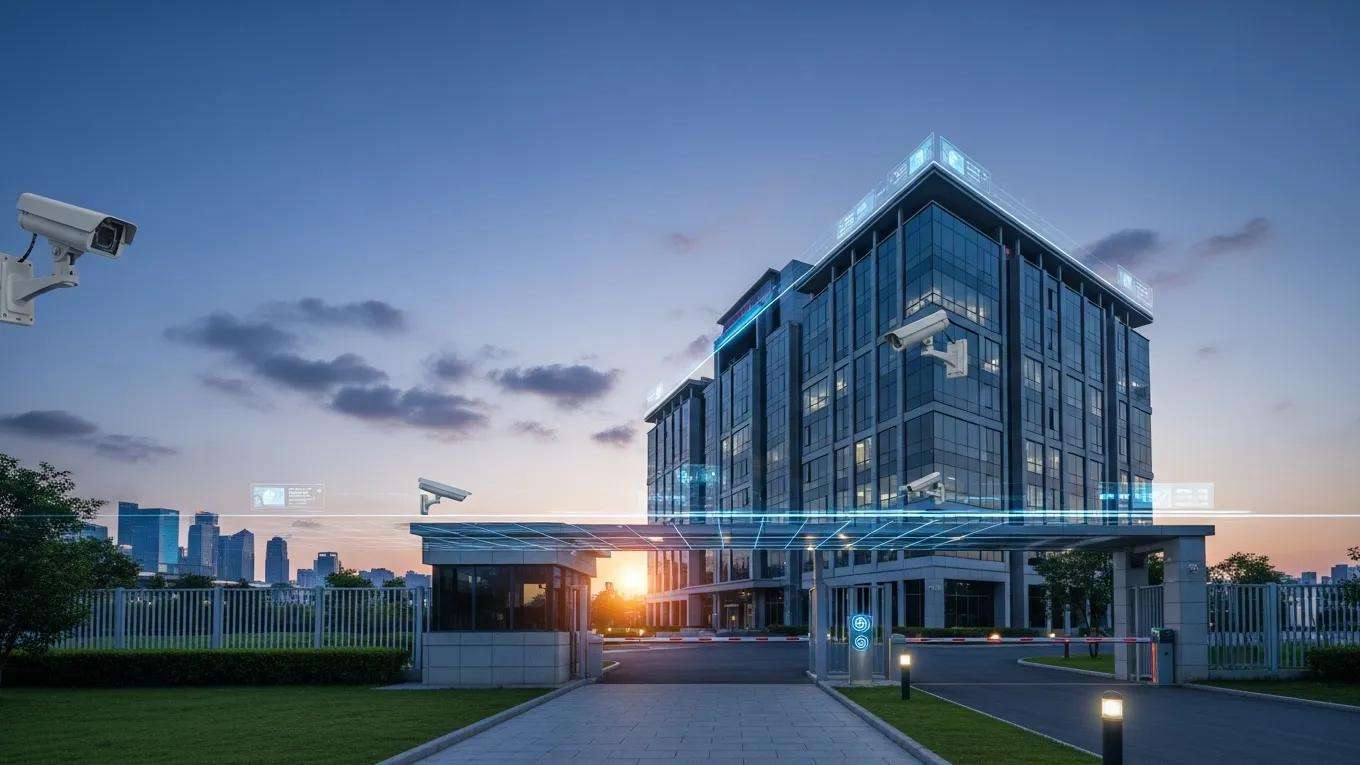
Tangible physical measures form the first line of defense by creating visible and physical obstacles that deter opportunistic and targeted threats. Perimeter fencing, controlled vehicle access, bollards, and secured gates slow attackers while lighting and natural surveillance reduce concealment opportunities. On-site security personnel and mobile patrols provide human detection and escalation capabilities, and physical barriers such as turnstiles and secure doors create layered access zones within buildings. These measures produce a combined deterrent/delay effect and are most effective when paired with detection systems and clear operational procedures for staff.
Selecting the right mix depends on the premises type, threat profile, and operational constraints. For example, a retail site benefits heavily from lighting, CCTV, and staffed reception, while a data center needs hardened fencing, mantraps, and redundant environmental systems. Designing layered measures and documenting rationale supports both operational effectiveness and audit evidence for compliance with information security requirements.
How Do Physical Security Systems Mitigate Risks to Your Business Premises?
Physical security systems mitigate risk by addressing the four core functions: deterrence reduces attempts, detection reveals incidents early, delay increases time to act, and response limits damage and recovers assets. For instance, integrating access control logs with CCTV allows rapid verification of anomalous entry and supports immediate containment decisions. Metrics for effectiveness include reduction in incident frequency, faster detection-to-response times, and the quality of forensic evidence for post-incident investigations. Risk assessments should identify critical assets, map existing controls to threats, and prioritize upgrades that yield the highest marginal improvement in these metrics. Creating measurable controls and test scenarios—such as table-top exercises and live-drill responses—improves confidence in system performance and uncovers gaps before an actual incident. Documented test results also serve as strong audit evidence during compliance assessments and certification processes, which ties directly into standards-based protection frameworks.
How Does ISO 27001 Address Physical Security Controls for Premises Protection?
ISO 27001 addresses physical and environmental security through Annex A controls that require organizations to identify secure areas, control access, protect equipment, and implement environmental safeguards to preserve information assets. The mechanism is a risk-based Information Security Management System (ISMS) that mandates documented policies, risk assessments, implemented controls, and audit evidence. The specific benefit is audit-readiness and demonstrable governance that links physical protections to information asset confidentiality, integrity, and availability. Mapping Annex A controls to operational measures simplifies compliance and makes physical security a visible part of an organization’s wider information security posture.
The following table maps common Annex A control themes to practical implementation examples and typical auditor evidence to help teams prepare for certification and internal audits.
Achieving compliance often requires guided gap analysis and targeted remediation. Organizations seeking support can engage specialist ISO 27001 ISMS consulting to perform a formal gap analysis, prioritize controls, and prepare audit documentation. ACATO specializes in ISO 27001 consulting, guidance, gap analysis, preparation, and audit support that explicitly cover physical security aspects and how they align with Annex A. A short case example illustrates this approach: an enterprise client used a gap analysis to consolidate access control logs with CCTV retention policies, producing clear audit evidence and reduced nonconformities during certification. For teams seeking hands-on assistance, ACATO offers free consultations to explore ISMS readiness and practical remediation steps.
What Are the Key ISO 27001 Annex A Physical and Environmental Security Controls?
Key Annex A controls focus on preventing unauthorized access to secure areas, protecting equipment and physical media, and ensuring environmental safeguards are in place to protect information assets. Mechanisms include controlled entry points, role-based access lists, asset inventories, environmental monitoring, and visitor management procedures. The primary benefit is that these controls provide auditors with traceable records linking policy through to implemented safeguards and monitored results. Examples of acceptable evidence include documented zone definitions, access logs, maintenance records for suppression systems, and retained CCTV footage in line with retention policies.
Organizations should maintain a control register that maps each Annex A requirement to implemented measures and supporting evidence. This practice streamlines internal audits and demonstrates continuous compliance during external certification reviews.
How Can Businesses Achieve ISO 27001 Certification for Physical Security?
Achieving ISO 27001 certification for physical security begins with an ISMS scoping exercise and a detailed risk assessment that identifies threats to people, premises, and information assets. Next steps include drafting or updating policies (access control, visitor, equipment handling), implementing technical and physical controls, compiling evidence of operation, conducting internal audits, and addressing nonconformities before external audit. Common pitfalls include undocumented temporary access practices and inconsistent CCTV retention policies; addressing these early prevents audit delays. The clear outcome is documented, repeatable processes and demonstrable controls that satisfy auditors and regulators.
A pragmatic timeline often spans several months depending on remediation scope; engaging external consultants for gap analysis and audit support can accelerate readiness. Consulting support focuses on translating Annex A requirements into pragmatic controls and the specific evidence auditors will accept.
What Are the Best Commercial Access Control Solutions for Secure Premises?
Commercial access control solutions range from simple standalone card readers to networked systems supporting biometrics and mobile credentials, and selection depends on security level, scalability, and integration needs. The mechanism behind modern systems is centralized credential management with event logging for audit trails, which produces the benefit of traceable access events and rapid lock-down capability. Evaluating solutions requires weighing security versus convenience, interoperability with CCTV and alarms, and lifecycle costs associated with credential issuance and revocation. Practical selection criteria should include encryption of credentials, vendor support for integrations, and administrative controls for role-based access.
Introductory comparison table to aid selection between common access methods and use-case guidance:
ACATO evaluates access-control cyber-physical risks as part of security audits and ISO 27001 certification projects, assessing credential lifecycle, integration with video/alarm systems, and logging for forensic readiness. Organizations considering a security audit or certification pathway can request a free consultation to review their access-control architecture and prioritize remediation steps.
How Do Digital Credentials and Biometrics Enhance Access Control?
Digital credentials and biometrics strengthen access control by tying access decisions to unique electronic tokens or physiological characteristics, which improves identity assurance and reduces the risk of misplaced physical keys. The mechanism involves cryptographic provisioning for mobile credentials and secure template storage for biometrics; these approaches provide benefits such as faster revocation and reduced tailgating when combined with multi-factor entry. Privacy and data protection considerations under GDPR require clear policies, data minimization, and controlled retention of biometric templates. Fallback procedures, such as supervised entry or secondary credentials, are necessary to preserve availability and support contingency operations. Implementing these technologies requires careful integration with existing identity management systems, clear consent and privacy notices where biometrics are used, and documented procedures for template storage, access, and deletion.
How Does Access Control Integrate with Video Surveillance and Alarm Systems?
Access control integrates with video surveillance and alarm systems through event-driven triggers that enhance detection, context, and response. Common patterns include access-triggered video recording, alarm correlation for unauthorized entry attempts, and synchronized logs that support rapid forensic analysis. The main benefit is improved situational awareness and evidence quality during investigations, enabling security teams to verify alarms and to reconstruct timelines during incidents. Technical considerations include time synchronization across systems, secure log retention, and ensuring that VMS and access control systems are hardened and segmented to reduce cyber-physical risks. Operational workflows should document who reviews correlated events, escalation paths, and retention schedules that meet both security and regulatory needs to preserve chain-of-evidence integrity.
How Can Video Surveillance Systems Improve Business Premises Security?
Video surveillance systems improve premises security by providing real-time monitoring, deterrence, evidence collection, and analytics-driven insights that prioritize human attention where it matters most. Modern IP-based cameras combined with AI-powered analytics can detect behaviors, count people, and trigger alerts for unusual events, reducing manual monitoring burdens while improving detection accuracy. The mechanism of analytics is pattern recognition that flags anomalies and focuses response resources, yielding faster detection-to-response times and richer forensic material. The net benefit is both preventive deterrence and enhanced incident investigation capability, which supports compliance and risk reduction objectives. Before deploying networked surveillance, organizations must plan for privacy compliance, secure camera/VMS configurations, and resilient storage strategies to ensure system integrity and evidentiary value.
This list summarizes surveillance benefits and a one-line example for operational clarity:
- Deterrence: Visible cameras discourage opportunistic crime, lowering incident rates in public-facing areas.
- Evidence collection: Recorded footage provides timestamps and visual proof for investigations and prosecutions.
- Real-time monitoring: Alerts enable security teams to intervene rapidly when incidents are detected.
- Analytics-driven insights: Behavioral analytics highlight anomalies such as loitering or perimeter breaches.
After considering capabilities, technical and network protections must be applied to maintain camera and VMS security before they can reliably support forensic and operational needs.
What Are the Benefits of CCTV and AI-Powered Analytics for Monitoring?
CCTV combined with AI analytics delivers improved situational awareness by automatically identifying events that require human attention and reducing false positives through contextual analysis. Mechanisms include object and behavior detection models that flag tailgating, perimeter intrusion, or left objects, which help security teams prioritize responses. The benefits include reduced monitoring costs, faster incident detection, and more actionable alerts that improve response quality. However, accuracy limits and bias in models necessitate human oversight and well-defined thresholds to avoid missed detections or excessive alerts. Operationally, teams should conduct validation tests of analytics in their environment and define escalation workflows that integrate alert verification with access control and alarm systems to close the response loop.
How Does Networked Surveillance Support Cyber-Physical Security?
Networked surveillance exposes cameras and recording systems to cyber risk if left unsegmented or poorly configured, but when hardened properly they become valuable sources of forensic data and continuous monitoring. The mechanism of secure deployment includes network segmentation, device hardening, encrypted management channels, and centralized logging; these measures reduce the attack surface and preserve evidence integrity. The benefit of such an approach is that cameras not only detect physical anomalies but also provide forensic artifacts that help trace cyber-physical attack vectors. Mitigations must include regular firmware updates, access control for VMS administration, and monitoring of device behavior for indicators of compromise. Forensic readiness requires secure retention of footage with preserved metadata and timestamps to enable incident reconstruction and support legal or regulatory investigations.
Why Is an Integrated Physical and Cyber Security Approach Critical for Premises Protection?
An integrated physical and cyber security approach recognizes that most modern security systems are cyber-physical and that vulnerabilities in one domain can be exploited to compromise the other. The mechanism of convergence is the interconnection of IP cameras, access control panels, and building management systems to corporate networks, which creates combined attack surfaces. Integrating security improves detection, response, and resilience by enabling correlated alerts, shared logs, and unified incident playbooks that address both physical and digital indicators. The clear benefit is reduced overall risk, faster incident containment, and enhanced evidence collection for post-incident analysis. Implementing integration requires governance that aligns IT and facilities teams, documented incident response roles, and technical controls such as segmentation and centralized monitoring to ensure coordinated action under pressure.
This numbered list outlines three key impacts of integration for featured-snippet clarity:
- Detection: Correlating physical and network telemetry increases the likelihood of spotting complex attacks.
- Response: Unified playbooks enable coordinated physical lockdowns and digital containment steps.
- Resilience: Holistic planning reduces single points of failure and speeds recovery of essential services.
Such integration also highlights the need for joint testing and cross-trained responders to validate combined procedures. ACATO provides holistic assessments that examine cyber-physical alignment and incident response readiness, including IT forensics capabilities to preserve digital evidence and support investigations. Organizations concerned about combined threats can access a free consultation to review their integration maturity and prioritize improvements.
How Do Cybersecurity Threats Impact Physical Security Systems?
Cybersecurity threats impact physical security systems when attackers exploit networked components—such as IP cameras, VMS, or access control controllers—to disable detection, manipulate logs, or grant unauthorized access. Typical attack vignettes include camera compromise to blind monitoring feeds and credential provisioning attacks that allow remote door releases. Indicators of compromise include unexplained configuration changes, inconsistent logs, or devices communicating with unknown external hosts. Detection methods combine network monitoring, anomaly detection on device behavior, and regular integrity checks of access logs and firmware versions. Recovery processes must include containment, forensic imaging of affected devices, rotation of credentials, and rebuilding of trust in the compromised systems before they are returned to production.
What Are Best Practices for Incident Response to Cyber-Physical Security Breaches?
Best practices for incident response to combined cyber-physical incidents include immediate containment to ensure physical safety, preservation of digital evidence, and coordinated communication between facilities, IT, and executive teams. Steps should be documented in a joint playbook that clarifies roles, technical containment actions (network isolation, credential revocation), and physical actions (evacuation, lockdown). Forensic preservation is essential: secure copies of logs, VMS exports, and device images must be taken with chain-of-custody procedures to support later investigations. Post-incident reviews should feed back into risk assessments and remediation plans to prevent recurrence. Engaging IT forensics specialists early preserves volatile evidence and accelerates incident understanding, which in turn informs legal, regulatory, and insurance reporting obligations.
How Do Security Policies, Training, and Compliance Support Physical Security Measures?
Security policies, training, and compliance establish the governance and human factors that make physical controls effective and repeatable across an organization. Policies set expectations for access, visitor handling, equipment protection, and incident reporting, while training ensures staff understand procedures and their responsibilities. The mechanism linking policies to outcomes is consistent execution and monitored adherence, which yields benefits such as reduced human error, better incident detection, and stronger audit evidence. Compliance with regulations like NIS 2.0 and GDPR further compels documented safeguards and demonstrable controls for premises protecting personal and business-critical data. A practical policy framework combined with role-based training creates a culture of security that amplifies technical controls and supports continuous improvement through audits and exercises.
This list outlines key policy elements and training components with practical application:
- Access policies: Define who may enter secure areas, approval workflows, and credential lifecycle management.
- Visitor management: Prescribe escorting, identification checks, and temporary access logs for third parties.
- Equipment handling: Set rules for portable media, asset tagging, and secure disposal of hardware.
- Incident reporting and escalation: Specify timelines, contact points, and evidence preservation steps.
These elements form the backbone of an effective physical security governance model and should be tested through regular drills and audits.
What Are Effective Physical Security Policies and Employee Awareness Programs?
Effective policies are clear, role-specific, and easily accessible; they include access control rules, visitor procedures, equipment protection standards, and incident escalation steps. Awareness programs should combine induction training, periodic refreshers, and role-based modules for reception, facilities, and IT personnel to ensure consistent application of controls. Mechanisms such as simulated phishing or access-policy exercises validate understanding and identify gaps that require corrective action. Measurable outcomes include improved policy adherence, reduced security incidents caused by human error, and documented training completion records for compliance purposes. Embedding security responsibilities into job descriptions and performance metrics reinforces the operationalization of policy and maintains attention to physical safeguards over time.
How Do Regulations Like NIS 2.0 and GDPR Influence Physical Security Compliance?
NIS 2.0 and GDPR influence physical security by tying organizational obligations for availability, integrity, and confidentiality of services and personal data to concrete premises safeguards. Under these frameworks, organizations must demonstrate proportionate technical and organizational measures, which often include physical access restrictions, environmental protections for systems processing personal data, and retained evidence of controls. Practical controls that demonstrate compliance include documented access logs, tested backup power systems, locked server cabinets, and retention policies aligned with data minimization principles. The critical benefit is that aligning physical protections with regulatory expectations reduces legal and financial exposure while improving trust with customers and regulators.
Audit evidence should explicitly map implemented physical controls to the relevant regulatory requirements to streamline compliance demonstrations. ACATO’s positioning in information security, cyber security, and IT forensics means clients can access advisory support that links physical controls to regulatory obligations and certification pathways. For organizations seeking objective guidance on meeting NIS 2.0 or GDPR expectations through physical measures, ACATO offers free consultations to scope requirements and recommend priority actions.
Physical Security Measures for Businesses: Protecting Your Premises with Integrated Solutions
This final short section consolidates ACATO’s practical services relevant to the topics above and a prompt to engage. ACATO specializes in ISO 27001 ISMS consulting and certification services that explicitly cover physical security controls, plus cyber security audits and IT forensics to support incident response and evidence preservation. Their approach integrates cyber and physical recommendations, helps clients map Annex A controls to tangible measures for audit-readiness, and assists organizations aiming to meet regulatory requirements such as NIS 2.0 and GDPR. For teams ready to assess their physical and cyber security posture, ACATO provides a free consultation to review risks, propose prioritized remediations, and outline steps toward certification and resilient operations.