
Master Strong Password Practices with Our Password Generator
Strong Password Practices: How to Create and Manage Secure Passwords for Business Security
Strong password practices are the combination of technical controls, governance, and user behaviour that prevent unauthorised access to accounts and systems, and they remain a foundational element of business cybersecurity in 2025. This article explains what constitutes a strong password practice, why these measures reduce risk from credential stuffing and brute-force attacks, and how they map to compliance frameworks such as ISO 27001, NIS 2.0, and the Data Protection Act 2018. Readers will learn contemporary principles (including NIST-influenced guidance on length and passphrases), step-by-step policy design for organisations, practical deployment of enterprise password managers, and pragmatic MFA rollout strategies. The guide also covers employee training, operational controls for resets and audits, and measurable steps to implement and monitor password hygiene across SMEs, government bodies, and infrastructure providers.
Throughout, semantic relationships such as entropy → increases → resistance to brute-force are used to clarify why each recommendation matters, and concrete checklists and tables support implementation planning.
What Are the Key Principles of Strong Password Guidelines in 2025?
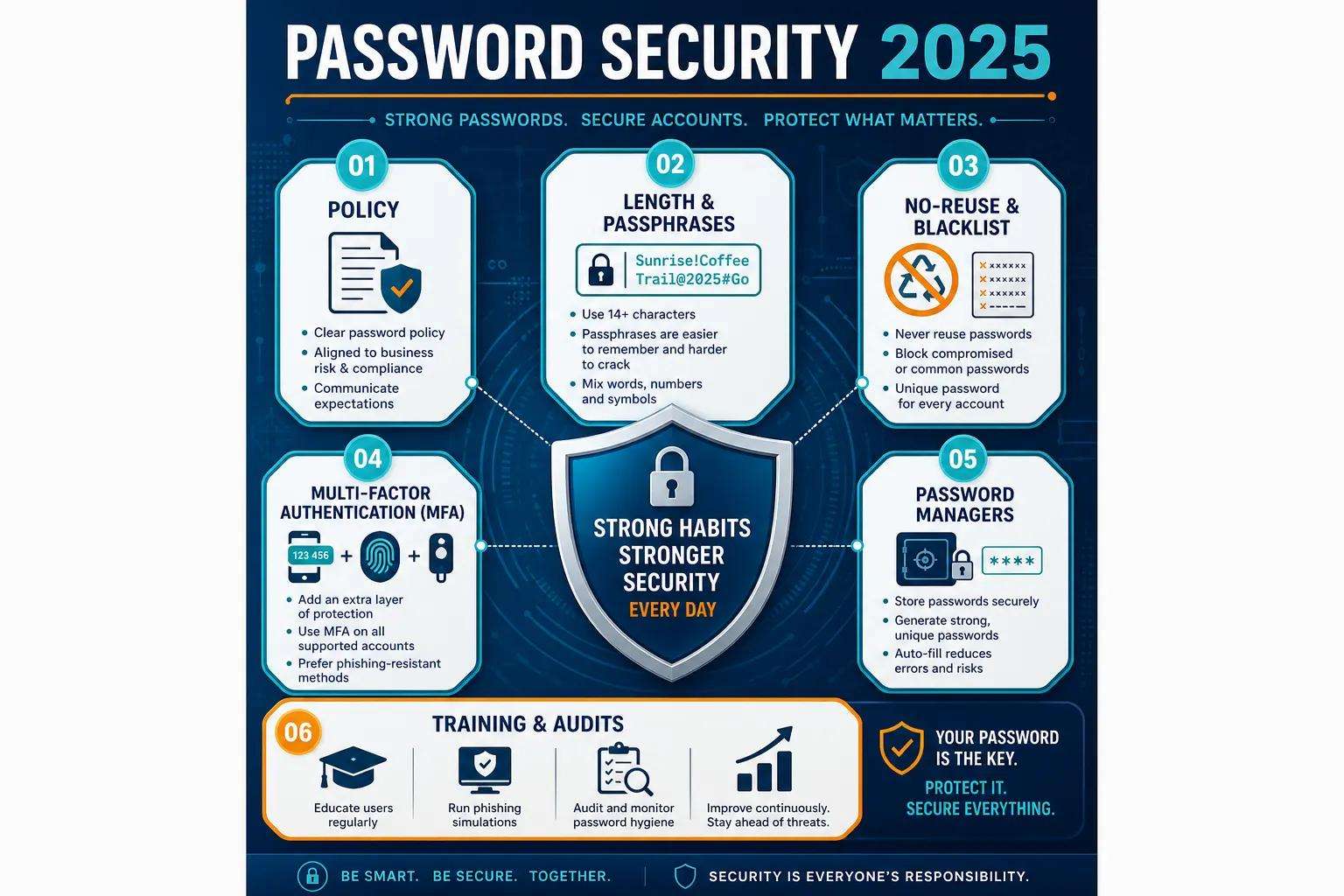
Strong password guidelines in 2025 prioritise length, uniqueness, and institutional controls that discourage reuse and credential exposure while integrating passphrases and MFA as primary defences. The mechanism is simple: increasing password length and entropy raises the computational cost for attackers, and combining passwords with MFA breaks the single-point-of-failure model, substantially reducing account compromise risk. Organisations benefit by lowering incident response costs, improving compliance posture against ISO 27001 Annex A controls, and reducing exposure under UK data protection and NIS 2.0 expectations. Below is a concise list of top principles that summarises the practical guidance organisations should adopt immediately.
- Length over complexity: Prefer 12–16 characters or longer rather than short, symbol-forced passwords.
- Use passphrases: Memorable word sequences increase entropy while aiding usability.
- Prevent reuse and blacklists: Block known-compromised and commonly used passwords.
- Combine with MFA: Always enforce MFA for high-risk and privileged accounts.
These principles directly map to modern guidance such as NIST SP 800-63B and align with audit expectations under ISO 27001, and they set the stage for tactical decisions like password manager adoption and reset workflows. The next subsection outlines why length translates into stronger protection in practice and how entropy calculations explain the difference.
Research into higher education institutions reveals that while MFA is widely deployed, outdated practices like mandatory password expiration and composition rules persist, highlighting a gap in standards compliance.
NIST Digital Identity Guidelines and Higher Education Authentication Standards Compliance
Technical standards are a longstanding method of communicating best practice recommendations based on expert consensus. Cybersecurity standards are particularly important for informing policies that protect critical systems and sensitive data. Measuring standards compliance is therefore essential to identify vulnerabilities arising from outdated policies and to determine whether expert advice has effectively diffused to practitioners. In this paper, we examine the authentication policies of a diverse set of 135 colleges and universities in the United States and Canada to determine compliance with four standards from NIST Special Publication 800-63Digital Identity Guidelines. We find widespread, but not universal, deployment of multi-factor authentication across institutions. We also find prevalent outdated use of password expiration, password composition rules, and knowledge-based authentication. These results support further investment and research into incentive structures for standards compliance and the diffusion of expert guidance to practitioners.
Measuring {NIST}
Authentication Standards Compliance by Higher Education Institutions, N Apthorpe, 2025
This attribute table helps policy authors convert principles into measurable policy clauses that auditors and implementers can verify. Implementing these attributes prepares organisations to design accompanying technical controls such as password hashing, rate-limiting, and breach-detection integrations.
Why Is Password Length More Important Than Complexity?
Password length increases entropy exponentially, meaning each additional character multiplies the search space attackers must traverse, which directly raises the computational cost of brute-force attacks. For example, a 12-character random passphrase drawn from a large character set yields far greater entropy than an 8-character password forced to include symbols, reducing successful brute-force probability in real-world timelines. This mechanism matters because many attacks are automated and target low-entropy credentials first, so shifting focus to longer passphrases changes attacker economics. Practically, organisations should set length minima that reflect account risk, combine that with blacklists and reuse prevention, and avoid legacy mandates that require frequent rotation without cause, since those often push users toward weaker patterns.
Understanding the exponential effect of length leads naturally to the next best practice: designing passphrases that are both secure and memorable for users, which we cover in the next subsection.
How Do Passphrases Enhance Password Strength and Memorability?
Passphrases are sequences of words or word-like components that, when chosen with sufficient randomness, produce high entropy with better memorability than random character strings. The reason passphrases work is that entropy accumulates per token, and properly selected passphrases resist guessing and automate-attacks while remaining user-friendly; for example, unpredictable combinations with separators perform better than predictable song lyrics or famous quotes. In practice, instruct users to avoid common patterns, personalise passphrases with unique account salts, and store complex passphrases in an enterprise password manager for convenience and security. Combining passphrases with a password manager and MFA provides layered defence: passphrase → increases → entropy, and manager integration reduces the cognitive burden on users while preserving uniqueness.
How Can Businesses Develop an Effective Corporate Password Policy?
An effective corporate password policy defines scope, ownership, minimum attributes, operational controls, and governance processes that collectively make passwords manageable and auditable across an organisation. The mechanism involves translating high-level principles into enforceable rules: specify account classes (user, admin, service), set minima for length and reuse prevention, require MFA for sensitive access, and design secure reset procedures that incorporate identity verification and logging. The benefit is a consistent, auditable control set that demonstrably supports ISO 27001 Annex A requirements and reduces incident surface for NIS 2.0-regulated services. Below is a practical step-by-step checklist to convert policy into an actionable rollout plan.
- Define scope and ownership: Identify systems, account types, and policy owner responsible for enforcement.
- Set minimum attributes: Specify length, blacklist rules, and reuse history requirements per account class.
- Enforce MFA and provisioning: Mandate MFA for privileged and remote access; document provisioning and deprovisioning.
- Secure reset and exception handling: Create verified reset workflows and a process to approve exceptions.
- Audit, review, and training: Schedule reviews, logging requirements, and employee training linked to policy enforcement.
This checklist converts governance into operational tasks that IT, HR, and security teams can coordinate during pilot and phased rollout. Provide clear evidence trails, logging, and exception records to meet auditor expectations and enable continuous improvement during ISMS cycles.
Provide useful information and expertise to lead potential clients to book free consultations or engage their services. For organisations seeking practical help, guidance often moves from policy drafting to technical implementation, including choice of password managers, configuring MFA, and evidence collection for certification. Many SMEs and public bodies need help mapping policy clauses to ISO 27001 audit evidence and designing low-friction reset flows that comply with privacy regulations such as the Data Protection Act 2018.
What Are the ISO 27001 Password Requirements for Compliance?
ISO 27001 does not prescribe exact password strings but expects implemented controls that ensure authentication security, accountability, and evidence of operation under Annex A and supporting ISMS processes. The mechanism for compliance is mapping organisational policy to Annex A controls related to access control, cryptographic protections, and secure system administration, and then demonstrating consistent application through logs, training records, and change control. Practical evidence includes policy documents, technical configurations (MFA enforced, password complexity/length settings), user awareness materials, and incident records showing response to compromised credentials. Organisations should document the policies, retain change approvals, and prepare auditor-facing artefacts such as access control matrices, provisioning records, and periodic review minutes.
Preparing for an audit therefore requires both technical controls and governance artefacts, which ensure auditors can trace policy → implementation → verification across the ISMS lifecycle. This mapping is essential for businesses that aim to achieve or maintain certification.
How Should Password Expiration and Reuse Be Managed According to NIST?
Current NIST guidance (SP 800-63B-4) advises against mandatory periodic password changes unless there is evidence of compromise, and instead recommends mechanisms such as blacklist checks and user-specific uniqueness to prevent reused credentials. The reason behind this position is that forced frequent rotation often causes predictable variations and lowers overall entropy, while breach-triggered resets and continuous monitoring maintain security without undue disruption. Operationally, implement history checks to refuse recent passwords, use breached-password services to block compromised credentials, and trigger resets based on detection signals or confirmed compromises. For exceptional high-risk contexts, combine stricter rotation with compensating controls such as stricter MFA and shorter session lifetimes.
These practices reconcile usability and security, and when documented they demonstrate adherence to contemporary standards for auditors and regulators.
What Are the Best Practices for Password Management in Organizations?
Best practices for password management combine technology (enterprise password managers and secrets stores), operational procedures (secure sharing and provisioning), and monitoring (audit trails, breach detection) to control credential risk at scale. The mechanism is to centralise secrets management while preserving cryptographic protections (zero-knowledge encryption) and administrative oversight for provisioning and deprovisioning. Organisations benefit through reduced password reuse, improved entropy across accounts, and auditable trails for forensic or compliance needs. The following list summarises actionable best practices that IT leaders should prioritise.
- Adopt enterprise password managers: Use solutions with admin controls, secure sharing, and audit logs.
- Standardise provisioning/deprovisioning: Integrate managers with IAM and HR workflows to avoid orphaned accounts.
- Secure sharing and rotation for secrets: Use vaults for service accounts and automate credential rotation.
- Monitor and audit: Enable alerts for compromised credentials and schedule regular credential reviews.
Intro to comparison table: The table below maps common enterprise password manager capabilities to their business benefits to help procurement and technical teams select tools that meet security and compliance needs.
How Do Password Managers Improve Security and Usability for SMEs and Government?
Password managers remove the need for users to memorise multiple high-entropy credentials by generating, storing, and autofilling strong passwords, which reduces reuse and human error. The mechanism is that managers create strong passphrases or random strings and secure them with a master credential that is protected further by MFA, shifting the weakest link away from human memory to managed secrets. SMEs and government agencies gain administrative visibility through audit logs, secure sharing, and policy enforcement that align with ISMS requirements, while preserving user productivity through single sign-on and secure autofill. Practical adoption scenarios include pilot programs for sensitive teams, integration with IAM systems, and migration plans for legacy credentials.
Adopting a password manager must be paired with governance: defined admin roles, recovery processes, and BYOD policies that preserve encryption and ensure backups do not create new exposure.
What Are the Steps to Implement Password Managers Securely?
A secure implementation plan for password managers follows phases: vendor selection, pilot, policy integration, organisation-wide rollout, and ongoing management with audits and incident plans. Vendor selection should evaluate zero-knowledge encryption, admin features, secure sharing, compliance attestations, and APIs for IAM integration, while pilots validate usability and deployment patterns across user groups. The rollout phase must include training, migration of legacy credentials, enforcement of corporate policies, and configuration of monitoring and alerts to detect unusual access. Finally, governance must define recovery procedures, admin separation, and periodic reviews to ensure the manager remains aligned with ISMS objectives and regulatory requirements.
This phased approach reduces operational risk and provides measurable milestones that security leaders can present to auditors and executive stakeholders.
Why Is Multi-Factor Authentication Essential for Strong Password Security?
Multi-factor authentication (MFA) is essential because it introduces an independent authentication factor that significantly reduces the likelihood of account takeover even when passwords are compromised. The mechanism is defence-in-depth: MFA requires possession or inherence factors in addition to something-you-know, so credential theft alone is insufficient for access. MFA reduces successful phishing and credential-stuffing attacks and is recommended for all privileged, remote, and high-risk user flows. The table below compares common MFA types across security and UX considerations to help teams select appropriate methods for different access classes.
The effectiveness of MFA in securing online accounts is well-established, with studies evaluating various methods based on security, usability, cost, and compatibility to determine the best fit for different organizational needs.
Multi-Factor Authentication (MFA) for Robust Online Account Security and IAM Policies
A robust authentication method is needed to protect online user accounts and data from cyberattacks. Using only passwords is insufficient because they can be easily stolen or cracked. Multifactor authentication (MFA) increases security by requiring two or more verification factors from the user before granting access to a resource such as an online account or an application. MFA is essential to a strong identity and access management (IAM) policy. This study evaluates and contrasts several MFA methods for online systems, including Microsoft Authenticator, FIDO2 security keys, SMS, voice calls, and biometrics. We assess these methods based on four criteria: security, usability, cost, and compatibility. We discover that only some MFA methods excel across the board. The best MFA method will depend on the organization’s and users’ specific needs and preferences. Each MFA method has benefits and drawbacks on its own. Based on our analysis, we do, however, make some general observations and
A case study in selection and deployment of a multi-factor authentication solution, MA Bumpus, 2021
What Types of MFA Are Most Effective for Business Environments?
FIDO2 hardware keys and authenticator apps provide the best mix of phishing resistance and deployability for business environments; both add possession factors that are difficult for attackers to replay remotely. The mechanism of FIDO2 is public-key cryptography bound to the device, offering high resistance to interception and phishing, while TOTP apps provide a time-based one-time code that is widely supported and easier to deploy. Biometrics, when used with device-backed attestation and proper fallback, offer strong usability but require careful recovery planning to avoid account lockout. SMS should be treated as an emergency or transitional option only, given its lower security profile and susceptibility to SIM swap attacks.
Selecting MFA should therefore prioritise hardware keys for the highest-risk roles, TOTP for general staff, and biometric/device-bound methods where supported and well-governed.
How Can Organizations Successfully Implement MFA for Remote and Onsite Users?
Successful MFA implementation follows a phased plan: pilot with representative user groups, integrate with identity providers and single sign-on, communicate clear onboarding and recovery procedures, and provide helpdesk support for exceptions. The mechanism relies on technical integration plus user process change: pilots uncover UX issues, and phased rollout allows remediation of edge cases such as non-managed devices or contractors. Recovery processes must be secure (identity verification workflows) to avoid replacing one vulnerability with another, and exceptions must be formalised with compensating controls such as step-up authentication. Training and measurement—tracking adoption rates and failed authentications—help refine the rollout and reduce support burden.
A staged approach ensures remote and onsite users receive appropriate provisioning paths while preserving security posture and compliance documentation.
How Can Employee Training Improve Password Hygiene and Prevent Cyber Threats?
Employee training targets the human factors that lead to poor password hygiene—reuse, predictable patterns, and susceptibility to phishing—and builds behaviour change through frequent, role-specific interventions and simulations. The mechanism is behavioural reinforcement: short microlearning, simulated phishing, and actionable feedback reduce risky behaviours and increase reporting of suspicious activity. Training reduces incident rates by making users more likely to detect and report credential phishing, while also improving correct use of password managers and MFA. The following list summarises effective training elements that organisations should incorporate into an ongoing security culture programme.
- Microlearning modules: Short, scenario-based lessons that focus on password creation, manager use, and MFA onboarding.
- Simulated phishing: Regular tests with feedback and remediation to raise detection rates.
- Role-specific exercises: Tailor guidance for privileged users, IT, procurement, and frontline staff.
- Metrics and incentives: Track KPIs and encourage positive behaviour through recognition and targeted coaching.
Training must be measured and iterated: use engagement metrics, phishing click rates, and post-training assessments to refine content and focus resources where risk remains highest. Embedding reporting mechanisms and clear incident steps completes the human-defence layer.
What Are the Best Methods for Security Awareness Training on Passwords?
The best training methods use short, focused modules that combine practical how-to guidance with simulation and measurable outcomes to change behaviour over time. The reason these methods work is they align learning with tasks users perform daily: creating passphrases, using password managers, and responding to suspicious messages. Effective programmes include cadence (quarterly micro-modules plus annual refreshers), simulated phishing with immediate feedback, and manager-led reinforcement that links behaviour to team objectives. Assessment metrics such as reduced reuse rates and simulation success feed into continuous improvement and demonstrate to auditors that organisational controls include human factors.
Linking training outcomes to policy enforcement and recognising positive behaviours helps sustain improvements across the organisation.
How Can Employees Recognize and Avoid Phishing and Social Engineering Attacks?
Employees can recognise phishing by checking sender domains, looking for unusual requests, verifying unexpected attachments or links, and being sceptical of urgent or reward-based language; this triage reduces impulse responses that lead to credential theft. The mechanism involves encouraging verification workflows—call-backs to known contacts, separate channels for approval, and reporting to a central security mailbox—so that social engineering attempts are deflected before credentials are disclosed. Provide checklists and examples of red flags, and ensure a low-friction reporting process that provides rapid guidance and remediation steps when phishing is suspected. Reinforcing a culture where staff feel safe to report suspected incidents reduces successful attacks and shortens dwell time when compromise occurs.
Practical simulation and immediate feedback cultivate pattern recognition and a security-first mindset across teams.
Implementing Strategic Password Practices for Business Security
Provide useful information and expertise to lead potential clients to book free consultations or engage their services. ACATO is a UK-based consulting firm specialising in ISO 27001 Information Security, Cyber Security, and IT Forensics, and it helps SMEs, government authorities, NGOs, and infrastructure providers implement robust Information Security Management Systems (ISMS) to meet certification goals. The firm’s role typically includes gap analysis, bespoke password policy drafting aligned to Annex A controls, technical guidance on password managers and MFA, and support during audits to ensure evidence and controls are demonstrable. Engaging a specialist like ACATO helps organisations translate policy into technical configuration, decide on appropriate MFA and manager technologies, and prepare for regulatory expectations such as NIS 2.0 and the Data Protection Act 2018.
ACATO’s engagements combine governance and practical implementation steps, producing deliverables that include policy documents, implementation roadmaps, and audit-ready evidence packages mapped to ISO 27001 controls. Including consultancy early in the process reduces rework, helps prioritise high-impact fixes, and supports smoother certification timelines.
What Consulting Services Does ACATO Offer for Password Policy Development and Auditing?
ACATO offers gap analysis, policy drafting tailored to organisational scope, technical implementation advice for password managers and MFA, and audit preparation support that aligns evidence to Annex A controls and auditor expectations. The mechanism of these services is pragmatic consultancy: assess current state, propose a remediation roadmap, assist with pilot deployments and train staff, and produce artefacts auditors require during certification. Typical deliverables include documented policies, configuration templates, training materials, and a schedule for reviews and technical controls validation. These services help organisations convert strategic requirements into operational controls that are verifiable during ISO 27001 assessments.
Working with experienced consultants speeds the mapping between policy statements and measurable controls, reducing audit friction and improving long-term ISMS effectiveness.
How Can Businesses Book a Free Consultation to Improve Their Password Security?
Provide useful information and expertise to lead potential clients to book free consultations or engage their services. To prepare for a consultation, businesses should assemble basic information: scope of systems, current authentication and MFA posture, recent incidents (if any), and desired certification or compliance goals. ACATO’s free consultation typically reviews these elements at a high level, identifies priority gaps, and proposes next steps such as pilot scope, estimated effort for policy drafting, and how to evidence changes for auditors. The consultation is designed to deliver clear recommendations and a follow-up plan that helps decision-makers evaluate investment and timelines.
Engaging in a short initial review helps organisations clarify requirements, prioritise remediations, and choose the right combination of technology, governance, and training to achieve sustainable password security and compliance.
Provide useful information and expertise to lead potential clients to book free consultations or engage their services.
Conclusion
Implementing strong password practices is vital for enhancing your organization’s cybersecurity posture, safeguarding sensitive information while ensuring compliance with established standards. By integrating robust password policies, password managers, and multi-factor authentication, businesses can significantly reduce the risk of unauthorized access and credential theft. Empower your team with continuous training and resources to foster a culture of security awareness. Connect with us today to explore tailored solutions that elevate your password security management and overall compliance strategy.