
NIST: Improving Your Security Posture

NIST Cybersecurity Framework Implementation: How to Improve Your Security Posture Effectively
The NIST Cybersecurity Framework (NIST CSF) is a voluntary, risk-based set of guidelines designed to help organizations of all sizes manage and reduce cybersecurity risk through a structured set of activities and outcomes. It organizes cybersecurity into core functions and outcomes that map directly to business risk, enabling teams to prioritize effort where it reduces exposure most effectively. This article explains how NIST CSF and the 2.0 update structure governance, asset identification, protective controls, detection capabilities, and response and recovery planning to measurably improve security posture. Readers will find step-by-step guidance for small and medium-sized enterprises, a clear comparison with ISO 27001, practical risk management best practices including supply chain risk, and a description of measurable benefits and KPIs. Later sections describe how a specialized information security consultancy can support assessments, remediation, documentation, and training. By the end of this guide, you will have a pragmatic roadmap for implementing NIST CSF, deciding between frameworks, and tracking improvement with meaningful metrics.
What Is the NIST Cybersecurity Framework and Why Does It Matter?
The NIST Cybersecurity Framework is a voluntary framework created to help organizations manage cybersecurity risk by translating governance and technical controls into measurable functions and outcomes. It matters because it provides a common language—Govern, Identify, Protect, Detect, Respond, Recover—that links business objectives to technical controls and enables prioritization based on risk. Organizations adopting the framework gain clearer visibility of critical assets, improved prioritization of remediations, and a repeatable path to demonstrate maturity to stakeholders. Understanding this structure supports regulatory alignment and practical improvements in detection and recovery times, which directly reduces both breach impact and operational disruption.
NIST Cybersecurity Framework: Best Practices for Improving Cybersecurity Measures
The NIST Cybersecurity Framework is a set of best practices, standards, and recommendations that support organizations to improve their cybersecurity measures. It focusses on using business drivers to guide cybersecurity activities and considering cybersecurity risks as part of the organizations cybersecurity risk management. In this regard, the framework provides a common organizing structure for multiple cybersecurity approaches by assembling standards, guidelines, and practices that are working effectively today.
NIST cybersecurity framework and MITRE cybersecurity criteria, 2023
What Are the Core Components and Functions of NIST CSF?
NIST CSF’s core organizes cybersecurity activities into six high-level functions that drive actionable outcomes: Govern, Identify, Protect, Detect, Respond, and Recover. Each function represents a cluster of activities: Govern focuses on strategy and policy; Identify inventories assets and evaluates risk; Protect implements access controls and hardening; Detect builds monitoring and anomaly detection; Respond codifies incident response actions; Recover establishes restoration and continuity plans. These functions map to controls from technical standards and to outcomes such as reduced time-to-detect and measured recovery SLAs. This functional mapping allows teams to set KPIs, for example, mean time to detect, patch cycle time, and recovery time objective, and then measure progress against them.
How Does NIST CSF 2.0 Update Enhance Cybersecurity Practices?
NIST CSF 2.0 builds on the original by elevating Governance as an explicit function and intensifying emphasis on supply chain and third-party risk management, broadening applicability across sectors. The update clarifies roles and responsibilities, integrates threat-informed practices, and provides more explicit alignment points with enterprise risk management and regulatory expectations. Practically, organizations should expand governance artifacts, formalize vendor assessment processes, and include supply chain controls in prioritization workshops. Adapting existing CSF plans means revisiting profiles and risk tolerances to incorporate governance metrics and vendor assurance evidence, which improves audit readiness and cross-organizational accountability.
NIST CSF 2.0: A Critical Review of the Updated Cybersecurity Framework
The National Institute of Standards and Technology’s (NIST’s)Framework for Improving Critical Infrastructure Cybersecurity(CSF) is often touted as the gold standard for building a robust cybersecurity program. But voluntary compliance with the framework has largely failed to generate effective cybersecurity, leaving critical infrastructure and other organizations vulnerable to serious cyber threats such as ransomware. Now, nearly a decade after its initial release, the CSF is undergoing a major overhaul to address changes in technology, risk, and the overall cybersecurity landscape. The updated framework (CSF 2.0) is due out in early 2024, but if NIST’s recently releaseddraftis any indication, CSF 2.0 is unlikely to fundamentally improve the nation’s cyber posture.
A review of nist’s draft cybersecurity framework 2.0, 2023
How Can Small Businesses Implement the NIST Cybersecurity Framework?
NIST CSF can be applied by small businesses through a lightweight, risk-based roadmap that focuses on high-impact, low-cost controls aligned to critical assets and business processes. Start with a focused asset inventory, perform a pragmatic risk assessment to identify top threats, then map those risks to CSF functions and select protective controls that reduce likely impact quickly. Small teams should prioritize basic hardening, multi-factor authentication for critical systems, patch management, and simple detection like centralized logging. This practical approach delivers rapid risk reduction and creates a foundation for continuous improvement and compliance with customer or supply chain requirements.
What Are the Step-by-Step Implementation Best Practices for SMEs?
A stepwise SME implementation emphasizes speed, simplicity, and repeatability: assess assets, prioritize risks, implement essential controls, and monitor outcomes. First, run a focused gap analysis of critical systems and data to produce a concise remediation backlog. Second, hold a prioritization workshop to map risks to quick wins and to plan phased implementations that balance effort and impact. Third, implement controls such as MFA, endpoint protection, and basic logging, and use lightweight policies and role-based responsibilities rather than extensive documentation. Finally, monitor key KPIs and repeat the cycle quarterly to maintain traction; this continuous loop ensures improvement without overwhelming limited resources.
Introductory implementation recommendations for SMEs are summarized in the table below to show expected deliverables and effort.
This roadmap highlights achievable steps that fit resource constraints and deliver measurable security improvements for small businesses. The phased approach encourages early wins that fund further maturity and aligns with stakeholder expectations for demonstrable progress.
What Are the Benefits Do Small Businesses Gain from NIST CSF Adoption?
Small businesses gain tangible security and commercial advantages by applying NIST CSF in a scaled way that targets their highest risks first. Immediate benefits include lower likelihood of disruptive breaches through targeted controls, improved customer and partner confidence when demonstrating risk management, and simpler fulfillment of supplier security requirements. Over time, adopting CSF practices translates into lower incident response costs, better insurance positioning, and a documented maturity trajectory that supports growth and tender processes. The structured approach also makes training and operational handover easier, strengthening resilience as the business scales.
What Are the Key Differences Between NIST CSF and ISO 27001?
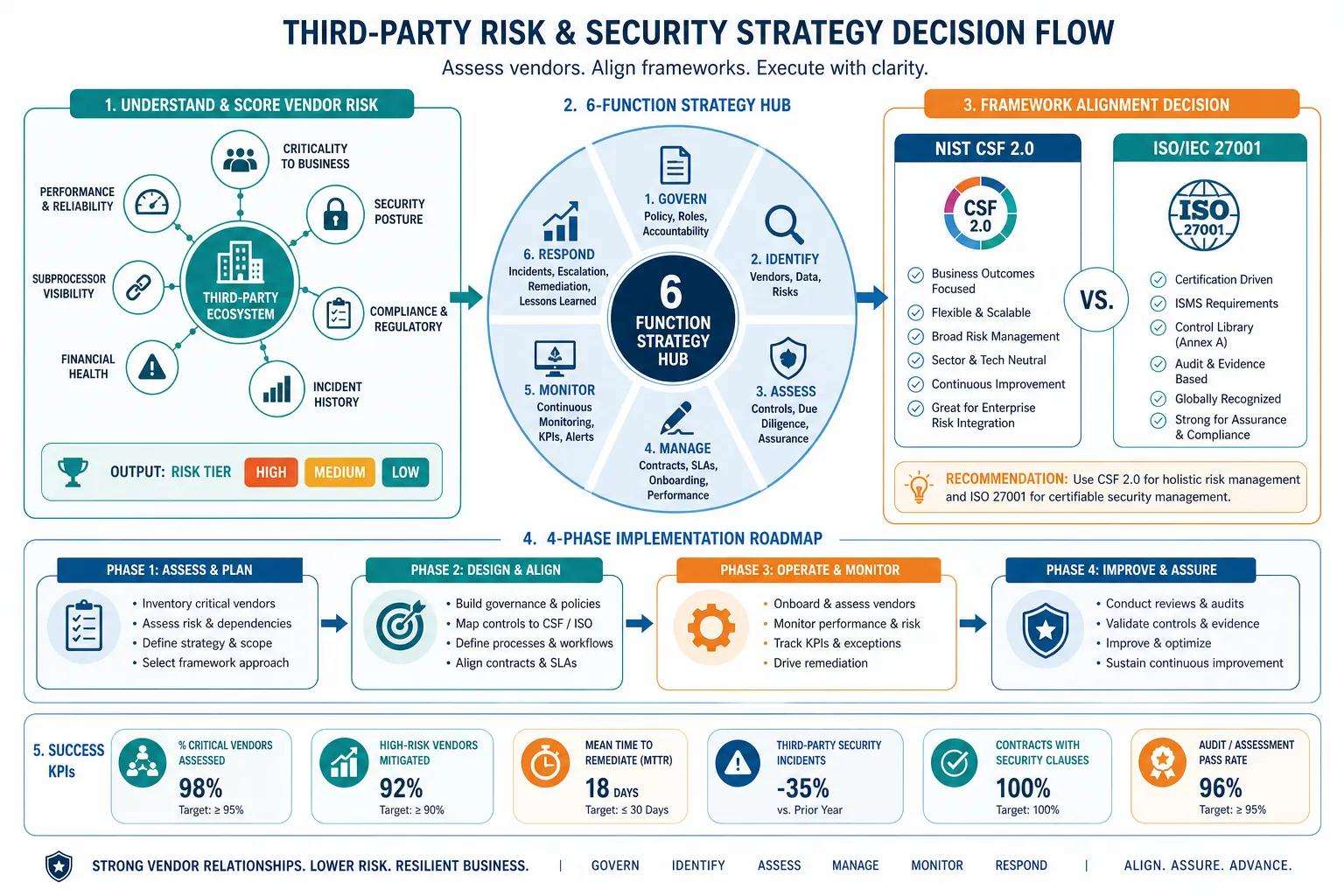
NIST CSF is a flexible, voluntary framework focused on outcomes and risk-based prioritization, whereas ISO 27001 is a certifiable standard that defines requirements for an auditable Information Security Management System (ISMS). NIST CSF excels at mapping technical and operational activities to business outcomes and rapid prioritization, while ISO 27001 provides prescriptive management system requirements for certification and continual compliance. Organizations often use NIST CSF for practical control selection and maturity tracking and ISO 27001 when formal certification and contractual evidence are required. Choosing between them depends on whether the primary goal is rapid risk reduction and operational alignment or formal, certifiable ISMS governance.
Before the detailed mapping below, note that ACATO’s ISO 27001 experience can bridge practical CSF adoption and formal certification, helping organizations map CSF functions to ISMS clauses and produce documentation that supports both maturity tracking and audits.
This comparison clarifies when a hybrid approach is advantageous: use CSF to choose and prioritize controls quickly, then formalize processes and documentation through ISO 27001 for certification and contractual assurance. The mapping table above provides a practical basis for that sequence.
How Do NIST CSF and ISO 27001 Complement Each Other?
NIST CSF and ISO 27001 complement by pairing CSF’s practical, outcome-focused control mapping with ISO 27001’s management system and certification pathway. Organizations can adopt CSF to identify high-impact controls and build operational capability, then translate those controls into ISO 27001 risk treatment plans and ISMS processes to achieve certification. This hybrid approach reduces the overhead of implementing an ISMS from scratch because existing CSF artifacts provide the evidence and control implementation that ISO auditors look for. Mapping CSF functions to ISO clauses creates a pragmatic roadmap to both improved posture and formal certification.
When Should Organizations Choose NIST CSF Over ISO 27001?
Choose NIST CSF when the priority is rapid, flexible risk reduction, internal alignment and when certification is not an immediate requirement; choose ISO 27001 when contractual or regulatory contexts demand third-party certification and formal ISMS governance. For many organizations, the right approach is phased: start with CSF to reduce exposure and demonstrate progress, then move toward ISO 27001 for formal assurance when required by customers or regulators. Decision factors include regulatory obligations, international contract needs, resourcing for ongoing ISMS maintenance, and the maturity of internal governance practices.
How Does NIST CSF Support Cybersecurity Risk Management Frameworks?
NIST CSF supports enterprise risk management by providing a structured, actionable bridge between business risk criteria and operational controls, enabling alignment between risk appetite and technical effort. The CSF’s functional structure allows risk teams to score, prioritize and monitor cyber risk with KPIs that tie directly to business outcomes such as downtime, data loss, and recovery time. By integrating CSF outputs into existing ERM processes, organizations gain consistent risk language across finance, legal and operations teams and improve decision-making for investment in security controls.
What Are the Best Practices for Cybersecurity Risk Management Using NIST CSF?

Effective risk management with NIST CSF uses clear risk criteria, consistent scoring and stakeholder-aligned KPIs to prioritize action and measure progress. Run regular cross-functional risk workshops to map threats to critical assets, score likelihood and impact, and convert the highest-ranked items into CSF-connected control projects. Use KPIs such as mean time to detect, patch lead time, and incident recovery time to measure control effectiveness and adjust priorities. Embedding CSF outcomes into governance forums ensures that remediation budgets and timelines reflect business risk tolerances and that security metrics influence strategic decisions.
For practical prioritization, use this short list of high-impact KPIs that tie CSF activities to business value:
- Mean Time to Detect: measures detection effectiveness.
- Patch Lead Time: captures speed of vulnerability remediation.
- Recovery Time Objective: quantifies recovery capability.
These KPIs provide numerical targets for improvement and help governance teams decide where to allocate resources next, closing the loop between assessment and measurable outcomes.
How Does NIST CSF Address Supply Chain and Third-Party Risk Management?
CSF 2.0 places explicit emphasis on supply chain risk by encouraging organizations to extend Identify and Protect activities to vendors, require evidence-based assessments, and embed contractual controls. Best practice steps include creating a vendor inventory categorized by criticality, performing risk-based vendor assessments, and enforcing minimum security clauses and monitoring requirements in contracts. Technical controls such as segmentation, least privilege, and strong authentication mitigate third-party access risk, while operational practices like periodic attestation and centralized logging provide continuous oversight. Together these measures create an auditable trail of vendor risk management that supports both compliance and resilience.
A concise vendor assessment checklist helps operationalize these steps:
- Inventory and criticality: Categorize vendors by access and data sensitivity.
- Assessment: Use focused questionnaires and evidence review for high-risk suppliers.
- Contractual controls: Specify security obligations and audit rights.
- Ongoing monitoring: Schedule attestations and review logs for anomalous access.
Applying this checklist ensures vendor risk is treated as an integral part of organizational cybersecurity, reducing the chance that third-party compromise becomes a business-impacting incident.
What Are the Benefits of Adopting the NIST Cybersecurity Framework for Your Organization?
Adopting NIST CSF produces measurable benefits across risk reduction, compliance readiness, and business resilience by aligning controls to business outcomes and enabling evidence-based prioritization. Organizations that apply CSF consistently see improvements in detection speed, faster response and recovery, clearer audit evidence and better ability to satisfy customers and regulators. Over the long term, CSF adoption reduces the total cost of incidents through earlier detection, focused remediations and a reduced attack surface. The framework’s flexible nature also helps organizations adapt to evolving threats without discarding prior investment in controls and processes.
How Does NIST CSF Improve Your Overall Security Posture and Compliance?
NIST CSF improves posture by converting vague security goals into specific actions mapped to measurable outcomes, making it easier to demonstrate compliance and readiness. For example, linking Identify activities to an asset inventory reduces unknown exposures, while Detect and Respond workstreams shorten mean time to detect and contain incidents. This mapping also supports regulatory requirements—documented controls and evidence from CSF projects can feed into audits and vendor assessments. Tracking posture with KPIs such as incident frequency, detection time, and percentage of critical systems with baseline controls provides governance with clear progress indicators and supports continuous improvement.
Below is a table that links benefits to measurable outcomes and example KPIs to help governance teams quantify CSF value.
What Are the Long-Term Advantages of Cyber Resilience with NIST CSF?
Long-term resilience created by NIST CSF reduces both the frequency and impact of cyber incidents by institutionalizing practices that detect, respond to, and recover from attacks effectively. Over time, organizations benefit from lower incident remediation costs, more predictable operational continuity, and stronger trust among customers and partners. The repeatable CSF cycle drives continuous improvement, where each incident or exercise produces lessons that harden capabilities and reduce future exposure. Building this capability also makes strategic initiatives—such as cloud migration or third-party integrations—safer because risk is managed through an established, measurable process.
How Can ACATO Help You Implement the NIST Cybersecurity Framework Successfully?
ACATO provides specialist consulting, assessment, and training services designed to turn NIST CSF guidance into practical, auditable improvements for organizations across the UK, EU, Poland, USA, and Canada. Their approach follows a clear assess → plan → implement → monitor methodology that converts CSF functions into deliverables such as gap analyses, remediation roadmaps, ISMS documentation, and tabletop exercises. ACATO’s service suite includes cybersecurity consulting, ISMS documentation and certification support, security awareness training, incident response planning, and digital forensics, all intended to help organizations achieve measurable security improvements. If you need external support to accelerate CSF adoption and create audit-ready evidence, ACATO can perform assessments, deliver prioritization workshops, and provide hands-on implementation guidance.
What Consulting and Assessment Services Does ACATO Offer for NIST CSF?

ACATO’s consulting services focus on practical deliverables that map directly to NIST CSF outcomes: gap analysis reports that list prioritized remediations, mapping documents linking controls to CSF functions, remediation plans with estimated effort, and evidence packages suitable for audits. Their assessment engagements typically include asset discovery, risk scoring, prioritization workshops, and a clear roadmap that shows which controls deliver the most risk reduction per unit effort. For organizations aiming for certification, ACATO also helps translate CSF outputs into ISMS documentation and audit-ready evidence, supporting the transition from practical controls to formal governance.
How Does ACATO’s Training and Awareness Programs Support NIST CSF Adoption?
ACATO’s training and awareness offerings are designed to operationalize CSF functions by improving staff behavior and incident preparedness through role-based training and simulated exercises. Typical programs include general awareness sessions, role-specific training for IT and security teams, tabletop incident response exercises, and phishing simulation campaigns to measure human risk. Training ties directly to Detect, Respond and Recover functions by reducing time-to-detect through improved reporting and by improving response coordination during incidents. Measured outcomes often include improved phishing resilience, faster escalation times, and clearer incident playbooks that align with CSF response activities.
- Awareness Training: Builds baseline staff understanding and reporting behaviors.
- Role-Based Training: Equips IT and security teams with practical procedures.
- Tabletop Exercises: Tests and refines incident response plans under simulated conditions.
These services help embed CSF practices into day-to-day operations and produce measurable improvements in detection and response capability, ensuring that technical controls are matched by organizational readiness.