
Identify Weaknesses: Your Guide to Vulnerability Assessments

Physical Security Assessments: Identifying Vulnerabilities for Effective Risk Mitigation
Physical security assessments evaluate the built and operational environment of facilities to identify vulnerabilities that could permit theft, sabotage, unauthorised access, or data compromise. These assessments work by combining on-site observation, technical testing of systems such as access control and CCTV, and procedural reviews to reveal gaps between policy and practice; the result is a prioritised set of mitigations that reduce risk and support compliance. Organisations use physical security vulnerability assessments to make evidence-based decisions that protect people, assets, critical infrastructure and information, and to provide audit evidence for standards such as ISO 27001. This article explains what a physical security vulnerability assessment is, how assessments identify weaknesses, common vulnerability types and mitigations, ACATO’s audit methodology and how assessments support UK regulatory and business resilience needs. You will also learn best practices for perimeter security and surveillance, how integrated cyber–physical strategies close gaps, and which industries benefit most from targeted assessments. Throughout, the piece uses practical examples, checklists and EAV tables to help security owners convert findings into prioritized, cost-effective action plans.
What is a Physical Security Vulnerability Assessment?
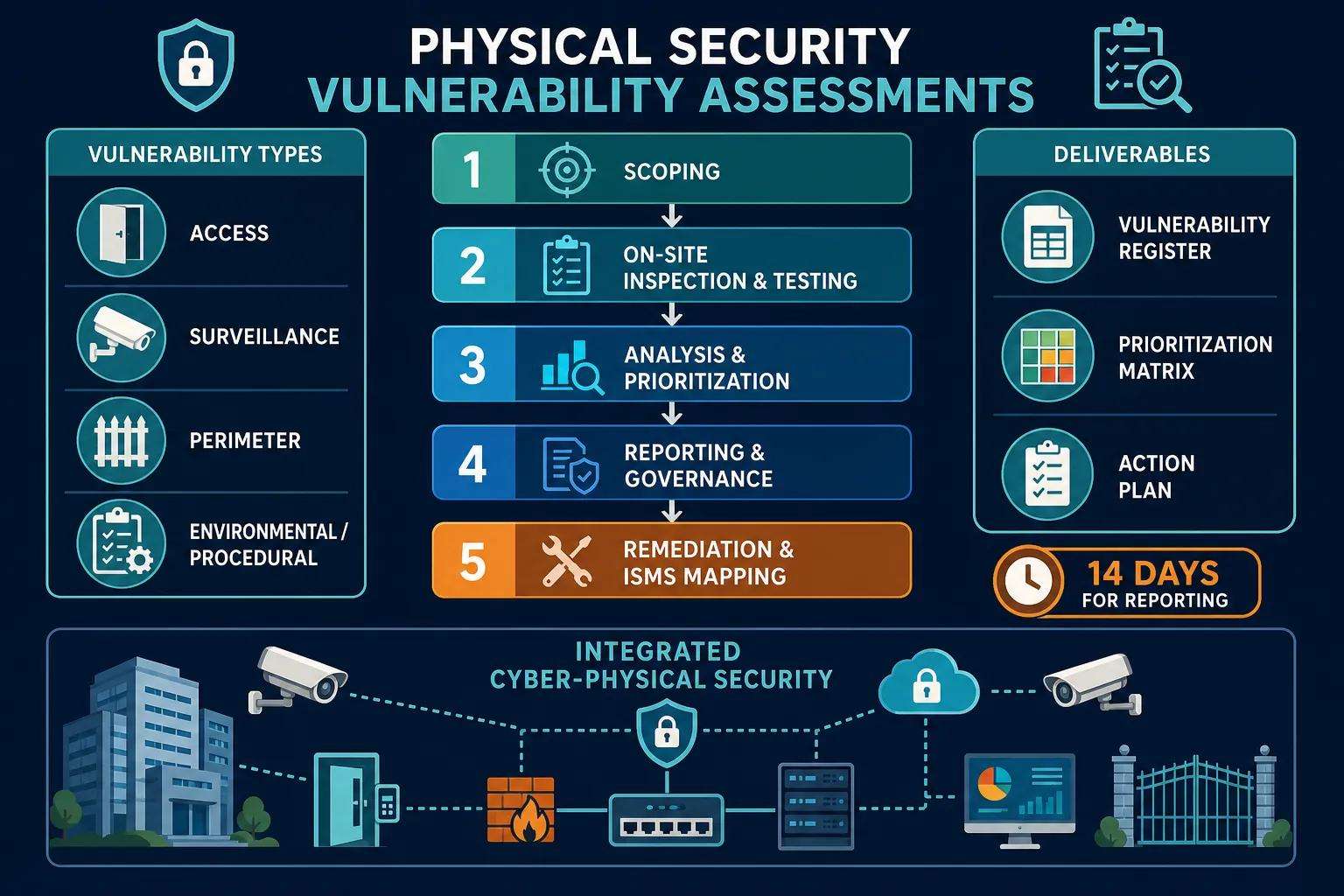
A physical security vulnerability assessment is a targeted review that identifies weaknesses in the physical, technical and procedural controls protecting a site or asset. The assessment inspects hard controls (perimeter barriers, locks, CCTV), tests technical systems (access control, alarms), and reviews policies and personnel practices to determine where an adversary could exploit gaps. Unlike a full risk assessment that combines likelihood and impact to prioritise controls, a vulnerability assessment focuses on what can be exploited now and how, creating a clear remediation list for immediate fixes. Typical deliverables include an annotated site plan showing findings, a vulnerability register, prioritised remediation options and a recommended implementation timeline. ACATO’s capability to assess physical controls is provided as part of broader ISMS audits and information security programmes, and this educational overview shows how findings translate into practical remediation steps and compliance evidence.
How do physical security assessments identify vulnerabilities?
Physical security assessments identify vulnerabilities through structured observation, targeted testing and stakeholder review that together reveal weaknesses in design, operation and governance. Inspectors conduct walkthroughs to spot physical gaps such as unlocked doors, ineffective fencing or lighting shortfalls, then run technical tests including access control provisioning checks, tailgating exercises and CCTV blind-spot analysis to validate findings. Review of policies, visitor procedures and maintenance logs uncovers procedural lapses and lifecycle issues such as delayed deprovisioning or missing camera retention policies. Findings are correlated into a vulnerability register with root-cause notes and suggested mitigations, which supports prioritisation based on exploitability and asset criticality. This combined approach—observation, technical testing and governance review—ensures that both obvious and subtle vulnerabilities are surfaced for remediation.
What are common types of physical security vulnerabilities?
Common physical security vulnerabilities fall into access control, surveillance, perimeter and procedural categories that create predictable exploitation paths if unaddressed. Access control weaknesses include poor credential life-cycle management and tailgating; mitigations involve stricter provisioning, visitor escorts and anti-tailgating measures. Surveillance gaps arise from camera blind spots, poor image quality or insufficient monitoring; mitigations include camera repositioning, higher-resolution cameras and tuned analytics. Perimeter failures include low fences, poor lighting and unprotected service entries; mitigations focus on layered barriers, bollards and improved lighting to increase detection and delay. Environmental and procedural vulnerabilities—such as inadequate HVAC protections for data centres or inconsistent maintenance schedules—are equally critical and require documented controls and testing. The following bulleted list summarises key vulnerability types and one-line mitigations.
- Access control failures: strengthen provisioning, deprovisioning and anti-tailgating measures.
- Surveillance blind spots: redesign camera coverage and deploy analytics for detection.
- Perimeter weaknesses: install layered barriers, lighting and intrusion detection.
- Environmental risks: secure HVAC, fire suppression and power resilience for critical rooms.
- Procedural gaps: formalise visitor policies, maintenance and incident-response workflows.
- Logging and monitoring shortfalls: implement centralised logs and review schedules.
These common categories map directly to practical remediation priorities and help teams target quick wins while planning longer-term investments.

How Does ACATO Conduct Comprehensive Physical Security Audits?
A comprehensive physical security audit follows defined stages that move from scoping and discovery to testing, analysis and practical remediation planning tailored to an organisation’s risk appetite. The audit begins with scoping and asset identification to clarify critical assets, followed by on-site inspections and technical tests of access control, CCTV, alarms and environmental controls. Findings are analysed using a risk-scoring model to prioritise remediation by likelihood and impact, and deliverables typically include a vulnerability register, remediation plan with estimated effort, and recommendations aligned to relevant compliance frameworks. Below is a concise methodology checklist that summarises the typical audit flow.
- Scoping & asset identification: define critical assets, stakeholders and constraints.
- Inspection & technical testing: walkthroughs, tailgating, credential checks and CCTV review.
- Analysis & prioritisation: risk scoring, root-cause analysis and remediation sequencing.
- Reporting & governance: deliver register, action plan, and integration guidance for ISMS.
ACATO is a UK-based consulting firm specialising in ISO certifications (ISO 27001, ISO 9001, ISO 42001), Cyber Security, IT Forensics, and Data Protection. ACATO’s ISO 27001 consulting and IT security audits inherently cover physical security controls (e.g., ISO/IEC 27001 Annex A.11 Physical and environmental security). Free consultations are offered. This combination of technical testing and governance review produces actionable evidence that integrates with an organisation’s ISMS and compliance evidence.
This table shows how each audit stage produces concrete outputs that stakeholders can act on, creating a traceable path from observation to remediation and evidence for certification or governance reviews.
What methodology does ACATO use for physical security vulnerability assessments?
ACATO applies a multidisciplinary methodology that combines scoping, asset criticality analysis, technical verification and ISMS-aligned reporting to produce prioritised remediation. The process begins with stakeholder engagement and scoping workshops to identify high-value assets, followed by a baseline control review and on-site verification activities such as tailgating tests and CCTV coverage mapping. Technical findings are scored against a risk matrix that uses likelihood and impact to prioritise fixes, and evidence is recorded to support ISO 27001 control mapping where relevant. Typical timeframes vary by site complexity but a standard single-site assessment often completes in days for inspection and testing, with reporting delivered within a fortnight. This method ensures assessments provide both immediate operational fixes and longer-term governance improvements.
How are access control systems evaluated during audits?
Access control evaluation examines the physical hardware, credential lifecycle, administrative processes and monitoring to ensure the system enforces intended policies and resists common attack vectors. Auditors check door hardware, control panels and networked readers for configuration and firmware issues, review provisioning and deprovisioning workflows for timeliness, and run operational tests such as tailgating and badge cloning risk assessments. Logs and monitoring practices are evaluated to confirm that access events are recorded, reviewed and retained in line with policy; weaknesses in these areas often lead to rapid remediation recommendations. Common findings include orphaned credentials, excessive access rights, and insufficient visitor management; recommended actions span policy updates, technical hardening and periodic re-certification of access rights.

Why is Physical Security Risk Assessment Critical for UK Businesses?
A physical security risk assessment is critical because physical vulnerabilities directly threaten operational continuity, data confidentiality and regulatory compliance, with measurable financial and reputational consequences. By identifying exploitable weaknesses, assessments reduce the likelihood of theft, sabotage and unauthorised data access that can cause service outages, regulatory investigations and loss of stakeholder trust. For UK businesses, assessments also map to compliance drivers such as ISO 27001 (Annex A.11), GDPR implications where physical access enables data exposure, and resilience obligations under sector-specific regulation such as NIS2 for critical infrastructure. Performing regular physical security risk assessments supports business continuity planning and provides demonstrable evidence that risk treatment is in place and effective. ACATO’s ISO 27001 consulting and IT security audits inherently cover physical security controls (e.g., ISO/IEC 27001 Annex A.11 Physical and environmental security). Free consultations are offered.
- Operational disruption: physical incidents can halt services and cause downtime that impacts revenue and customer commitments.
- Data breaches and compliance fines: physical access can enable data exfiltration, leading to regulatory fines and contractual penalties.
- Reputational harm: visible failures in facility security damage stakeholder confidence and market standing.
These business impacts make clear why organisations should prioritise assessments as part of their broader risk management and resilience programmes.
What are the business impacts of physical security vulnerabilities?
Physical security vulnerabilities produce a spectrum of business impacts ranging from immediate operational interruptions to long-term reputational and financial damage. A targeted theft or sabotage event can cause service outages that interrupt customer-facing systems and critical operations, with remediation and recovery costs that include repairs, investigations and potential legal exposures. Data accessed through poor physical controls may trigger regulatory action under GDPR and sectoral rules, increasing the risk of fines and contractual liabilities. Indirect costs include loss of customer trust, higher insurance premiums and diversion of management attention from strategic priorities. Quantifying these impacts through scenario modelling helps boards and risk owners prioritise investments and choose cost-effective mitigations.
How do physical security assessments support ISO 27001 compliance?
Physical security assessments provide the tangible evidence and remediation traceability required to meet ISO 27001’s Annex A.11 controls and demonstrate that physical protections are commensurate with information risk. Assessment findings map directly to specific A.11 clauses, enabling organisations to show auditors how identified weaknesses were analysed, treated and validated, and how residual risk is managed. Typical mappings include linking access control failures to credential management controls and surveillance gaps to monitoring and review clauses; recommended actions become part of the ISMS risk treatment plan. Assessments also provide documentation—test logs, photographic evidence, registers—that supports certification audits and continuous improvement cycles, strengthening the organisation’s overall information security posture.

What Are Best Practices for Enhancing Perimeter Security and Surveillance?
Effective perimeter security and surveillance rely on layered design that combines detection, delay and response to reduce the chance of successful unauthorised entry while enabling timely intervention. Design principles include using natural and engineered barriers to slow intruders, ensuring CCTV coverage eliminates blind spots, and implementing lighting and sightline improvements to increase detection probability. Surveillance systems should be planned around coverage needs, tailored analytics and operational response capability; analytics such as motion detection or loitering alerts add detection capacity but require tuning to control false positives. Procurement and maintenance practices—firm lifecycle plans, firmware management and scheduled testing—are essential to keep systems effective over time. The following table compares perimeter elements with recommended technical and operational controls.
Perimeter and surveillance controls and recommended actions are shown below to guide procurement and operations decisions.
Layered perimeter measures combined with operational processes and testing produce a resilient outer defence that supports detection and response.
How do surveillance systems detect and reduce security gaps?
Surveillance systems detect security gaps by providing continuous observation, contextual analytics and integrated alerts that convert visual data into actionable events. Coverage planning eliminates blind spots through a mix of fixed and pan-tilt-zoom cameras, while video management systems (VMS) aggregate feeds for central review and retention. AI-powered analytics can identify intrusion, loitering or suspicious behaviour, but they must be tuned to local conditions to reduce false positives and aligned with privacy obligations such as data minimisation. Operationally, surveillance effectiveness depends on clear response protocols that convert detections into verified incidents and timely interventions. Regular testing and red-teaming of camera coverage ensures that analytics and placement meet real-world detection goals.
What perimeter security measures effectively prevent unauthorized access?
Preventing unauthorised access at the perimeter combines robust physical barriers, detection systems and clear procedures that delay intrusion and enable response. Physical measures include appropriate fencing, bollards and controlled gates that deter and slow attack, while electronic measures—sensors, perimeter alarms and monitored lighting—provide early warning. Integration with access control ensures that vehicle and pedestrian entry points are managed consistently, and routine maintenance prevents equipment degradation that creates vulnerabilities. Cost-effective implementation uses risk-based zoning—applying stronger measures around critical assets—and aligns maintenance and testing schedules with operational readiness objectives to sustain long-term effectiveness.
How Can Integrated Cyber and Physical Security Strategies Improve Protection?
Integrated cyber and physical security strategies close the gaps that exist when IT and facilities teams operate in isolation, because many modern attack vectors span both domains. Convergence examples include networked access control systems and IP cameras whose firmware vulnerabilities can be exploited to gain physical access or pivot into corporate networks. Integrated assessments produce a single risk register that scores cross-domain risks and prioritises remediation by overall business impact, enabling coherent governance and combined remediation plans. Operational coordination—shared incident response plans, common logging and cross-team exercises—ensures that detections in one domain inform actions in the other. Applying an integrated approach increases visibility and reduces the probability that a domain-specific fix simply shifts risk elsewhere.
What risks arise from the convergence of IT and physical security?
Convergence creates attack surfaces where compromised devices or credentials in one domain enable breaches in the other, such as hacked keycard controllers providing unauthorised door release or insecure camera firmware exposing the internal network. Supply-chain and IoT risks are also prominent: devices with weak provisioning and update practices introduce long-lived vulnerabilities. Credential compromise affects both domains when single-sign-on or shared credential systems are used without proper segmentation. Recommended mitigations include network segmentation for OT/physical systems, strict device provisioning policies, firmware management and centralised logging to enable correlation and forensic investigation. These measures reduce the chance that a single compromise leads to cascaded failures across physical and IT environments.
How does ACATO integrate cyber and physical security assessments?
ACATO integrates cyber and physical security assessments through multidisciplinary scoping that includes IT, facilities and operations stakeholders to create combined risk scoring and remediation plans that reflect overall business impact. The integrated process maps networked physical devices—access control panels, IP cameras and building management systems—into IT asset inventories and applies forensic and technical testing alongside physical inspections. Deliverables include a unified risk register, cross-domain remediation roadmap and governance recommendations to support coordinated change control and incident response. ACATO is a UK-based consulting firm specialising in ISO certifications (ISO 27001, ISO 9001, ISO 42001), Cyber Security, IT Forensics, and Data Protection. Free consultations are offered to discuss integrated programmes and prioritised remediation planning.
What Industries Benefit Most from Physical Security Assessments?
Physical security assessments deliver measurable value across sectors by aligning threat profiles to tailored protections, with SMEs, government bodies, NGOs and infrastructure providers each gaining sector-appropriate benefits. Small and medium-sized enterprises often need pragmatic, budget-aware controls that reduce common loss and downtime, while government organisations prioritise regulatory compliance and chain-of-custody for sensitive areas. NGOs face donor and personnel safety concerns that require discretion combined with effective controls, and infrastructure providers demand resilience, redundancy and rapid recovery capabilities. The table below maps industry types to their key risks and priority controls to help decision-makers allocate resources efficiently.
This mapping clarifies how assessment scope and priority controls differ by sector and supports return-on-investment conversations that balance cost and risk reduction.

How do SMEs, government, NGOs, and infrastructure providers differ in security needs?
Different sectors exhibit predictable differences in asset criticality, regulatory drivers and resourcing that shape assessment scope and recommended controls. SMEs typically prioritise pragmatic, low-cost mitigations such as improved locks, visitor procedures and CCTV placement to reduce common losses, whereas government entities emphasise chain-of-custody, strict access provisioning and audit-ready evidence for compliance. NGOs often balance personnel safety with operational discretion, requiring non-invasive but effective perimeter controls and emergency planning, and infrastructure providers invest in resilience measures—redundant power, physical isolation and hardened control rooms—to avoid cascading service failures. Tailoring assessments to these differences ensures resources are applied where they deliver the greatest risk reduction per pound spent.
What case studies demonstrate successful physical security improvements?
High-level case examples illustrate how targeted assessments move organisations from exposure to measurable improvement through prioritized remediation and governance change. In a hypothetical SME scenario, a short assessment that identified tailgating and orphaned credentials led to procedural changes and an access-control recertification that cut unauthorised entries by over 70% within three months. A government facility audit that yielded documented evidence for ISO mapping resulted in smoother certification outcomes and clearer audit trails. For a critical infrastructure provider, remediation of surveillance blind spots combined with fast-response integration reduced incident detection-to-response times significantly. These anonymised examples show typical trajectories: assessment → prioritized fixes → governance and measurement that demonstrate reduced incidents and improved compliance.
ACATO is a UK-based consulting firm specialising in ISO certifications (ISO 27001, ISO 9001, ISO 42001), Cyber Security, IT Forensics, and Data Protection. Their primary goal is to provide useful information and expertise to lead potential clients (SMEs, government authorities, NGOs, infrastructure providers) to book free consultations or engage their services. Free consultations are offered.