
Elevate Your Team’s Skills with Continuous Security Training

Continuous Security Awareness Training: Reinforcing Security Awareness for Effective Cybersecurity
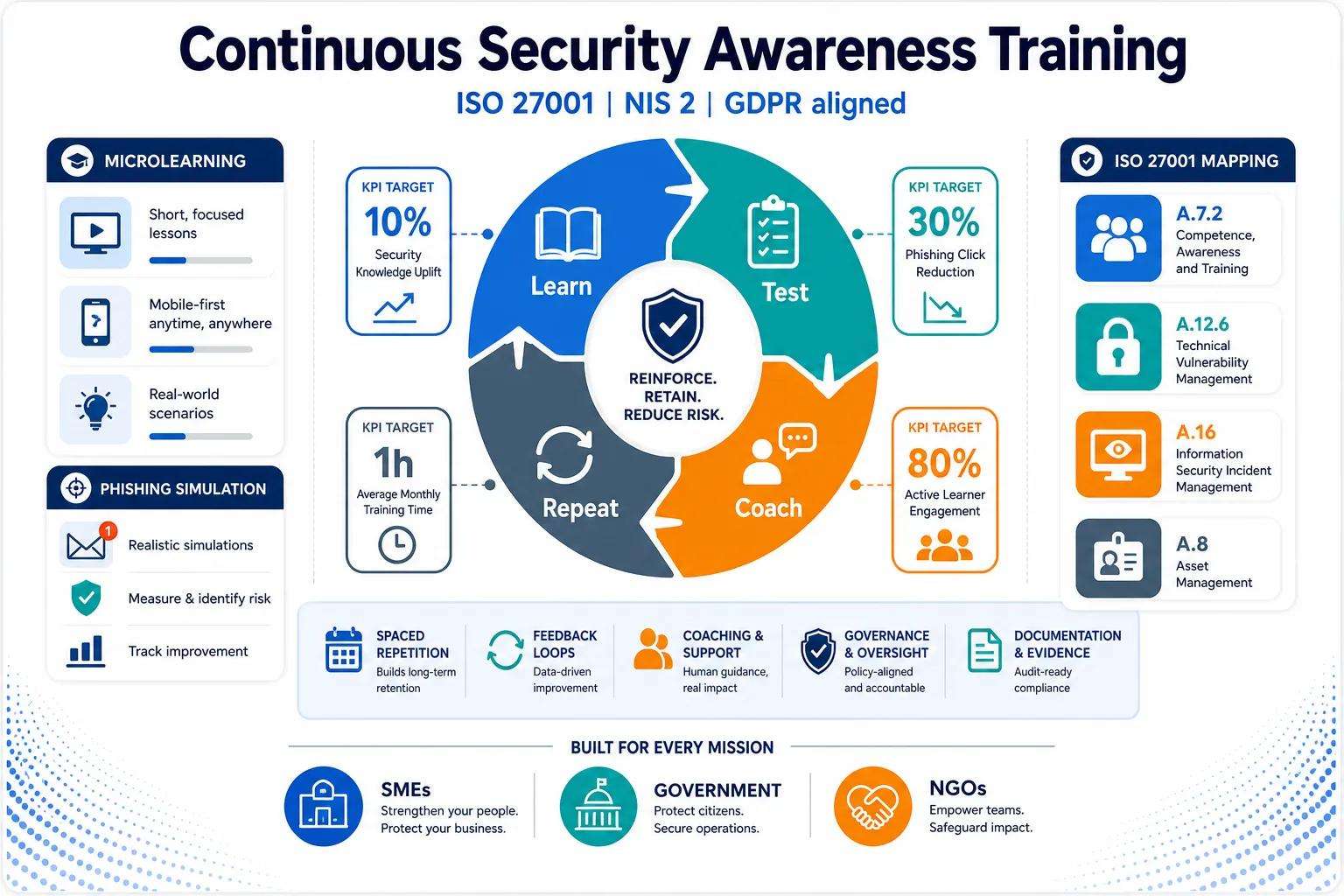
Continuous security awareness training is an ongoing programme that reinforces employee understanding of cyber risks through regular, bite-sized learning, realistic simulations, and feedback loops to change behaviour and reduce human error. By combining spaced repetition, microlearning modules, simulated phishing and measurable assessments, organisations convert knowledge into reliable actions that lower breach likelihood and improve compliance posture. This article explains why one-off training is insufficient, presents proven reinforcement techniques, maps ISO 27001 awareness to operational activities, shows how to tailor programmes for SMEs, government and NGOs, and outlines KPI-led measurement approaches. Readers will gain practical cadences, implementation parameters, and audit-ready documentation patterns that align continuous training with risk management and regulatory needs such as NIS 2 and GDPR. The guidance uses semantic relationships—entities, mechanisms, outcomes—to help practitioners design programmes that demonstrably reduce incidents tied to human error while supporting ISMS evidence requirements. Read on for concrete practices, tables that compare techniques and KPIs, and selective notes on how ACATO supports ISO-aligned awareness and workshops for organisations seeking implementation support.
The Role of Continuous Security Training in Modern Cybersecurity
Continuous security awareness training is essential because evolving threats and human error make static, annual sessions ineffective at preventing breaches. Regular reinforcement works by refreshing critical behaviours, strengthening retention through spaced practice, and converting awareness into reporting habits that interrupt attack progress. Organisations that treat training as continuous develop security culture, reduce incident response times, and provide documented evidence for audits and insurers. The next subsections explain behavioural mechanisms that reduce human error and the specific threat trends that demand ongoing education.

How does continuous training reduce human error and security breaches?
Continuous training reduces human error by leveraging spaced repetition and retrieval practice to move critical security behaviours from short-term awareness to long-term habit. Spaced microlearning prompts repetition at intervals tailored to forgetting curves, while simulated incidents provide immediate corrective feedback that strengthens memory and judgement. For example, repeated phishing simulations commonly reduce click rates by measurable percentages within months, converting a reactive employee into an active reporter. This behaviour-change cycle—learn, test, coach, repeat—creates durable improvements in threat detection and reporting that directly lower breach frequency.
What are the evolving cyber threats that necessitate ongoing security education?
Threats such as sophisticated phishing, deepfake-enabled social engineering, supply-chain compromises, and targeted credential harvesting have intensified in recent years, making static training obsolete. Attackers increasingly use context-aware messages and AI-generated content to bypass generic advice, so staff must learn to recognise subtle cues and follow up reporting steps. Remote and hybrid work expands the attack surface through unmanaged devices and shadow IT, requiring ongoing modules on secure access and data handling. Staying current on threat evolution ensures training curricula remain relevant and actionable for employees.
ACATO supports organisations seeking structured implementation and practical audit-readiness by providing ISO-aligned awareness training and offering free consultations and informative workshops. Their certified experts help map continuous training to organisational risk profiles and recommend simulation cadences and documentation practices that support compliance and NIS 2 objectives.
What Are the Best Practices for Security Awareness Training Reinforcement?
Best practices for reinforcement combine short, frequent learning, realistic simulations, motivational design, continuous assessment, and clear reporting mechanisms to close the loop between awareness and behaviour. Effective programmes prioritise role-based content, measurement of key behaviours, and rapid remediation after simulated failures so learning is targeted and timely. The following list summarises high-impact methods and why each matters to retention and culture-building.
- Microlearning modules delivered frequently strengthen retention by repeating core concepts in manageable doses.
- Simulated phishing and social engineering exercises provide real-world practice and teach detection and reporting habits.
- Gamification and incentives increase engagement and motivate positive security behaviours with measurable participation rates.
These reinforcement approaches work best when embedded in scheduled cadences and supported by management reporting that tracks improvements and resource allocation. The next paragraphs explore microlearning and gamification mechanics, then the role of simulations and remediation workflows.
Before comparing parameters in a table, note that implementation choices should reflect organisational size, risk profile, and regulatory demands; what works for one team may not fit another.

This comparison clarifies how to balance frequency and depth across methods to keep reinforcement effective without overwhelming staff. Choosing the right mix aligns training load with attention capacity and risk exposure, which leads into practical implementation tips like scheduling and remediation workflows.
How do microlearning and gamification improve knowledge retention?
Microlearning improves retention by breaking complex topics into focused, single-concept modules that fit working schedules and support retrieval practice. Short modules target a single behaviour—such as identifying a suspicious link—so employees practise and recall the action repeatedly, which strengthens long-term memory. Gamification overlays motivation mechanics like points, leaderboards and badges to sustain participation and reward consistent reporting and quiz performance. A practical microlearning module might include a 5–7 minute scenario, a two-question quiz for retrieval practice, and an automated follow-up email; these elements together increase completion rates and accelerate behaviour adoption.
What role do simulated phishing and social engineering attacks play in reinforcement?
Simulated phishing and social engineering create teachable moments by exposing real decision points under low-risk conditions and collecting data on user responses for targeted coaching. Well-designed simulations include immediate feedback, a remediation module for those who click, and manager reports that flag repeat risky behaviour for one-to-one coaching. Recommended cadence is monthly to quarterly based on risk and tolerance, with KPI targets such as click rates below 5–10% for mature programmes. Simulations also test technical controls and incident escalation, so their results inform both training content and policy updates for stronger organisational resilience.
How Does ISO 27001 Awareness Training Support Compliance and Security?
ISO 27001 awareness training supports compliance by aligning staff understanding with ISMS policies, defined roles and responsibilities, incident reporting processes, and control objectives. Awareness training maps directly to audit evidence requirements: records of attendance, assessment results, simulation outcomes and remediation logs form part of the documented proof auditors expect. Integrating ISO-focused onboarding with continuous reinforcement operationalises controls, reduces non-conformities, and demonstrates due diligence to regulators and certifying bodies. The following subsections outline key training components and how to combine ISO modules with ongoing learning.
What are the key components of ISO 27001 security awareness training?
Core ISO-aligned awareness topics include the organisation’s information security policy, staff roles and responsibilities, incident reporting procedures, access-control basics, and secure data handling. Training must cover expectations for all staff, including trainees and freelancers, because ISO scope and certification evidence require broad coverage. Each module should link to operational procedures and include assessment artifacts—attendance logs, quizzes, and simulation records—that auditors can review. By mapping content to documented ISMS processes, organisations can show consistent application of controls in daily operations and provide auditors with a chain of evidence tying behaviour to policy.
This mapping helps teams design training activities that create direct audit artifacts and show how staff actions implement ISMS controls in practice. The next subsection explains how to integrate these ISO modules with continuous reinforcement.
How does ISO 27001 training integrate with continuous security education?
ISO 27001 training integrates with continuous education through an operational pattern: initial ISO-focused onboarding, followed by scheduled microlearning that reinforces specific clauses, and simulation-driven assessments that validate behaviour. For example, onboarding covers policy and roles, microlearning reinforces incident reporting and phishing awareness, and simulations test those behaviours with immediate remediation. Linking training cycles to risk assessments ensures that control updates trigger targeted modules, maintaining alignment between the ISMS and staff capability. Organisations that document these cycles—module content, attendance, quiz scores and remediation—create the evidence auditors and regulators expect for certification and compliance.
ACATO provides ISO 27001 Awareness Training and supports organisations with audit readiness and NIS 2 alignment; their services include mapping training to ISO clauses and advising on documentation practices to demonstrate compliance in audits and regulatory reviews.
How Can Cybersecurity Training Be Tailored for SMEs, Government, and NGOs?
Tailoring training means adjusting content, cadence, and evidence expectations to the audience’s risk profile, resources, and regulatory obligations. SMEs often need high-impact, low-cost interventions with pragmatic cadences and clear vendor guidance. Government bodies require formal documentation, strong governance and chain-of-custody evidence, while NGOs balance mission-driven priorities with privacy and donor trust concerns. The following sections describe audience-specific adjustments and practical steps each organisation type can apply.
- SMEs should prioritise pragmatic, low-cost training that focuses on high-risk actions and vendor hygiene.
- Government agencies must emphasise formal records, role-based compliance modules, and incident escalation workflows.
- NGOs benefit from privacy-focused modules and donor-data handling scenarios tailored to their mission context.
Customisation starts with risk assessment and role mapping, which then informs module selection, cadence and evidence collection that fits organisational capacity and obligations. The next subsections provide SME-focused steps and explain benefits for government authorities and NGOs.
What are the unique security challenges faced by SMEs and how training addresses them?
SMEs typically face constrained budgets, limited IT staff, and disproportionate exposure to supply-chain and credential-based attacks; their recovery costs can be devastating. Effective SME training focuses on three pragmatic steps: implement short microlearning on phishing and password hygiene, schedule quarterly phishing simulations to measure progress, and document simple remediation logs to satisfy insurers and partners. Low-overhead modules and automated learning paths reduce management effort while improving baseline behaviours quickly. These steps lower breach probability, reduce incident impact and strengthen vendor trust with concise evidence of staff competence.
How do government authorities and NGOs benefit from customized security awareness programs?
Government authorities and NGOs operate under stringent regulatory and public-trust expectations, so customised programmes emphasise formal governance, audit trails, and specialist modules on sensitive data handling. Training must include documented attendance, assessment artifacts, and incident reporting workflows that integrate with formal governance processes. Simulations and tabletop exercises should map to escalation chains and legal requirements, creating artifacts that demonstrate compliance and readiness. Tailored awareness increases operational resilience, preserves citizen and donor trust, and ensures that mission-critical services remain available under stress.

How Can Organizations Measure the Effectiveness of Security Awareness Programs?
Measuring effectiveness requires a mix of behavioural KPIs, incident metrics, and quality of evidence that ties training to reduced risk and operational cost. Practical KPIs include simulated-phish click rate, reporting rate, time-to-report, assessment pass rate and reduction in incidents attributed to human error. Combining quantitative dashboards with qualitative feedback creates a full picture of programme maturity and ROI. The next subsections define key KPIs with formulas and a recommended benchmarking table, then describe how feedback and incident reporting create a closed-loop improvement system.
These KPIs provide quantifiable signals of behaviour change and allow teams to convert improvements into risk reduction estimates that inform ROI calculations and resource allocation. The following subsection gives formulas and data practices for KPI tracking.
What key performance indicators track training success and ROI?
Key performance indicators track the frequency and quality of safe behaviours as well as the program’s impact on incidents and costs. Simulated-phish click rate = (clicked users / recipients) × 100, reporting rate = (reports / recipients) × 100, and time-to-report is measured as the median minutes between receipt and report. To estimate simple ROI, calculate avoided incident cost = baseline incident cost × reduction in incidents attributable to training; ROI = (avoided cost − training cost) / training cost. Data collection best practices include single-source dashboards, anonymised user-level metrics for pattern detection, and retention of artifacts that tie remediation to improvements. These metrics allow security teams to show executives that behaviour-change investments reduce measurable risk.
How does feedback and incident reporting enhance continuous training outcomes?
Feedback and incident reporting close the improvement loop by converting real incidents into targeted learning that addresses root causes and prevents recurrence. A practical workflow is: incident → root-cause analysis → targeted microlearning module → reassessment and follow-up simulation, which creates both corrective action and evidence of improvement. Near-real-time feedback encourages reporting and reduces dwell time for threats, while remediation logs show auditors and insurers that the organisation acted on issues. Integrating feedback loops into the training cadence ensures that lessons from live incidents rapidly update learning content and policy.
How Does Continuous Security Training Help Meet NIS 2 and Other Regulatory Requirements?
Continuous training supports regulatory compliance by producing documented, regular, and role-specific evidence that staff understand reporting duties, supplier risks and incident escalation, all key expectations under frameworks like NIS 2 and GDPR. Ongoing training demonstrates due diligence, helps maintain required governance controls, and provides artefacts auditors require, such as attendance records, simulation results and remediation logs. The next subsections summarise NIS 2 obligations tied to awareness and outline audit-ready recordkeeping practices that align training with regulatory scrutiny.
What are the NIS 2 compliance demands related to security awareness?
NIS 2 expects entities to ensure staff are aware of cybersecurity risks, reporting obligations, and supplier risk management, with documented evidence of training and governance processes. Practical ways to satisfy these demands include role-based modules for critical staff, records of attendance and assessments, supplier-awareness modules for procurement teams, and simulation results that demonstrate active testing of staff preparedness. Regulators accept documented workflows and logs showing regular refreshers and evidence that lessons from incidents were incorporated into training. Demonstrating these practices helps organisations show compliance with NIS 2 expectations for preparedness and response.
How does ongoing training ensure audit readiness and regulatory adherence?
Ongoing training ensures audit readiness by maintaining a structured archive of evidence—training schedules, attendance, quiz scores, simulation campaigns, remediation actions and incident follow-ups—that auditors can review to confirm compliance. Recommended records to keep include module versions, attendance logs with timestamps, simulation campaign results with remediation notes, and post-incident training updates tied to root-cause analyses. Scheduling refresher training and retaining these records in an organised, searchable format makes regulatory reviews more efficient and reduces the risk of non-conformities. Proper documentation also supports procurement and insurance processes that require proof of proactive security education.
For organisations seeking implementation help, ACATO offers free consultations and free informative workshops and webinars and provides ISO 27001 and ISO 42001 awareness training delivered by international experts who can assist with mapping training evidence to regulatory expectations and audit preparation. This support is designed to complement internal efforts and accelerate readiness for certification and regulatory reviews.