
Essential Virus Scan Tips for Successful Malware Detection
Business Malware Detection and Removal: A Strategic Guide
Malware in a business context is malicious software designed to disrupt operations, steal data, or enable persistent unauthorised access, and enterprise-focused detection and removal require different priorities than consumer advice. This guide explains practical, defensible detection and remediation methods—covering common malware types, proactive prevention controls, early detection indicators, and a stepwise incident response (IR) approach that aligns with regulatory needs. Readers will gain clear, actionable techniques for reducing downtime, preserving evidence for legal or regulatory reporting, and restoring systems securely, with attention to enterprise tools like EDR and SIEM. The article maps common threats (ransomware, spyware, trojans, APTs), preventive investments (endpoint controls, segmentation, patching, backups, training), detection signals for security monitoring, and a complete IR lifecycle including digital forensics. Throughout, we weave operational examples, comparison tables, and checklists designed for IT leaders, SOC engineers, and compliance owners to implement or refine malware protection and removal processes in 2024 and beyond.
To further underscore the pervasive nature of these threats and the critical need for robust defenses, consider this perspective on understanding malware:
Understanding Malware: Types, Threats, and Enterprise Defenses
Malicious software, commonly known as malware, presents one of the most formidable threats in the digital landscape. Malware’s evolution over the years has seen it transform from simple viruses to sophisticated threats like ransomware, spyware, and advanced persistent threats (APTs). This malicious code infiltrates systems through various vectors, including email attachments, compromised websites, and even legitimate software vulnerabilities. The repercussions of a malware infection can be severe, ranging from data theft and financial loss to significant operational disruptions. The increasing sophistication of malware underscores the necessity for robust, comprehensive malware defenses within any cybersecurity framework.
Malware Defenses, 2024
What Are the Common Types of Malware Threatening Businesses?
Malware categories most likely to target organisations include ransomware, spyware, trojans, and advanced persistent threats (APTs), each using distinct vectors and delivering different impacts. Ransomware typically encrypts data via phishing, stolen credentials, or exposed RDP and leads to operational downtime and ransom negotiations. Spyware focuses on data exfiltration through stealthy installers or malicious macros, compromising PII and IP. Trojans establish backdoors that enable lateral movement, while APTs combine social engineering, custom tooling, and long dwell times for targeted objectives. Understanding these categories helps prioritise detection and remediation investments, and the next section compares vectors, impacts, detection difficulty and common remediation approaches.
Different malware families demand different defensive focus; the comparison below helps teams identify which controls best reduce business risk.
This table clarifies why layered controls and evidence-preserving remediation are essential; the next section shows prioritised prevention measures to reduce these attack vectors.
How Do Ransomware, Spyware, and Trojans Impact Business Operations?
Ransomware rapidly converts operational assets into a liability by encrypting files and disrupting services, forcing organisations to decide between paying a ransom or invoking recovery plans. In many incidents, encrypted databases and unavailable applications translate into measurable revenue loss, contractual penalties, and reputational damage, which makes rapid containment and backup validation critical. Spyware often produces a slower, more insidious harm by exfiltrating credentials and sensitive datasets over weeks or months, triggering regulatory breach timelines and forensic obligations. Trojans enable pivoting and persistence: a single compromised endpoint can become a beachhead for lateral movement and privilege escalation, so containment must include account resets and network segmentation. These operational patterns underline why detection, rapid isolation, and forensic preservation are core components of effective malware removal.

What Are Advanced Persistent Threats and Their Risks to Enterprises?
Advanced Persistent Threats (APTs) are targeted campaigns conducted by well-resourced actors who prioritise stealth, persistence, and custom tooling to achieve strategic objectives over long timeframes. The typical APT lifecycle includes reconnaissance, initial access, lateral movement, data collection, and exfiltration, often blending living-off-the-land techniques with bespoke malware to evade signature-based detection. Indicators of compromise (IoCs) can be subtle — anomalous scheduled tasks, unusual outbound connections at odd hours, or low-volume beaconing to external infrastructure — making EDR telemetry and threat hunting essential to detect them. APT incidents frequently require specialist incident response and digital forensics to scope impact, attribute activity where possible, and remediate without destroying evidentiary value. Understanding the APT model directs investment toward long-term monitoring, threat intelligence, and forensic readiness.
How Can Businesses Proactively Prevent Malware Infections?
Proactive prevention focuses on layering controls that reduce the probability of initial compromise and minimise the blast radius if compromise occurs. Effective primary controls include robust endpoint detection and response (EDR), disciplined patch management, network segmentation, reliable backups, and regular employee security training. Combining these controls increases resilience: EDR agents detect anomalous behaviour, segmentation limits lateral spread, and validated backups enable recovery without capitulation to ransom demands.
Key preventive controls that provide the greatest risk reduction are:
- Endpoint Detection and Response (EDR): Continuous endpoint telemetry and behavioural blocking reduce successful payload execution.
- Regular, Tested Backups: Immutable or air-gapped backups enable recovery without paying ransom.
- Patch Management: Promptly closing known vulnerabilities prevents common exploit paths.
- Security Awareness Training: Phishing-resistant training lowers the rate of successful social-engineering attacks.
These controls work together to reduce both infection likelihood and operational impact; the following table helps teams prioritise investment and understand what each control protects.
Prioritising according to this table enables pragmatic budgeting: start with EDR and backups, then invest in segmentation and patch processes. The next subsection explains how EDR and segmentation specifically interoperate to prevent spread.
What Role Do Endpoint Security and Network Segmentation Play in Prevention?
Endpoint security, particularly modern EDR, provides continuous process and behaviour monitoring that can detect and block malicious execution patterns before persistence occurs. EDR agents collect rich telemetry—process trees, parent-child relationships, command-lines—that allow detection of living-off-the-land techniques and automated containment of suspicious hosts. Network segmentation complements EDR by limiting which systems can reach critical servers and by enforcing least-privilege network paths, reducing the potential damage from a single compromised host. Combined with SIEM for correlated alerting, EDR and segmentation form a contextual defence that balances prevention with visibility. Implementing these controls together supports effective threat hunting and reduces recovery scope when incidents occur.
How Does Employee Training and Patch Management Reduce Malware Risks?
Human error and unpatched vulnerabilities remain among the most common initial access vectors for malware, so targeted training and disciplined patching are foundational controls. Training programs that simulate phishing and emphasise verification of attachments reduce click-through rates and credential compromise, which in turn lowers risk of initial footholds. Patch management closes known software vulnerabilities used by exploit kits, while a predictable cadence and emergency hotfix process ensure high-priority fixes are applied quickly. Measuring program effectiveness through phishing metrics, time-to-patch, and vulnerability backlog gives security leaders actionable KPIs. Combining people-focused controls with technical patch processes creates a layered defence that significantly reduces overall malware risk.

What Are the Key Signs of Malware Infection in an Enterprise Environment?
Early detection relies on observable indicators across endpoints, networks, and identity systems; recognising these signs reduces dwell time and limits damage. Key indicators include unexplained file encryption or deletion, spikes in CPU or disk usage on servers, unusual outbound connections or beaconing to unknown IPs, anomalous authentication patterns such as logins at odd hours or geographic jumps, alerts from EDR indicating suspicious process behaviour, and unexpected modification of system or security logs. Monitoring these signals through SIEM and EDR enables faster triage and containment.
The list below summarises the most actionable signs for SOC teams and operators.
- Unexplained file encryption or renamed files: Suggests ransomware activity.
- Persistent unusual outbound traffic: Indicates potential data exfiltration or C2 beaconing.
- Authentication anomalies: New account activity, impossible travel, or sudden privilege use.
- High CPU/disk usage with no business reason: May signal cryptomining or payload execution.
- EDR alerts for unusual child processes or script executions: Sign of living-off-the-land techniques.
- Tampered or missing logs: Attackers often clear traces to hinder investigation.
The complexities of identifying these threats are further highlighted by research into the challenges faced by Security Operations Centers in malware detection:
Malware Detection Challenges in Security Operations Centers
Security Operations Centres (SOCs) are the first-line of defence in an organisation, providing 24/7 monitoring, detection, and response to security attacks. This thesis aims to explore the challenges in malware detection in Security Operation Centres (SOCs) providing recommendations for possible technological solutions.
Malware detection in security operation centres, BA Alahmadi, 2019
Recognising these indicators informs containment choices; the next subsection explains how SIEM and monitoring make these signs actionable for detection and response.
How Can SIEM and Cyber Attack Monitoring Detect Early Malware Threats?
SIEM and cyber attack monitoring aggregate logs and telemetry from endpoints, network devices, identity providers, and cloud services, applying correlation rules and analytics to identify suspicious patterns indicative of malware. Effective detection leverages rule-based alerts for known IoCs and behavioural analytics for anomalies like lateral movement or privilege escalation, enabling faster triage. Tuning alert thresholds and integrating threat intelligence reduces false positives and focuses human analysis on high-confidence events. Continuous monitoring paired with playbooks ensures that when telemetry indicates probable compromise, containment actions can be executed quickly. Properly instrumented monitoring turns dispersed signals into coherent incidents ready for containment and forensic capture.
What Are Effective Threat Intelligence Integration Methods for Businesses?
Threat intelligence becomes operational when indicators of compromise (IoCs) and tactics, techniques and procedures (TTPs) are fed into detection tools and playbooks in a structured way, such as STIX/TAXII feeds or integration via a threat intelligence platform (TIP). Translating high-level TTPs into detection rules for SIEM and EDR requires threat hunting expertise to avoid excessive false positives and ensure contextual relevance. SMEs can prioritise intelligence that maps to their asset profile and threat landscape to maximise ROI; larger organisations often automate enrichment and prioritisation to scale. An operational workflow that ingests TI, enriches alerts, and triggers containment playbooks converts external knowledge into practical detection and response actions.
How Should Businesses Develop and Execute a Malware Incident Response Plan?
An effective malware incident response (IR) plan organises people, processes, and tools into a repeatable lifecycle: prepare, detect, contain, eradicate, recover, and review, with clear roles, communication paths, and evidence preservation steps. Preparation includes maintaining an asset inventory, IR runbooks, contact lists, and forensic readiness (log retention, imaging capabilities). Detection combines SIEM/EDR alerts with analyst triage to verify incidents. Containment isolates affected hosts and accounts while preserving volatile evidence; eradication removes malware artifacts and addresses root causes; recovery restores services from validated backups and hardens systems against re-infection. Post-incident review captures lessons learned and updates controls and documentation.
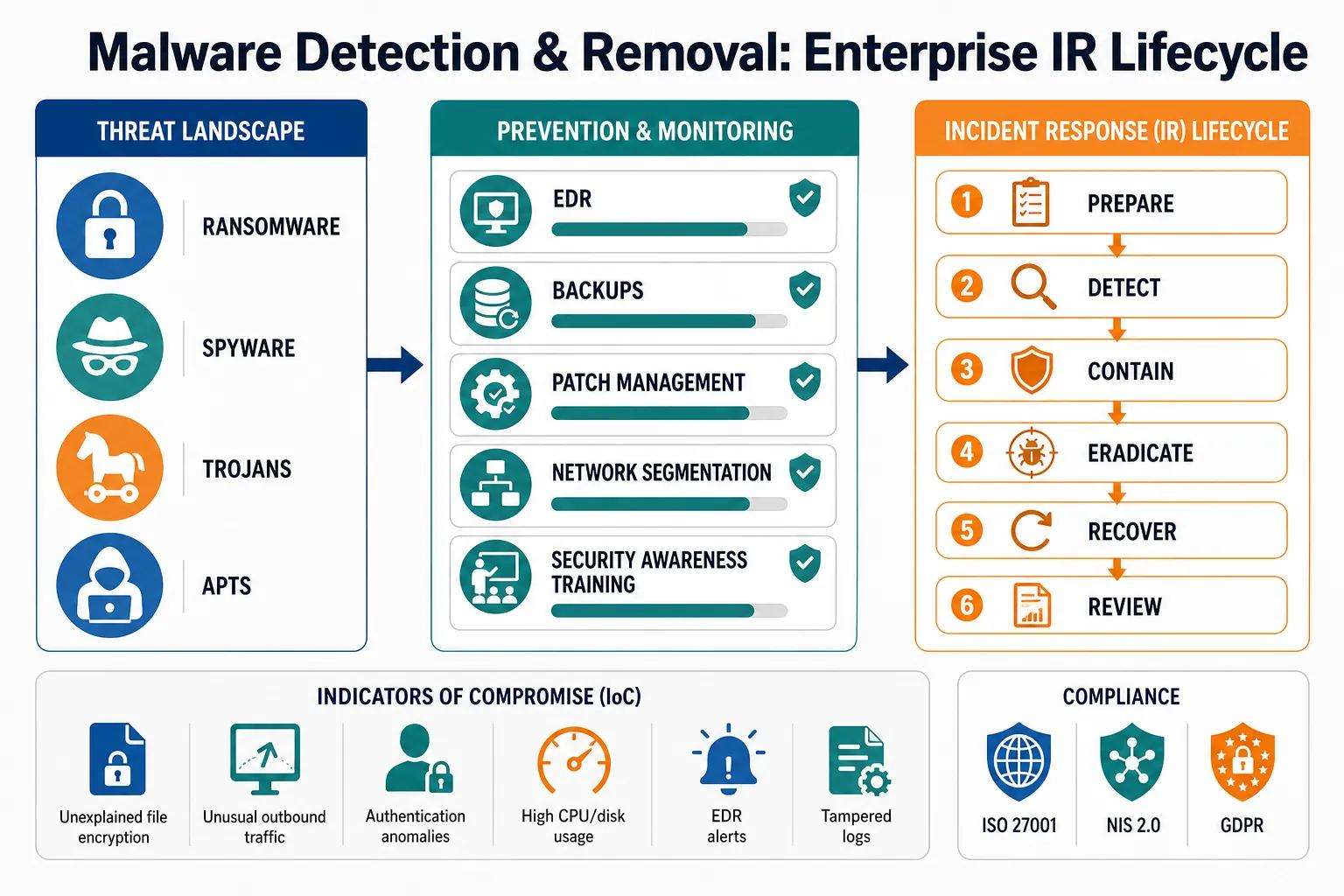
The following table maps IR phases to responsible roles and expected outputs to make responsibilities explicit for teams.
Clear role mapping accelerates response and supports regulatory reporting obligations; the next subsection outlines practical containment and eradication steps.
What Are the Essential Steps for Containment and Eradication of Malware?
Containment begins with isolating affected systems from networks and disabling compromised credentials to prevent lateral movement and further exfiltration. Immediate technical steps include network segmentation adjustments, endpoint isolation via EDR, snapshotting disks and memory for forensics, and preserving SIEM and endpoint logs to maintain evidentiary continuity. Eradication typically requires either targeted removal of malicious artifacts where feasible or full reimaging of compromised hosts to eliminate hidden persistence, followed by patching and credential resets. Throughout containment and eradication, maintain a detailed timeline and change log to support legal and regulatory review. Preserving artifacts while remediating ensures root-cause analysis and helps prevent repeat incidents.
How Does Digital Forensics Aid in Root Cause Analysis and Recovery?
Digital forensics provides the methodology and evidence required to determine how an intrusion occurred, the scope of compromise, and whether data was exfiltrated, producing deliverables like timelines, file system images, and chain-of-custody documentation. Forensics teams collect volatile and non-volatile artifacts, reconstruct attack paths, and identify IoCs to inform containment and remediation efforts while also preserving admissible evidence for legal or regulatory processes. Results of a forensic investigation often guide targeted recovery actions and post-incident hardening measures by revealing exploited vulnerabilities or misconfigurations. When investigations exceed in-house capability or when legal reporting is at stake, engaging external forensic specialists ensures impartiality and technical depth in evidence handling.
ACATO offers Incident Response and Digital Forensics support tailored to organisations requiring rapid containment and forensic-quality evidence collection. Their specialist teams combine IR playbooks with forensic methodologies to preserve artifacts, map attack scope, and produce reports that support regulatory reporting and recovery planning. Organisations engaging expert responders gain access to experienced analysts, structured deliverables, and a coordinated escalation path that reduces mean time to containment and clarifies next steps. If your team needs external assistance, a focused consultation can triage urgency and outline a structured engagement aligned to business and compliance priorities.
How Does ISO 27001 Certification Enhance Malware Security and Compliance?
ISO 27001 certification establishes a management system (ISMS) that formalises risk management, documented controls, and continuous improvement—mechanisms that directly reduce malware risk by enforcing processes like patch management, access control, and incident response. The standard encourages documented policies, role definitions, and measurement practices that prepare organisations for regulatory obligations such as incident notification requirements. Mapping ISO controls to malware mitigations ensures that defensive measures are auditable and repeatable, improving stakeholder confidence and regulatory readiness. The table below maps specific ISO control areas to practical malware mitigation steps to demonstrate how certification supports durable cybersecurity posture.
Certification translates technical controls into governed processes that sustain security improvements; the next subsection summarises direct business benefits.
What Are the Benefits of ISO 27001 for Information Security Management?
ISO 27001 delivers structured risk assessment and continuous improvement cycles that reduce exposure to malware by ensuring controls are designed, implemented, and reviewed systematically. Certification provides demonstrable governance to customers and regulators, increasing trust while making incident handling and reporting more predictable and auditable. The ISMS framework ties technical practices—patching, backups, access control—to documented roles and measurable outcomes, which in turn supports faster, more organised response when malware events occur. Clients seeking certification benefit from guidance that aligns security investments with business risk and compliance obligations. Establishing this management discipline is a strategic way to lower malware risk over time.
How Do NIS 2.0 and GDPR Regulations Influence Malware Protection Strategies?
NIS 2.0 and GDPR heighten obligations for entities providing essential services and organisations processing personal data, by imposing stricter incident reporting timelines, security requirements, and potential penalties for non-compliance. These regulations drive requirements for documented incident response capabilities, evidence preservation, and timely notification to authorities and affected parties when personal data exposure occurs. Practically, compliance forces organisations to invest in monitoring, forensic readiness, and legal coordination so that incident data and timelines are defensible. Where regulatory reporting is required, having an ISMS aligned to ISO 27001 simplifies demonstrating adequate controls and consistent responses to malware incidents.
ACATO provides ISO 27001 certification support and advisory services that can help organisations map their security controls to regulatory obligations like NIS 2.0 and GDPR. Their offerings include guidance on ISMS documentation, certification audit preparation, and alignment of incident response processes to compliance needs. A focused consultation can identify gaps between current operations and certification requirements, and outline prioritized remediation steps to achieve demonstrable compliance. Organisations preparing for regulatory scrutiny or seeking certification may find this external guidance valuable in accelerating readiness and reducing compliance risk.

Why Partner with Cybersecurity Experts for Business Malware Protection?
Partnering with experienced cybersecurity and forensics specialists accelerates containment, improves accuracy of root-cause analysis, and supplies the technical and governance artifacts required by regulators and insurers. External experts bring specialised tooling, established playbooks, and cross-sector experience—advantages that typically reduce downtime, limit exposed data, and produce higher-quality forensic reports than ad hoc internal efforts. For many organisations, the measurable benefits include faster mean time to containment, clearer remediation roadmaps, and reduced regulatory exposure through proper evidence handling.
- Faster Containment: Expert teams deploy tested playbooks to limit spread and reduce downtime.
- Comprehensive Forensics: Accredited evidence collection supports legal and regulatory reporting.
- Improved Recovery: Coordinated remediation and validated restores reduce recurrence risk.
- Governance and Compliance Support: Documentation and reporting help meet regulatory obligations.
These benefits translate into tangible ROI by minimising operational disruption and liability; the next subsection details the specific value of consulting and IR services.
What Value Do IT Security Consulting and Incident Response Services Provide?
IT security consulting builds proactive controls such as ISMS documentation, risk assessments, and hardening guidance that reduce the likelihood and impact of malware incidents, while incident response services deliver rapid triage, containment, and evidence collection when breaches occur. Typical deliverables include IR runbooks, forensic reports, remediation plans, and recommendations for durable technical controls like EDR, segmentation, and backup validation. Engagements often follow time-and-material or retainer models with defined SLAs for response time; the core value is access to expertise and tools that many organisations cannot maintain in-house. After-action reviews from consultants also inform continuous improvement and help prioritise future security investments.
How Can Businesses Benefit from Free Consultations and Expert Guidance?
A well-structured free consultation should triage the current incident or risk posture, identify immediate containment actions, and outline recommended next steps with estimated effort and priorities, enabling organisations to decide whether to escalate to a formal engagement. Useful consultation agendas typically include a rapid evidence review, attack surface assessment, critical asset identification, and an initial remediation roadmap. This initial engagement clarifies urgency versus longer-term programme needs and sets expectations for cost, timescales, and deliverables. ACATO offers free consultations to help organisations assess incident severity and determine appropriate IR, digital forensics, or ISO 27001 certification support tailored to SMEs, authorities, NGOs, and infrastructure providers, enabling informed decisions about next steps.
- Scope Assessment: Rapidly determine which systems and data may be affected.
- Immediate Actions: Recommend immediate containment and evidence preservation steps.
- Engagement Options: Outline likely remediation paths and whether forensic investigation is warranted.
These consultations help teams prioritise resources and decide on a precise engagement path, ensuring business continuity and compliance readiness.