
Mastering Risk Assessment: Expert Consulting Solutions
Strategic Risk Management through Cyber Security and ISO 27001
Risk management consulting helps organisations identify, assess, and reduce threats to people, processes, information and technology by turning uncertainty into managed, measurable outcomes. This article explains how cyber security practices and ISO 27001-based Information Security Management Systems (ISMS) work together to identify vulnerabilities, prioritise risks and implement controls that protect confidentiality, integrity and availability. Readers will learn practical steps for carrying out cyber security risk assessments, how ISO 27001 consulting supports certification and continuous improvement, which IT security services add the most value, and how to align risk work with GDPR and NIS 2 compliance. Unmanaged risk leads to financial loss, regulatory penalties and reputational damage; this guide focuses on concrete mitigation strategies — technical, organisational and governance — that reduce likelihood and impact. The sections below map to common decision points for SMEs and larger organisations: defining risk management consulting, ISO 27001 consulting in the UK, cyber security assessments, IT security services, compliance integration, and non-technical risk strategies including supply chain and board engagement. Practical examples, EAV tables, and actionable lists are included to help practitioners and decision-makers convert assessment results into prioritized remediation and measurable resilience.
What is Risk Management Consulting and Why is it Essential for Businesses?
Risk management consulting is a structured advisory service that identifies threats, assesses likelihood and impact, and recommends controls so organisations can prioritise and manage exposures to acceptable levels. Consultants apply methods such as asset inventories, risk matrices, and control frameworks to translate abstract threats into a prioritized risk register with remediation plans. Effective consulting reduces incident probability, lowers potential losses, and supports business continuity while aligning security work with strategic objectives and regulatory obligations. Below are key benefits organisations typically realise from professional risk management guidance, presented as a concise benefits list that can serve decision-makers evaluating a consulting engagement.

Risk management consulting delivers these core benefits:
- Enhanced resilience: systematic identification and prioritisation of critical assets reduce downtime and operational disruption.
- Regulatory readiness: mapping controls to GDPR and NIS 2 simplifies audit evidence and incident reporting obligations.
- Financial protection: quantified risk assessments focus remediation on high-impact exposures to minimise potential losses.
- Competitive advantage: demonstrable security posture and certification can increase trust with customers and partners.
These benefits illustrate why a strategic, repeatable risk management practice matters; the next subsection explains how information security risk management protects organisations in practice.
How Does Information Security Risk Management Protect Your Organization?
Information security risk management protects organisations by creating repeatable processes for asset identification, threat analysis, control selection and continuous monitoring that reduce both likelihood and impact of incidents. The approach begins with an inventory of critical information assets and associated owners, proceeds to map threats and vulnerabilities, and concludes with targeted controls — technical, procedural and organisational — chosen to reduce risk to acceptable levels. Common controls include access management, encryption, patching, backup and incident response playbooks that directly affect confidentiality, integrity and availability outcomes. An anonymised example: a retail client reduced payment-card related incident risk by combining segmentation, logging and a focused patch programme, which lowered exploit likelihood and supported faster detection. Understanding these mechanisms sets up the next focus on the measurable benefits that flow from effective mitigation strategies.
What Are the Key Benefits of Effective Risk Mitigation Strategies?
Effective risk mitigation delivers measurable reductions in incident cost, improved compliance posture and stronger customer trust through documented controls and testing processes. Quantitatively, organisations that prioritise high-impact risks can achieve disproportionate reductions in expected loss by addressing a few critical vulnerabilities first, and industry studies show faster detection and containment significantly lower breach costs. Beyond economics, mitigation enhances operational continuity and supports brand reputation by demonstrating governance and due diligence to stakeholders. Practical takeaways include maintaining a concise risk register, applying risk quantification (likelihood × impact) for prioritisation, and embedding remediation tracking into governance cycles to ensure sustained risk reduction. These benefits naturally lead into frameworks that structure mitigation work at the organisational level, of which ISO 27001 is a primary example.

How Does ISO 27001 Consulting in the UK Support Risk Identification and Mitigation?
ISO 27001 provides a structured framework for an Information Security Management System (ISMS) that institutionalises risk identification, treatment and continuous improvement across people, process and technology domains. Consulting accelerates adoption by running gap analysis, drafting policies, implementing controls and preparing organisations for certification audits while mapping ISO requirements to business objectives. UK organisations often combine ISO 27001 projects with assessments against GDPR and NIS 2 to demonstrate regulatory alignment, and a consultant-led approach reduces overhead by delivering templates, training and internal audit support.
Further research highlights how frameworks like ISO 27001 are essential for managing information security and assessing risks effectively.
ISO 27001 for Information Security Management & Risk Assessment
Information is a fundamental asset within any organization and the protection of this asset, through a process of information security is of equal importance. COBIT and ISO27001 are as reference frameworks for information security management to help organizations assess their security risks and implement appropriate security controls. One of the most important sections of IT within the COBIT framework is information security management that cover confidentiality, integrity and availability of resources.
Effectiveness of ISO 27001, as an information security management system: an analytical study of financial aspects, NK Sharma, 2012
The table below maps core ISMS components to their purpose and expected mitigation outcomes to clarify how each element contributes to lowering risk and supporting compliance.
The ISMS component table shows mapping to risk outcomes:
This mapping shows that ISO 27001 structures risk work into repeatable activities; the next subsection explains the specific role of ISMS components in operational risk management.
What is the Role of an Information Security Management System in Risk Management?
An ISMS institutionalises risk management by combining policy, scope definition, risk assessment, control implementation and monitoring into a Plan-Do-Check-Act cycle that drives continuous improvement. The ISMS ensures that control decisions are evidence-based, documented and aligned with organisational appetite, which converts ad hoc security activities into measurable programmes. Key outputs include a formal risk register, documented policies, control implementation evidence and internal audit reports that provide proof points for certification and regulator engagement. This systematic approach increases predictability and creates records that demonstrate due diligence to stakeholders, which leads into how a consultant supports SMEs through these practical steps.
How Does ACATO Guide SMEs Through ISO 27001 Certification?
ACATO supports SMEs by scoping requirements, conducting ISO 27001 gap analysis, drafting required policies and controls, delivering internal audits and guiding certification readiness with a pragmatic, risk-based approach. Consultants typically start with a focused gap review to identify critical gaps, then prioritise implementation tasks to reduce audit risk while preserving business agility. For SMEs, this approach minimises disruption by aligning templates and controls to existing processes and providing focused staff training that embeds ownership. ACATO also offers free consultations to scope projects and outline timeframes, which helps leaders decide whether to pursue certification immediately or stage improvements in manageable phases.

What Are the Steps Involved in a Cyber Security Risk Assessment?
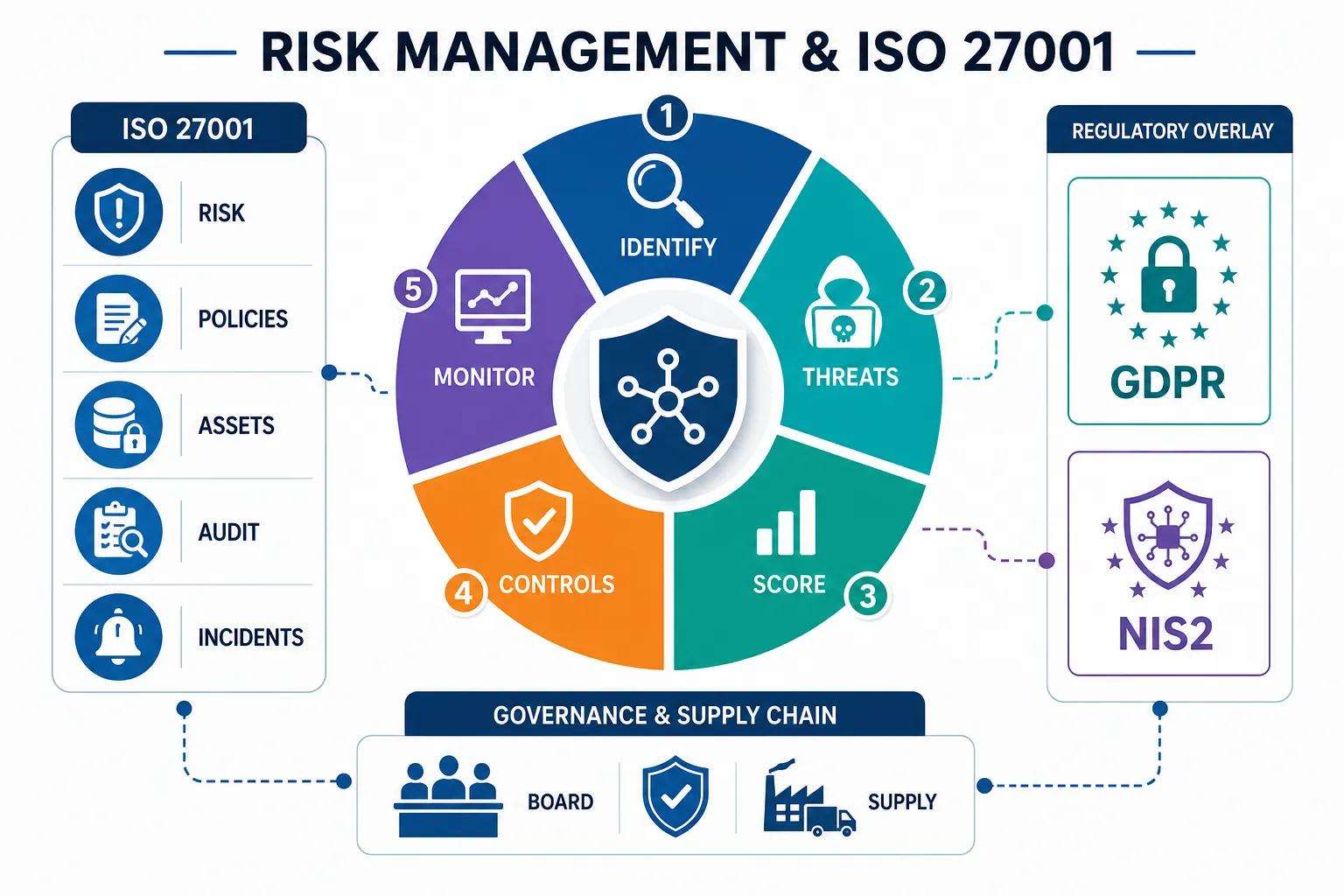
A cyber security risk assessment follows a structured sequence of scoping, discovery, analysis, prioritisation and reporting to deliver a remediation roadmap that reduces exposure to threat actors and system failure. The standard assessment workflow starts with scoping and asset inventory, follows with threat and vulnerability identification, applies likelihood and impact scoring, and concludes with prioritised remediation recommendations and monitoring plans. Deliverables commonly include an executive summary, a risk register with quantified ratings, and a remediation plan with timelines and effort estimates. The concise numbered steps below mirror common assessment outputs and are intended for featured-snippet style consumption.
Indeed, risk assessment is a fundamental technique for managing information systems security, with various methodologies available to organizations.
Information Systems Security Risk Assessment Methodologies
Risk assessment is currently used as a key technique for managing Information Systems Security. Every organization is implementing the risk management methods. Risk assessment is a part of this superset, Risk Management. There are various information security risk assessment methods available that can be implemented by the organization, and each has different approaches to assess the information security risks.
A comparative study of risk assessment methodologies for information systems, 2012
A practical assessment step-by-step:
- Scoping and asset identification: define in-scope systems, data and owners.
- Discovery and data collection: perform inventories, logs review, interviews and scans.
- Threat and vulnerability identification: combine intelligence with scan results to list exposures.
- Likelihood and impact analysis: score each risk to prioritise remediation based on business impact.
- Remediation planning: propose technical and organisational controls with effort and timeline.
- Reporting and monitoring: deliver a prioritised roadmap and measurable metrics for follow-up.
These steps lead naturally to a table that clarifies typical activities and deliverables at each assessment phase.
The assessment-phase EAV table clarifies client deliverables:
This table makes client expectations explicit, and the next subsection explains how threats and vulnerabilities are identified and analysed in practice.
How Are Threats and Vulnerabilities Identified and Analyzed?
Threats and vulnerabilities are identified using a mix of automated tools and human-led techniques: asset inventories, vulnerability scanning, patch analysis, threat intelligence feeds, and stakeholder workshops that surface contextual risks. Vulnerability scanners and configuration checks identify technical weaknesses, while interviews and process reviews expose governance and procedural gaps; combining these data sources provides a holistic view of exposure. Analysis methods include qualitative scoring (low/medium/high) and quantitative approaches that estimate expected loss to support prioritisation by business impact. A simple semantic triple captures the process: Asset → exhibits → Vulnerability; Vulnerability → exploited by → Threat; Exploit → causes → Impact; this framing helps convert findings into a prioritized remediation plan. The following subsection outlines the types of mitigation recommendations that flow from such assessments.
What Mitigation Recommendations Stem from Cyber Security Assessments?
Recommendations typically fall into technical fixes, process changes, policy updates and people-focused measures; each recommendation is prioritised by expected risk reduction per unit effort. High-impact fixes often include patching critical vulnerabilities, enforcing multifactor authentication, network segmentation and improving backup and recovery capabilities as quick wins. Medium-to-long term projects can include secure development practices, identity and access management overhauls and infrastructure redesign to reduce attack surface. All recommendations should be accompanied by suggested timelines, estimated effort and verification criteria so organisations can track remediation and validate effectiveness through follow-up testing and metrics. Prioritised remediation then feeds into broader service choices that extend risk mitigation beyond point fixes.
Which IT Security Consulting Services Enhance Business Risk Mitigation?
IT security consulting services provide a portfolio of interventions that together reduce cyber and information risk across detection, prevention and response phases. Core services include cyber security risk assessments, penetration testing, incident response and digital forensics, managed security services and security awareness training; each service maps to a stage in the risk lifecycle and offers distinct business value. Organisations should engage these services based on maturity: assessments and penetration tests inform priorities, managed services provide ongoing protection, and incident response supports containment and recovery when breaches occur. The list below summarises common services with concise benefits to help leaders match offerings to needs and timing.
Key IT security consulting services and one-line benefits:
- Cyber security risk assessment: prioritises vulnerabilities and recommends targeted controls to reduce exposure.
- Penetration testing: simulates attacks to validate defences and reveal exploitable weaknesses.
- Incident response & digital forensics: contains incidents, preserves evidence and identifies root causes to prevent recurrence.
- Managed security services: continuously monitor environments to detect anomalies early and reduce dwell time.
- Security awareness training: reduces human-factor risk by changing behaviours and increasing phishing resilience.
Understanding these services clarifies why response capabilities and forensics are crucial when incidents occur; the next subsection delves into how incident response and digital forensics reduce future risk.
How Does Incident Response and Digital Forensics Support Risk Reduction?
Incident response (IR) and digital forensics reduce risk by enabling rapid containment, evidence-based root cause analysis and lessons learned that strengthen controls and improve preparedness for regulators and customers. The IR lifecycle typically includes preparation, detection, containment, eradication, recovery and post-incident review; forensics provides the technical analysis that supports legal and compliance actions while informing control improvements. Effective IR shortens dwell time and limits impact, while forensic reports create the artefacts needed for insurer or regulator discussions and for corrective action tracking. Investment in IR and forensics therefore converts incidents into structured improvement opportunities that feed back into the ISMS and risk register.
What Role Does Security Awareness Training Play in Risk Management?
Security awareness training addresses human-factor risk by teaching staff to recognise phishing, protect credentials and follow incident reporting procedures, thereby complementing technical controls. Effective programmes combine role-based training, simulated phishing exercises and measured KPIs such as click-through rates and report rates to track behaviour change. Frequency should reflect risk levels — basic annual training for general staff with more frequent, scenario-based training for high-risk roles — and measurement enables continuous refinement. Training reduces the likelihood of successful social-engineering attacks and supports faster reporting, which improves detection and containment and ties directly into incident response readiness.
How Can Businesses Integrate Compliance Requirements like GDPR and NIS 2 into Risk Management?
Businesses can integrate GDPR and NIS 2 into risk management by mapping legal obligations to ISMS controls, documenting evidence through policies and records, and embedding monitoring and incident reporting into operational practice. The practical steps are: map controls to regulatory clauses, perform Data Protection Impact Assessments (DPIAs) where required, and apply supplier checks to demonstrate third-party diligence. Continuous monitoring and retention of audit trails provide the evidence base for regulators and support timely notifications when incidents meet reporting thresholds. Below is a short action checklist designed to help teams align compliance requirements with ongoing risk management activities.
The legal implications of vulnerability disclosure, particularly concerning GDPR and NIS2, are critical for organizations to navigate.
GDPR & NIS2 Compliance for Cybersecurity & Vulnerability Disclosure
The disclosure of vulnerabilities in the context of data protection and cybersecurity raises numerous legal aspects that require careful navigation. This paper examines the legal implications of vulnerability disclosure within the context of data protection and cybersecurity, with a specific focus on the General Data Protection Regulation (GDPR) and the Network and Information Systems (NIS2) Directive.
Legal Aspects of Vulnerability Disclosure: Navigating GDPR and NIS Directive Obligations for Data Protection and Cybersecurity, 2023
Action checklist to integrate GDPR and NIS 2:
- Map regulatory requirements to ISMS controls and update the risk register accordingly.
- Document DPIAs and processing records for high-risk data flows.
- Establish supplier security checks and contract clauses to manage third-party obligations.
- Implement monitoring and incident reporting procedures aligned to regulator timelines.
These integration steps make compliance demonstrable and actionable; the following table gives examples of mapping standard requirements to specific controls.
Compliance mapping table:
This mapping shows that aligning standards to ISMS activities turns legal obligations into operational controls and measurable evidence; the next subsection clarifies overlaps between ISO 27001 and GDPR.
What Are the Overlaps Between ISO 27001 and GDPR Compliance?
ISO 27001 and GDPR overlap in controls such as access control, encryption, incident management and documentation practices, meaning an ISMS aligned to ISO 27001 can materially reduce GDPR compliance effort. ISO documentation — policies, risk assessments, control implementation records and incident logs — serves as evidence for GDPR obligations like integrity, confidentiality and availability of personal data. For SMEs, immediate actions include classifying personal data, implementing basic access controls and ensuring incident response includes notification triggers for personal data breaches. Leveraging ISO 27001 practices therefore streamlines GDPR readiness by converting regulatory requirements into the ISMS artefacts auditors and regulators expect.
How Does NIS 2 Impact Risk Mitigation for Critical Infrastructure?
NIS 2 expands the scope of entities with security obligations and tightens governance, incident reporting and supply chain requirements, increasing expectations for demonstrable cyber resilience. Organisations in scope must enhance supplier oversight, improve incident detection capabilities and establish clearer governance and accountability structures to meet notification and continuity requirements. Immediate actions for critical infrastructure providers include mapping upstream and downstream dependencies, strengthening contractual security clauses and improving monitoring to meet shortened notification timelines. These changes mean risk programmes must include supplier controls, clear escalation paths and evidence collection to demonstrate compliance and operational resilience.
What Are Effective Business Risk Mitigation Strategies Beyond Cyber Security?
Effective business risk mitigation extends beyond technical cyber controls to include supply chain risk management, governance frameworks, insurance, and business continuity planning that preserve operations under adverse conditions. Non-technical strategies focus on contracts and KPI-based supplier oversight, resilience testing, insurance cover aligned to measured exposures, and embedding risk appetite at senior levels to secure resources and accountability. A compact comparison table below shows strategy types, typical controls and the business benefits they deliver to help leadership balance investments between technical and non-technical measures.
Non-technical mitigation comparison:
This table highlights that combining governance with contractual and financial instruments reduces residual risk; the next subsection explains supplier risk management techniques.
How Can Supply Chain Risk Be Identified and Managed?
Supply chain risk is identified through supplier inventories, classification by criticality, questionnaires, on-site or remote audits and performance monitoring tied to contractual obligations. Management options include contractual security requirements, periodic assurance activities, technical segmentation to limit supplier access, and escalation thresholds for critical indicators such as repeated security failures. Tools for ongoing monitoring range from supplier scorecards to automated telemetry feeds where available; frequency of review should match supplier criticality and business impact. By integrating supplier metrics into the risk register, organisations create clear escalation criteria and remediation pathways that reduce downstream impacts and support regulatory expectations.
Why Is Board-Level Engagement Crucial for Successful Risk Management?
Board-level engagement secures the governance, budget and cultural change required to turn recommendations into implemented risk reduction measures by setting risk appetite, approving priorities and demanding accountability through KPIs. Presenting cyber risk to non-technical executives requires translating technical exposures into business impact metrics, scenario-based financial estimates and concise remediation roadmaps that enable informed decisions. Recommended KPIs include mean time to detect, number of unresolved high-risk items and remediation velocity, with reporting cadence aligned to board meetings to maintain visibility and oversight. Strong sponsorship accelerates adoption of controls, embeds risk-aware behaviours and ensures sustained investment in resilience programmes.
For organisations ready to act on the guidance above, ACATO offers consulting across ISO 27001, cyber security risk assessments, incident response and digital forensics, with emphasis on pragmatic certification support and regulatory alignment. ACATO provides expert guidance for certification, holistic protection across cyber security and data protection, and assistance with GDPR and NIS 2 compliance; prospective clients can request a free consultation to scope projects and build a targeted roadmap. This business offering supports the technical and governance measures discussed while remaining an optional partner to implement the strategies described throughout this article.