
Mastering Threat Assessment Techniques for Risk Management

Risk Assessment Methodology: Identifying and Evaluating Risks for Effective Information Security Management
A risk assessment methodology is a structured process for identifying assets, threats, vulnerabilities, and the likely impact of adverse events, applied to prioritise and treat risks to information and systems. By defining measurable risk criteria and repeatable analysis steps, the methodology converts qualitative observations and quantitative data into actionable risk scores that drive control selection and governance decisions. Organisations that adopt a clear methodology improve continuity, meet regulatory and certification obligations, and focus limited security resources on the highest-impact items. This article explains canonical risk assessment steps, compares main methodological approaches, maps risk assessment into ISO 27001 requirements, surveys cyber risk frameworks and threat modelling techniques, and clarifies how NIS 2.0 and supply-chain rules change assessment practice. Readers will gain practical templates, comparison tables, and implementation tips suitable for SMEs, government bodies, NGOs, and infrastructure providers seeking to strengthen resilience and certification readiness.
What Is a Risk Assessment Methodology and Why Is It Essential?
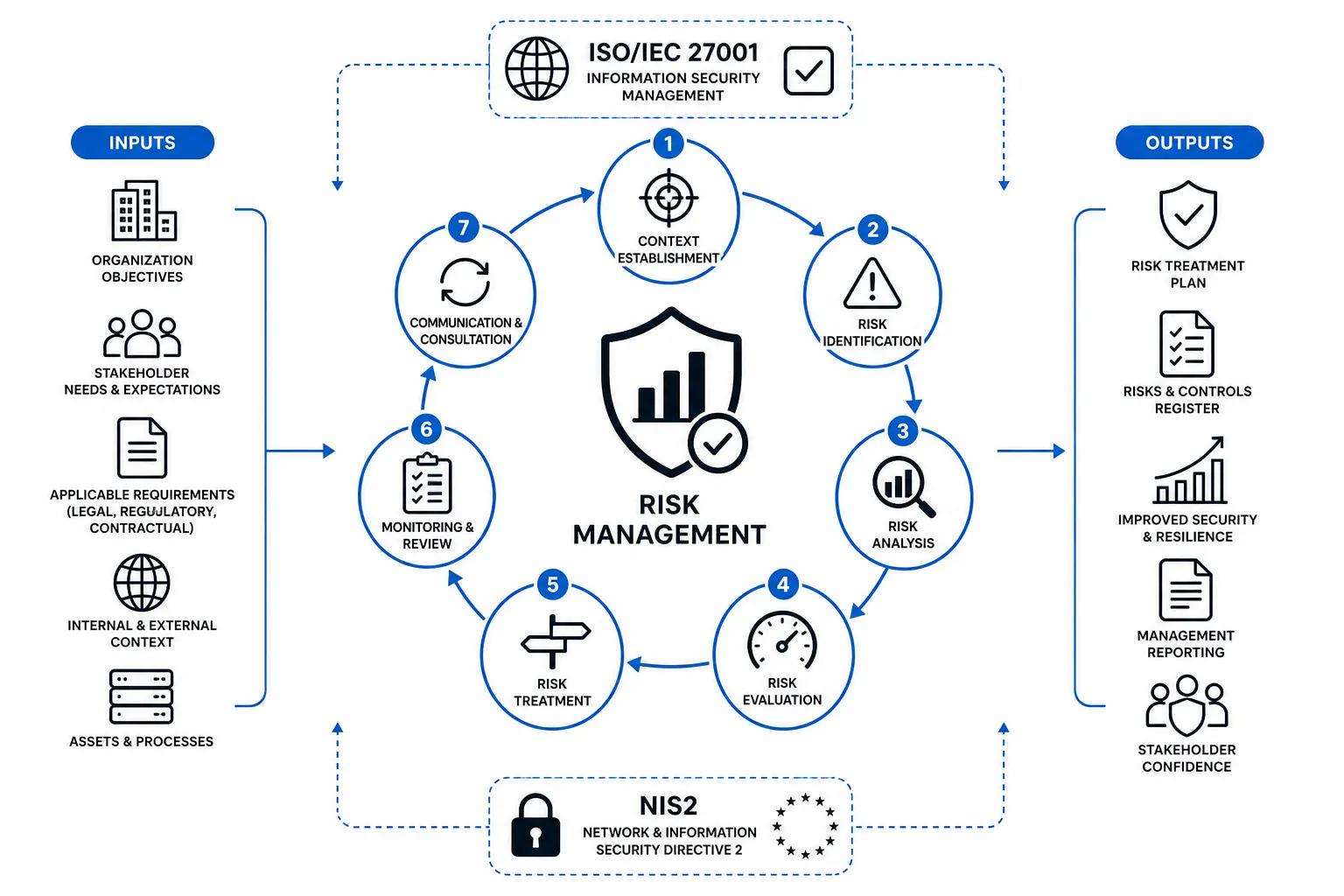
A risk assessment methodology defines how an organisation finds, analyses, evaluates, treats, and monitors risks so decisions about information security are consistent and auditable. It establishes scope, asset definitions, risk criteria (likelihood × impact), and repeatable analysis techniques so outcomes are comparable across time and business units. This clarity supports business continuity, regulatory compliance, board-level reporting, and prioritised investment in controls that reduce residual risk. Below are the core steps every methodology should include to form a defensible audit trail and improvement loop.
This list summarises the foundational steps found in most accepted frameworks:
- Risk identification: catalogue assets, threats, vulnerabilities, and existing controls.
- Risk analysis: estimate likelihood and impact using qualitative or quantitative scales.
- Risk evaluation: compare results to risk criteria and prioritise treatment.
- Risk treatment: select actions to reduce, transfer, accept, or avoid risk.
- Monitoring and review: track control effectiveness and re-assess after incidents.
These steps create a continuous cycle that feeds into an ISMS and into regulatory evidence requirements. Organisations that operationalise these stages convert abstract threats into measurable control actions and clear governance outputs, which leads into a more detailed look at how risk assessment specifically supports information security and compliance requirements.
How Does Risk Assessment Support Information Security and Compliance?
Risk assessment underpins information security by linking assets to threats and controls, producing evidence auditors and regulators can inspect. When an organisation documents why it selected specific controls—based on measured likelihood and impact—it provides traceable justification for its security posture and for the Statement of Applicability required by standards such as ISO 27001. Risk assessment also helps align security investments with legal and contractual obligations, making it easier to demonstrate due diligence under regimes like data protection and sector-specific regulation. Recent guidance emphasises that risk assessment outputs should feed incident response, vulnerability management, and supplier assurance processes so that compliance and operational resilience work together.
This function of risk assessment naturally leads to a concise, executable sequence of steps teams can follow during an assessment.
What Are the Key Steps in the Risk Assessment Process?
The steps below provide a practical sequence for teams performing an information security risk assessment and are optimised for reproducibility and auditability.
- Define scope and context: set ISMS boundaries, business processes, asset owners, and risk criteria.
- Inventory assets and map value: list information, systems, services and estimate business impact.
- Identify threats and vulnerabilities: use threat intelligence, logs, pen-tests, and stakeholder interviews.
- Analyse likelihood and impact: apply qualitative scales (e.g., low/medium/high) or numeric scoring.
- Evaluate and prioritise: compare scores to risk appetite and identify top risks for treatment.
- Select and implement treatments: reduce, transfer, accept, or avoid; record residual risk.
- Monitor, review and iterate: schedule re-assessments after changes or incidents.
Following these numbered steps ensures each activity produces a deliverable—asset register, risk register, treatment plan, and monitoring metrics—that supports continuous improvement. The next section compares the methodological choices teams make when analysing risk in practice.
What Are the Main Types of Risk Assessment Methodologies?
Choosing between qualitative, quantitative, or semi-quantitative approaches affects speed, repeatability, and defensibility of results; the right choice depends on available data, organisational maturity, and risk appetite. Qualitative methods are descriptive and fast, suited to early-stage ISMSes or small teams. Quantitative methods use numerical likelihoods and economic impact, delivering precise prioritisation but requiring data and specialist skills. Semi-quantitative approaches combine rating scales and weighted scores to balance practicality and comparability. Below is a compact comparison to help teams pick an approach.
The table below compares three common approaches and guides selection for different audiences:
Data-intensive, requires modelling expertise
This comparison clarifies trade-offs so teams can match method to capacity and evidential needs. Having selected an approach, many organisations blend asset-focused and vulnerability-focused lenses to ensure both business impact and exploitability are visible.
How Do Qualitative, Quantitative, and Semi-Quantitative Risk Assessments Differ?
Qualitative assessments rely on subject-matter expertise to assign categories for likelihood and impact; this mechanism speeds decisions and supports early-stage prioritisation without heavy data requirements. Quantitative assessments use probabilistic models and measurable impact metrics (e.g., downtime cost) to produce dollar-value or numeric risk scores that support investment business cases. Semi-quantitative methods apply numeric scales to descriptive categories—for example, multiplying likelihood (1–5) by impact (1–5) to create comparable risk scores—offering a practical compromise between precision and effort. Choosing the right method depends on organisational maturity, data availability, and the need to demonstrate compliance or make costed remediation choices. Understanding these distinctions helps shape the assessment cadence and tools organisations adopt, and that leads naturally to discussing asset-based versus vulnerability-based approaches.
What Are Asset-Based and Vulnerability-Based Risk Assessment Approaches?
Asset-based assessments begin with business-critical assets and evaluate how threats to those assets would affect operations, emphasising business impact and owner accountability. Vulnerability-based assessments start from technical weaknesses identified through scans and tests, prioritising exploitability and remediation cadence. Hybrid approaches integrate both: they map vulnerabilities to critical assets so that the highest exploitability for high-impact assets receives the fastest remediation. For example, a critical SCADA controller with a medium-severity vulnerability should be higher priority than a non-critical server with the same vulnerability because the asset impact differs. Combining asset and vulnerability views produces a richer risk register and better-aligned treatment plans. Integrating these approaches ensures that control selection both reduces exploitability and protects critical business functions; next we map how ISO 27001 expects risk assessment to be done within an ISMS.
How Does ISO 27001 Integrate Risk Assessment for Information Security?
ISO 27001 requires organisations to perform a systematic risk assessment process as part of an ISMS, including defining the context, criteria, and documented outcomes that justify selected controls. The standard expects an asset inventory, risk criteria (risk appetite/tolerance), documented risk assessments, risk treatment plans, and a Statement of Applicability that maps chosen controls to identified risks. Effective ISO integration makes risk assessment the core mechanism linking business needs to Annex A control selection and external audit evidence. The mapping below shows key ISMS steps, typical deliverables, and where specialist support can add value in operationalising the standard.
Use the following table to see how ISO steps map to activities and support:
What Is the ISO 27001 Risk Identification Process?
ISO 27001 risk identification focuses on enumerating assets, owners, business processes, threats, and vulnerabilities with sufficient detail for credible scoring and remediation prioritisation. Practically, teams should build an asset register that includes information classification, owners, criticality, and reliance on third parties. Threats and vulnerabilities are then linked to each asset along with existing controls and gaps, producing evidence entries for each risk record. This checklist-style approach ensures assessors can validate reasoning behind control choices and that the risk register supports a defensible Statement of Applicability. Capturing this level of detail prepares an organisation for external audit and for effective incident response alignment. Identifying risks clearly sets up the treatment step where decisions about accept, reduce, transfer or avoid are recorded and implemented.
How Is the ISO 27001 Risk Treatment Plan Developed and Applied?
Risk treatment in ISO 27001 follows a clear set of options—accept, avoid, reduce, transfer—and requires justification and evidence for chosen actions, including timelines and owners. Organisations should map selected controls to risk entries in the risk register, record residual risk after treatment, and update the Statement of Applicability to reflect implemented controls and justification. Practical evidence includes policy updates, implemented technical controls, testing records, and monitoring metrics. For certification, auditors expect to see traceability from identified risk through chosen treatment to measurable outcomes, and that monitoring is in place to validate control effectiveness. A consistent treatment plan converts risk prioritisation into project-level workstreams, enabling governance to track closure and residual exposure. Understanding this treatment cycle connects naturally to cyber-specific frameworks and threat modelling techniques that enrich risk identification and analysis.

Risk Assessment Methodologies for Robust Information Security
Cybersecurity frameworks and exercises make risk assessments more actionable by focusing on realistic adversary behaviours, exploitable vulnerabilities, and response readiness. Frameworks such as threat modelling, MITRE ATT&CK mapping, and structured vulnerability management connect technical findings to business impact and remediation cadence, strengthening overall resilience. Applying these frameworks helps teams translate a risk register into incident response priorities, patching schedules, and architecture changes that materially reduce attack surface. The following section outlines practical threat modelling techniques and vulnerability management best practices that integrate directly into a robust risk assessment methodology.
Below are effective threat modelling techniques and when to apply them:
- STRIDE: categorises threats (Spoofing, Tampering, Repudiation, Information disclosure, Denial of service, Elevation of privilege) and is useful for developer-led design reviews.
- PASTA: a risk-centric, seven-stage process good for aligning threat modelling with business impact in complex systems.
- Attack trees: build detailed exploit paths from attacker goals to system weaknesses and are valuable for critical infrastructure and high-security assets.
These techniques complement vulnerability assessments by providing attacker-centric context that helps prioritise which vulnerabilities matter most for business-critical assets. The next subsection covers operational best practices for vulnerability management and aligning incident response with risk priorities.
What Are Effective Threat Modeling Techniques in Cyber Security?
STRIDE provides a concise taxonomy for design review, enabling teams to spot categories of threats across a system architecture and to prioritise control patterns during development. PASTA (Process for Attack Simulation and Threat Analysis) adopts a business-risk lens and is suitable for organisations that need to justify mitigation in executive terms. Attack trees and similar scenario-based models break down attacker goals into steps and control points, which is especially useful when mapping exploitability back to the risk register. For SMEs, lightweight STRIDE or simplified attack-tree exercises provide quick wins; for critical infrastructure and government bodies, PASTA and scenario-based red-team work deliver higher-fidelity risk insight that informs large-scale remediation planning. Threat modelling outcomes feed directly into vulnerability management, helping decide which patches and mitigations will most reduce organisational risk.
What Are Best Practices for Vulnerability Assessment and Incident Response Planning?
Effective vulnerability management requires a defined cadence of discovery, prioritisation, remediation, and verification tied to business impact and the risk register. Regular automated scanning combined with periodic authenticated assessments and targeted penetration tests creates a layered view of exploitable weaknesses. Prioritisation should map CVSS or scanner output to asset criticality and business impact so high-value targets receive immediate attention. Incident response planning must align to those priorities with clear playbooks, escalation paths, and regular tabletop exercises to validate procedures. Lessons learned from incidents should feed back into the risk register and trigger re-assessment of treatment plans to prevent recurrence.
Consistent practice ensures vulnerability findings convert into measurable risk reduction and prepares teams to respond effectively when incidents occur.

How Do Regulatory Requirements Like NIS 2.0 Impact Risk Assessment Practices?
NIS 2.0 and similar regulations raise the bar for documented, demonstrable risk-based security measures, especially for essential and critical entities. The regulation emphasises governance, mandatory risk assessments, third-party and supply-chain assurance, and timely incident reporting. Organisations in scope must show risk treatment decisions, evidence of controls, and mechanisms to detect and report significant incidents within defined timeframes. The table below summarises key requirement areas and typical evidence that regulators expect to see.
The following table maps NIS 2.0 requirement areas to expectations and evidence:
What Are the Critical Infrastructure Risk Assessment Requirements Under NIS 2.0?
Entities classified as essential or critical must perform documented, risk-based security measures that reflect the system dependencies and potential societal impact of outages. NIS 2.0 expects clear governance, assigned responsibilities, regular risk assessments, monitoring of critical systems, and documented incident escalation routes. Controls typically include robust logging and detection, redundancy for essential services, and clear recovery objectives. Evidence for compliance includes up-to-date risk registers, records of executive oversight, and demonstrable procedures for incident handling. These requirements mean that risk assessment is no longer a periodic checkbox but a continuous governance activity linked to service continuity and public safety.
Fulfilling these obligations requires organisations to extend risk assessment to suppliers and partners, which is discussed next.
How Does Supply Chain Risk Management Fit Into NIS 2.0 Compliance?
Supply-chain risk management under NIS 2.0 requires third-party screening, contractual security obligations, and ongoing monitoring of critical suppliers to ensure risks are managed beyond organizational boundaries. Practical steps include classifying suppliers by criticality, implementing security questionnaires, embedding SLA and audit rights in contracts, and integrating supplier incidents into the main risk register. Organisations should also require evidence of suppliers’ own risk assessments and incident response capabilities. Monitoring supplier performance and security changes allows organisations to update their assessments and treatment plans proactively, reducing the chance of supply-chain-driven outages or breaches.
The EU Network and Information Systems (NIS2) Directive, adopted in 2023, mandates specific rules for supply chain cybersecurity for entities in critical sectors, aligning closely with established risk management guidelines.
NIS2 Directive: Supply Chain Cybersecurity and Risk Management Alignment
The EU Network and Information Systems (NIS2) Directive, which was adopted in 2023, introduces rules on supply chain cybersecurity for the network and information systems (e.g., Internet of Things devices) of entities in critical sectors (e.g., energy providers, hospitals). This article shows that the NIS2 Directive aligns closely with established risk management guidelines. Thus, the Directive, at first glance, offers a proper response to supply chain cybersecurity problems.
The regulation of supply chain cybersecurity in the NIS2 Directive in the context of the Internet of Things, M van’t Schip, 2024
Taking these steps ensures supply-chain risk becomes a managed extension of the organisation’s ISMS and links supplier events directly into internal risk governance.
How Does ACATO’s Integrated Approach Simplify Risk Assessment for SMEs, Government, and NGOs?
ACATO is a UK-based consulting firm specialising in ISO 27001 information security, cyber security, and IT forensics, and it provides practical services that package risk assessment, ISMS documentation, and audit support into deliverable streams for resource-constrained organisations. For SMEs and NGOs, ACATO focuses on pragmatic, asset-driven risk registers and streamlined treatment plans that balance control effectiveness with budget realities. For government and infrastructure providers, the approach blends rigorous quantitative assessments, threat modelling, and forensic readiness to satisfy regulators and incident management needs. Provide useful information and expertise to lead potential clients to book free consultations or engage their services.
Below is a concise list of ACATO’s core service capabilities and how they map to assessment tasks:
- ISO 27001 consulting: scoping, ISMS documentation, risk register creation, SoA preparation and audit accompaniment.
- IT security consulting and audits: vulnerability assessments, scanning cadence design, and practical remediation playbooks.
- IT forensics: post-incident analysis, root-cause identification, and evidence packages for re-assessment and legal processes.
These services are delivered with tailored roadmaps that prioritise quick wins for SMEs while providing the deeper forensic and certification support required by larger or regulated entities. The next two subsections explain how ACATO supports certification and leverages forensics to improve future assessments.

How Does ACATO Support ISO 27001 Certification Through Risk Assessment?
ACATO supports certification by producing tailored ISMS documentation, constructing a defensible risk register aligned to business priorities, and preparing a Statement of Applicability that ties controls to assessed risks. Typical deliverables include a scoped ISMS plan, risk assessment templates, control implementation roadmaps, and audit accompaniment during external assessment. For small organisations the pathway often starts with a focused asset inventory and a 90-day remediation plan to address high-priority gaps before formal certification activities. This combination of documentation, practical remediation advice, and audit support reduces the friction of certification and improves the organisation’s readiness for external assessment.
What Role Does IT Forensics Play in Post-Incident Risk Identification and Re-assessment?
IT forensics provides the evidence base to determine root cause, exploitability, and true impact after a security incident, enabling more accurate re-scoring of risks and refinement of treatment plans. Forensics outputs—timeline reconstructions, exploited vulnerability identifiers, and scope of data exposure—translate directly into updated risk register entries and prioritised remediation tasks. A common forensic-informed workflow is: incident detection → containment → forensic analysis → risk re-assessment → updated treatment and controls implementation. These insights ensure that post-incident adjustments are proportional and targeted, reducing the chance of recurrence and improving the organisation’s long-term resilience.
The integration of Enterprise Risk Management (ERM), ISO 27001, and mobile forensics methodologies offers a comprehensive framework for enhancing digital security, significantly improving an organization’s ability to manage digital risks effectively.
Integrating ERM, ISO 27001, and Forensics for Enhanced Digital Risk Management
This research paper explores the integration of Enterprise Risk Management (ERM), the ISO 27001 standard, and mobile forensics methodologies as a comprehensive framework for enhancing digital security measures within modern business ecosystems. Employing a quantitative research design, this paper utilized a survey methodology, gathering data from 372 professionals across various sectors including risk management, IT/security, and forensic analysis. The analysis was conducted using Partial Least Squares Structural Equation Modeling (PLS-SEM) to test the research hypotheses and assess the impact of the integrated approach on organizational digital security capabilities. The findings reveal a significant positive effect of integrating ERM, ISO 27001, and mobile forensics on an organization’s ability to manage digital risks effectively. Specifically, the integrated approach was found to enhance strategic digital security management, improve the identification, assessment, and mitigation of digital risks, strengthen information security management practices, and elevate the effectiveness and efficiency of digital crime investigation processes. These outcomes underscore the value of a cohesive strategy that leverages the strengths of ERM, ISO 27001, and mobile forensics in addressing the complex and interconnected digital threat landscape.
CyberFusion protocols: Strategic integration of enterprise risk management, ISO 27001, and mobile forensics for advanced digital security in the modern business …, OO Olaniyi, 2024
Embedding forensic outcomes into the ISMS closes the loop between incidents and prevention, ensuring lessons learned become measurable risk reduction actions. Provide useful information and expertise to lead potential clients to book free consultations or engage their services.